In Mandy Haynes’s collection of Southern tinged short stories, Sharp as a Serpent’s Tooth, characters are as different as Jayhawks and Starlings, they grin like possums, and, if in need while in someone’s bad graces, are told they can go get what they want “their own dang self.” Throughout the assembly of Haynes’s five, compelling stories, her character-intensive narrative is urgent and breathless, so regionally pitch-perfect as to feel indiscreet:
“Now don’t roll your eyes at me,” the narrator of short story, Junebug Fischer says. “You know dang good and well Rita’s daughter did not get pregnant on her honeymoon. And you know same as me that she shouldn’t have married that no count Tucker, pregnant or not.”
Sharp as a Serpent’s Tooth is laser-sharp, finely wrought fiction in each stand alone story. In “Eva,” the abused daughter of a con-artist preacher is depicted with such Southern Gothic surrealism as to make her seem other-worldly. In “Plans for Sweet Lorraine,” a fearlessly headstrong mother is led by gut-intuition to rescue her innocent daughter from the clutches of a smooth-talking charlatan posing as a man of God.
In each story, the narrator’s voice is chock full of gumption– the sure-footed kind grown and fostered in the hollows of the rural South. They are all unique, memorable narrators. In “The Day I threw the Rock,” the young, red-haired narrator prefers to go barefoot in overalls, in whose pocket she keeps a garden snake as she unfurls the high-drama of events that lead to her throwing the eponymous rock. In “Cussing Snakes and Candy Cigarettes,” a young girl defies common, local opinion of her dead mother’s twin sister, in an eye-opening summer that impacts her coming of age.
Author Mandy Haynes approaches her craft with an uncanny grasp on pace in perfect measure. Her authentic voice is beyond comparison. Her high-stakes stories are layered with utter unpredictability. I cannot recommend this Southern to the core collection of short stories emphatically enough. Each of the five stories in Sharp as a Serpent’s Tooth is the perfect combination of riveting story and character as place.
Mandy Haynes has spent hours on barstools, at backstage venues, and riding in vans listening to some of the best songwriters and storytellers in Nashville, Tennessee. She now lives in Fernandina Beach, Florida with her three dogs, one turtle, and a grateful liver. Her first collection, Walking the Wrong Way Home was a finalist for the Tartt Fiction Award, and selected as a bonus pick for The Pulpwood Queens’ 2020 Reading List.
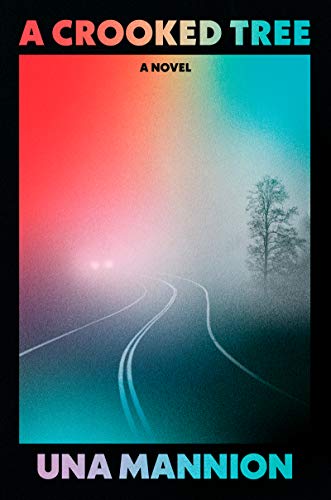
A Crooked Tree: Una Mannion, Release Date: January 5, 2021, Publisher/Imprint: Harper, Reviewed by: Claire Fullerton
A Crooked Tree is a sonorous ode to youth with all its innocence, angst, disillusionment, and unfiltered honesty. Author Una Mannion tells a coming-of-age story in its full expression as told by clear-eyed, 15-year-old Libby Gallagher, the third of five siblings born to a family most would call dysfunctional, yet with Mannion’s deft handling, we experience the family as normal; we accept as plausible the frame of reference in this heart-tugging cause and effect story.
It is the early 1980s. The five Gallagher siblings, whose ages span a decade, jostle, and spar with each other in the back seat, while their distracted mother is behind the wheel, on the eve of summer vacation. It is coming dusk as they drive home to bucolic Pennsylvania’s Valley Forge Mountain, and divorced mother, Faye, has had enough. Twelve-year-old Ellen tests Faye’s last nerve by giving her lip, and in a stunning fit of pique, Faye stops the car and demands that Ellen get out. Libby recounts what becomes the pivotal, repercussive scene, “We were still five or six miles from home. I hadn’t said anything to make my mother stop. We careened down the road, went through the covered bridge, past farmland, and fences. Beside us, the shadows of dogwoods blurred in the dark as my mother kept driving.”
Una Mannion’s debut novel A Crooked Tree will be published by Faber and Faber in the UK and Ireland and by Harper Collins in the US in 2021. It will also be published in Germany with Steidl publishing house and in Italy by Astoria.
Una has won numerous prizes for her short fiction and poetry including The Hennessy New Irish Writing Poetry Award, The Cúirt International Short Fiction Award, Doolin short story prize, Ambit fiction award, Allingham short fiction prize among others.
Her work has been published in numerous journals such as Crannóg, The Lonely Crowd, Bare Fiction, Ambit and her stories have been included in recent collections: Galway Stories: 2020 edited by Lisa Frank and Alan McMonagle (April 2020) and The Art of the Glimpse: 100 Irish Short Stories edited by Sinéad Gleeson, (autumn 2020).
Along with writers Louise Kennedy and Eoin McNamee, Una edits The Cormorant, a broadsheet of poetry and prose. She curates The Word, a monthly author series hosted by Sligo Central Library and the BA Writing + Literature at IT Sligo.
Una is represented by Peter Straus at Rogers, Coleridge & White
It has been my great honor and joy to align with author and book-blogger, Sally Cronin, who lives in County Wexford, Ireland and spearheads the wildly popular WordPress blog, Smorgasbord. If you’re unfamiliar with Smorgasbord, don’t miss out. Look into it here!
Blog magazine for lovers of health, food, books, music, humour and life in general
Recently, Sally released an E-Book that I want to tell you about:
Book Description: Life is Like a Bowl of Cherries: Sometimes Bitter, Sometimes Sweet is a collection of short stories with scattered poetry, reflecting the complexities of life, love and loss.
The stories in the collection dip into the lives of men and women who are faced with an ‘event’ that is challenging and in some cases life changing.
Even something as straightforward as grocery shopping online can be frustrating, and a DNA test produces surprise results, the past reaches out to embrace the present, and a gardening assistant is an unlikely grief counsellor. Romance is not always for the faint-hearted and you are never too old for love. Random acts of kindness have far reaching consequences and some people discover they are on a lucky streak. There are those watching over us who wish us well, and those in our lives who wish us harm.
I enjoyed this e-book immensely and left this review on Goodreads, Amazon, and Book Bub!
Author Sally Cronin wields heartwarming magic in this delightful collection of short stories, each written with a keen eye focused on the nuances of human nature. Life is Like a Bowl of Cherries: Sometimes Bitter, Sometimes Sweet is a series of lovely vignettes written with a clean hand as Cronin builds her common man, everyday stories. It’s the little things in life that matter, and Cronin depicts such topics as random acts of kindness, unforeseen good fortune, falling into and out of love, and the magic of animals in such an optimistic way that the reader is morally encouraged and given great hope. Each story lulls the reader with neat, simplistic beauty even as it takes an unexpected turn. In Cronin’s The Scratch Card, Elsie Thompson wins twenty pounds on a scratch card, which she puts to use in such a way that events are set in motion and change a young man’s life. In Friday Night, a young woman is taken for granted by her clueless boyfriend, until a stranger whispers a line that puts her life on another course, and in the satisfying The Gaffer, a duplicitous wife-abuser gets creative comeuppance. Interspersed throughout this e-book are poems and photographs that poignantly highlight the collective spirit of the book. The characters persevere, help each other, and come to their senses in a manner suggestive of hard-won insight, and written with all the impact of a parable. A pleasurable, enchanting read with a heart of gold, Sally Cronin’s latest release is nothing short of a charming assembly of uplifting stories.
Behold: the delightful Sally Cronin!
Here’s a little something about Sally you’ll want to know! She writes:
“I have been a storyteller most of my life (my mother called them fibs!). Poetry, song lyrics and short stories were left behind when work and life intruded, but that all changed in 1996.
My first book Size Matters was a health and weight loss book based on my own experiences of losing 70kilo. I have written another twelve books since then on health and also fiction including three collections of short stories. My latest collection is Life’s Rich Tapestry : Woven in Words.. verse, micro fiction and short stories.
I am an indie author and proud to be one. My greatest pleasure comes from those readers who enjoy my take on health, characters and twisted endings… and of course come back for more.
As a writer I know how important it is to have help in marketing books.. as important as my own promotion is, I believe it is important to support others. I offer a number of FREE promotional opportunities on my blog and linked to my social media. If you are an author who would like to be promoted to a new audience of dedicated readers, please contact me via my blog. All it will cost you is a few minutes of your time. Look forward to hearing from you.”
I read and enjoyed Sally Cronin’s book, Tales from the Irish Garden!
Book Description: The queen of Magia and her court have fled their sun filled Spanish homeland and the palace beneath the magnolia tree.
Arriving on the backs of geese and swans, they seek sanctuary in the magic garden of The Storyteller who welcomes them to the Emerald Island, a place where rain is almost a daily feature.
Grateful for their safe haven and the generosity of their host, the queen and her courtiers embrace their new surroundings with delight. As the seasons change throughout the year, they come into contact with many of the human and animal inhabitants of the garden and the surrounding forest, all of whom have a story to tell.
This is a magical fairy story infused with fantasy and romance, as well as opportunities for mischief in the company of goblins, witches and Lerpersians.
My Review of Tales from an Irish Garden:
I was attracted to this book because of its title. Show me a title concerning Ireland, and you’ve got my attention! I had seen good reviews of this book and, as are legions of others, have been a devoted fan of author Sally Cronin’s blog Smorgasbord on WordPress for years. And so it was that I bought Tales From the Irish Garden, not fully knowing what to expect. To say I was roped in from the onset puts it mildly! I was immediately bowled over by the minute details in this highly creative story, one part fantasy, one part fairy story and all parts sheer, delightful suspension of belief. Only, and here’s the kicker, as I read this engaging story, lured along by its romantic, magical undercurrents, I began to intuit the deeply human parables! Sally Cronin is a writer gifted with insight, humor, whimsy, and unparalleled story pacing abilities. Tales From the Irish Garden invites the reader to enter a plausible, magical realm so real as to make the reader want to stay there
I also read and enjoyed Life’s Rich Tapestry:
Book Description: Life’s Rich Tapestry is a collection of verse, microfiction and short stories that explore many aspects of our human nature and the wonders of the natural world. Reflections on our earliest beginnings and what is yet to come, with characters as diverse as a French speaking elephant and a cyborg warrior.
Finding the right number of syllables for a Haiku, Tanka, Etheree or Cinquain focuses the mind; as does 99 word microfiction, bringing a different level of intensity to storytelling. You will find stories about the past, the present and the future told in 17 syllables to 2,000 words, all celebrating life.
This book is also recognition of the value to a writer, of being part of a generous and inspiring blogging community, where writing challenges encourage us to explore new styles and genres.
My Review of Life’s Rich Tapestry!
We come to know a person’s mind through the words they speak; their personality through what they create, and their heart through what they write. Put this all together and you’ve been gifted a glimpse into an artist’s soul. This is how Life’s Rich Tapestry Woven in Words impressed me. Author Sally Cronin’s precious gem of a book is nothing short of fluid insight into all that it means to be human in a round-robin way as to address the entire sphere in bits and pieces that leave a lasting impression. These are musings delivered artfully, the perfect melding of heart, mind, and soul. In sharing her personal views, the author invites us to examine our own impressions of the day-today by shining light on life’s rich nuance. There is something profound in these meditative pages, something joyous and real that takes nothing for granted by sheer virtue of the fact that Sally Cronin has called them by name. In addressing the natural world, celebrating pets, seasons of the year, and random thoughts, Cronin speaks to the reader conversationally in such a manner that told me I’d revisit the pages. Her flash fiction, speculative fiction, and short stories are vignettes to savor—all told, this book is a work of art at its finest. All praise to author Sally Cronin, who has earned a constant and significant place in the blogging world by selflessly serving as the fulcrum of focus for so very many. That she has stepped forth by assembling and publishing this collection of letters has gifted us all with the awe-striking opportunity to see a writer’s career shine at its brightest.
Many of us who follow Sally on Smorgasbord are familiar with the storied life of her collie, Sam, of whom Sally wrote ANOTHER book!
I’m sharing the effervescent D.G.Kaye’s review here of Sam: A Shaggy Dog Story! D.G. Kaye rated it it was amazing This book, a memoir from Sam, the Lassie-like Collie, will warm anyone’s heart. Cronin tells the story through Sam’s voice in this delightful read. If you’re not already a dog lover, you will be after reading Sam’s story.
If you want to know how a dog views his life, Sam shares his adventures as a dog, how he learned manners, how he learned to speak a few human words, and even he even shares his opinions on going to the vet.
Sam is truly a heart-warming read for everyone.Love this photograph!
Another of Sally Cronin’s 10 published books!
Whatever the name there is always a story behind it. In What’s in a Name? – Volume One, twenty men and women face danger, love, loss, romance, fear, revenge and rebirth as they move through their lives.
Book Reviewer Darlene Foster writes: An awesome collection of short stories based on the names of the main characters. We don’t normally choose our own names, but they tend to define us. Names like Jana, Zoe, Hector, Hannah, Emma, Lily, Isobel, Fionnuala and many more, each have a story to tell. Some happy, some sad, some bittersweet, and some heartbreaking. F. Scott Fitzgerald said, “Find your key emotion, this may be all you need know to find your short story.” Ms. Cronin has certainly found the key emotion in each story in this enjoyable book.
Sally has a grand total of 10 published books, which you can learn about on Goodreads:
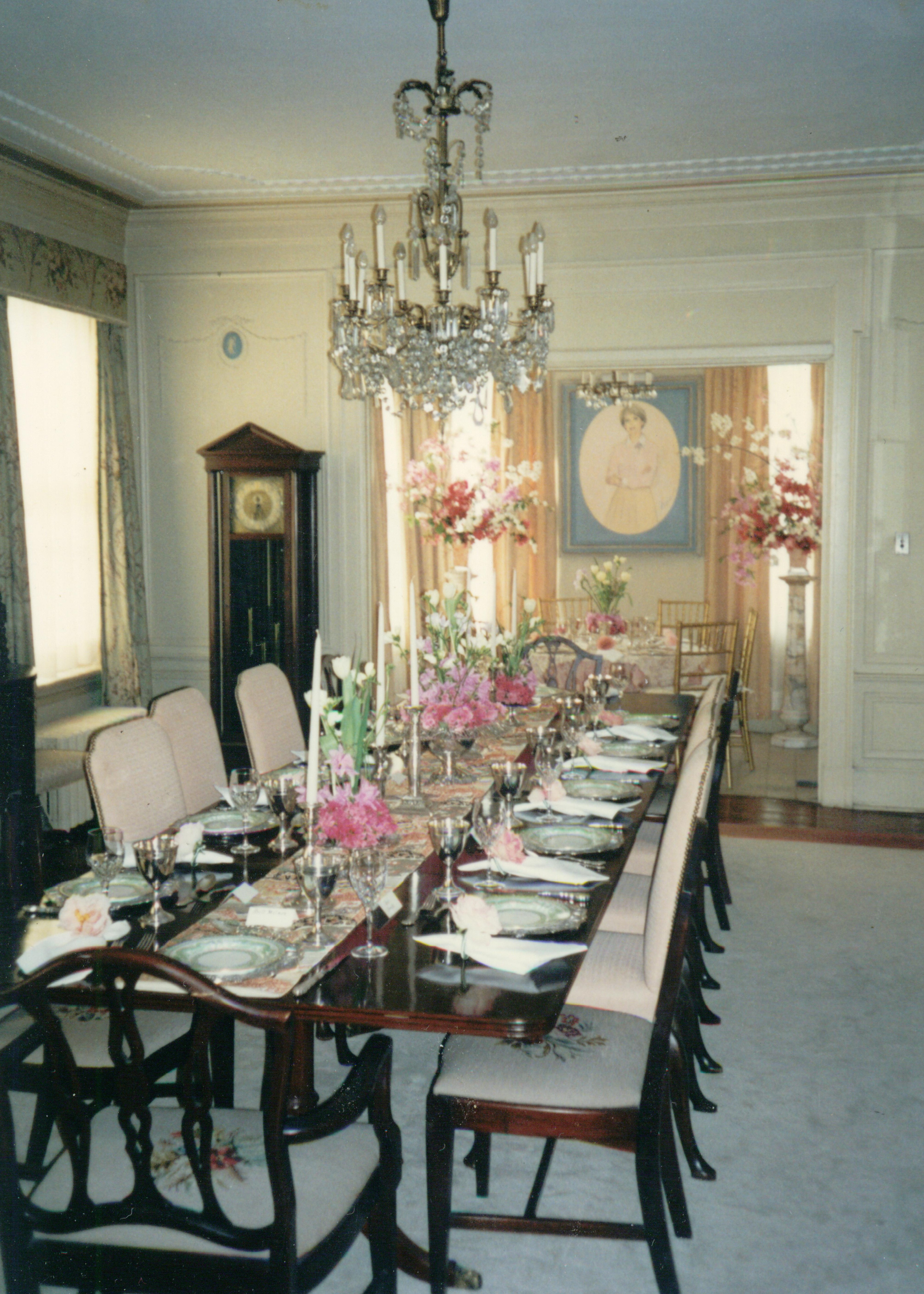
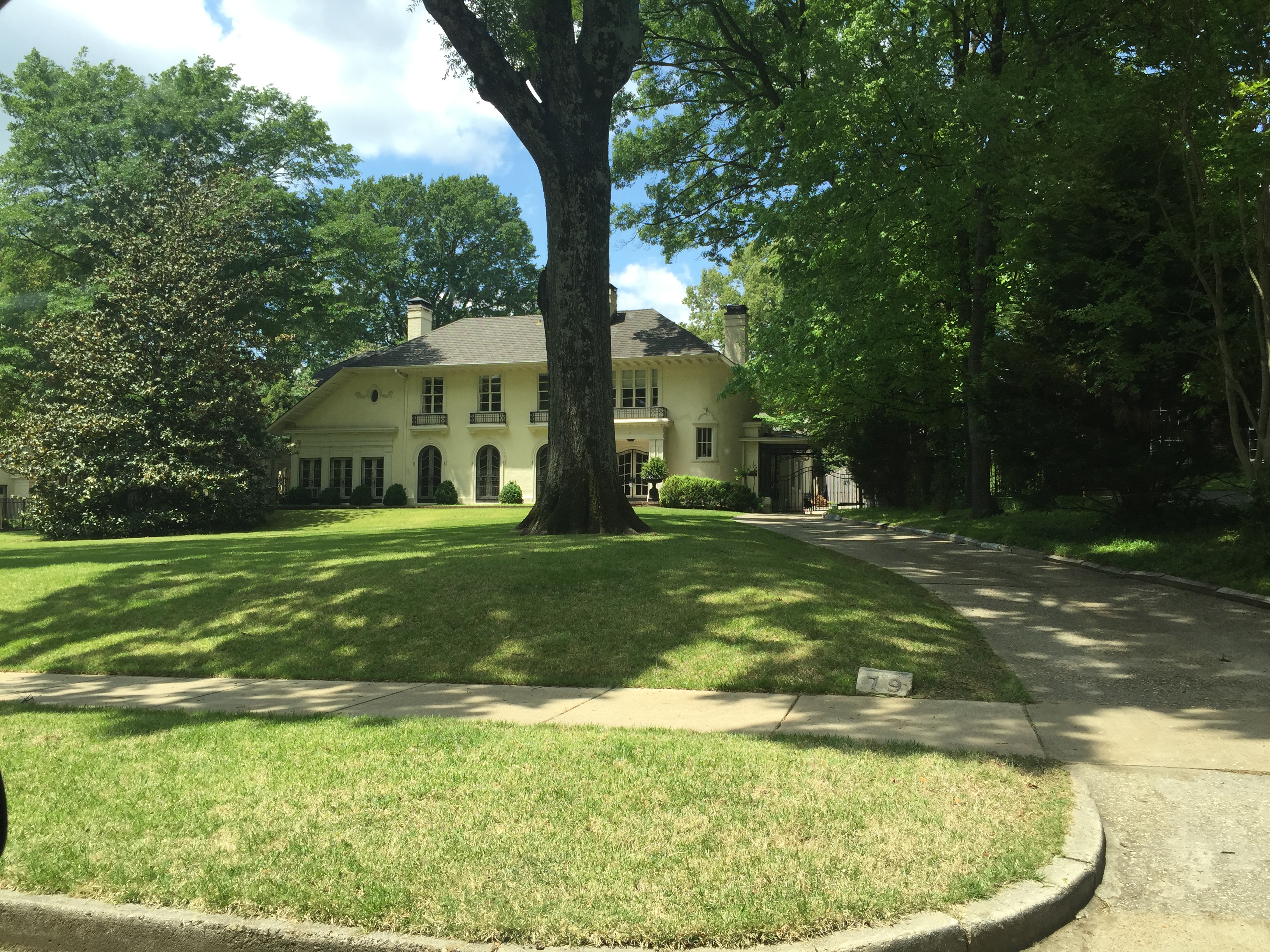
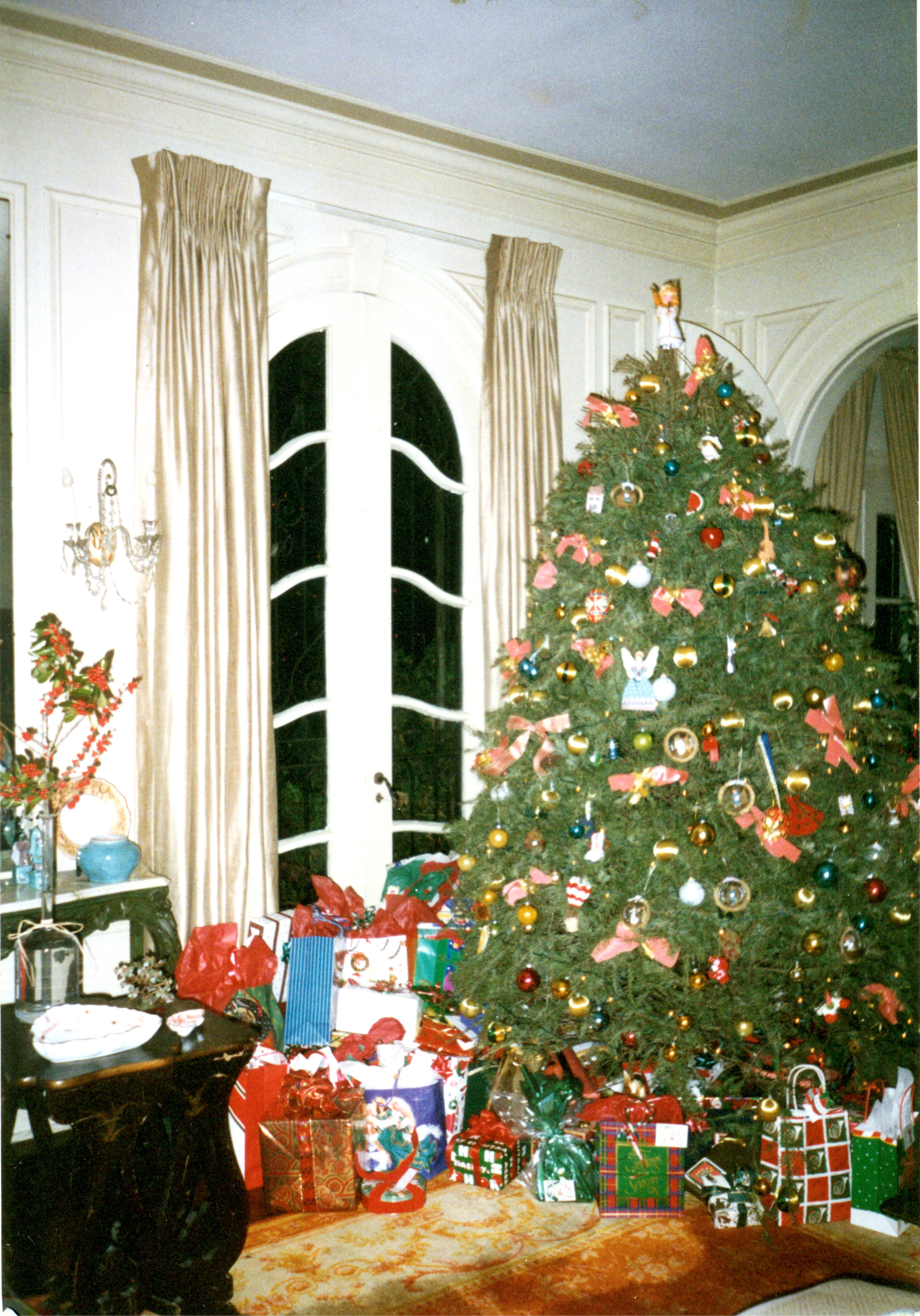
Christmas, in the house in which I grew up in Memphis’s Morningside Park, was a festive season. My mother, whose name was Shirley Crossan Francis, was a member of the tribe my contemporaries and I now consider the last of the true Southern belles. Were my mother alive, she’d be ninety. She didn’t believe in half-measures, and was a champion of tradition and perfect form. When I think of her now, I think of her many graceful gestures.
Lately, I’ve been going through what seems like endless mounds of scrapbooks my mother kept. They are huge volumes, all dated, and the space these forty-some-odd books take up is staggering. Organizing the scrapbooks has been one of the tasks I’ve put by the wayside “for another day,” but I’ve run out of excuses during the pandemic. Because we’re approaching Christmas Day, I’m sharing some of the photographs I’ve come across. It’s my way of saying happy holidays. May you all make the most of the holidays and create wonderful, new memories. Don’t forget to hold your memories of the past in your heart, and to build that foundation with joy!
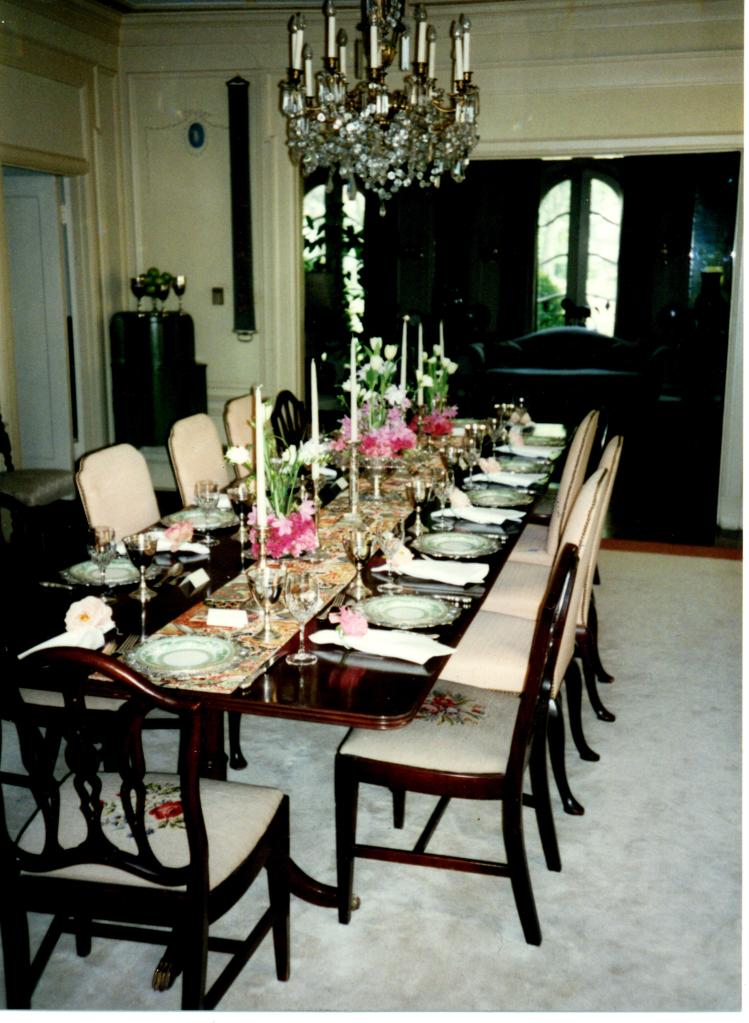
The dining room set for Christmas Eve dinner.
The alcove at the end of the dining room.
Another angle of the dining room that goes into the parlor.
The Christmas Tree in the ParlorThe House in which I grew up
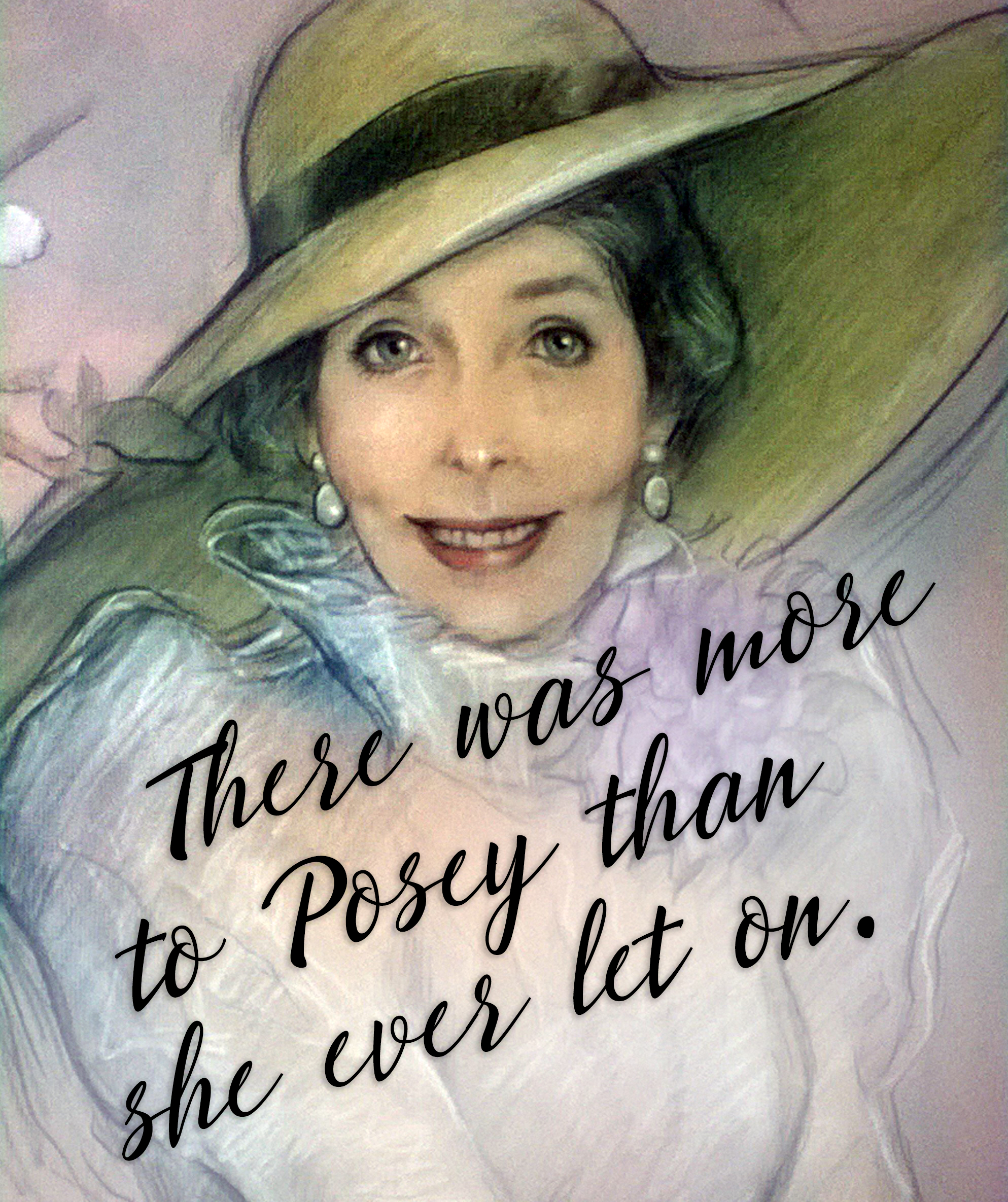
In speaking of my mother, above is a portrait Memphis artist, Charles Inzer, drew of her. She was never partial to this portrait, and I do have others, but I took the liberty of using it for a graphic for my novel, 12-time award winner, Mourning Dove. In seeing these photographs, it may be clear to you from where I drew inspiration for Mourning Dove, which I set “on the genteel side of 1970’s Memphis, where all that glitters isn’t gold.” When one writes a novel with a particular point in mind, one draws from what one knows!
When we publish a book, we want it to be read. Obviously. But what else do we want?
At the most concrete level, we want our book to be bought, liked, recommended, and reviewed. We want to see it on lists; we want lots of reviews (and stars) on Goodreads and Amazon. But we want something else, too—that connection with specific human beings who’ve been touched and changed by what we wrote.
When I published Queen of the Owls, I wanted all of those things, and I got many of them. The book earned awards, made it onto several “best of” lists. And yet, the most important outcomes are ones I never could have foreseen. They’re what I’m calling “unexpected, long-tail gifts”—responses from readers, often months later, that let me know how much my story meant to them.
My experience isn’t unique. When I reached out to other authors I knew, I found that all of them had a story (or two) about an encounter with a reader that left them humbled, honored, even moved to tears. Pondering what they told me, I’ve identified several themes that I’d like to share with you, along with some of their stories, as this year-to-end-all-years draws to a close. My hope is that these examples will help to remind us how much our writing really does matter and why it’s so deeply needed—especially now.
Finding the strength to go on
Therese Walsh tells how her novel, The Moon Sisters, found its way to a woman whose son had taken his own life. Though hesitant to read the book since she knew it was framed around a death in the family, the woman did read it and then reached out to let Therese know that it helped her to see a path forward for herself. She wrote: “What my heart appreciated the most was that the search eventually morphs into what the quest must be when answers remain elusive: Where do we go from here?” For Therese, “the book was written exactly for a person who needed hope after loss. That it found her, and that it resonated for her and hopefully brought some measure of comfort—helped her to find hope, despite the absurdity and sometimes even the brutality of life— well, gratified isn’t the right word for what I felt. It’s so much bigger than that.”
I’d venture to say that Therese is talking about the feeling of purpose, and of awe. There’s a sense of being of service—of playing a role in something that was meant to be—as someone picks up our book at just the moment when it’s needed most. As Caroline Leavitt, author of With You or Without You, said to me: “I got this astonishing email from a stranger who told me that she’d been going through a really hard time. She was stuck in a bad marriage and thought her life was over, but she read my book and told me, ‘I swear there was magic in that novel of yours’ because she suddenly felt that there might still be possibilities for her.”
Several authors told of equally extraordinary moments, when a reader shared how knowing that someone else—even if it was “just” a character in her book—had not only survived, but found a path forward, helped them find a freedom and a hope that had seemed unattainable. Kathryn Craft, author of The Far Side of Happy, told me: “The most touching comments I received were from people who had survived family suicides that no one ever spoke about, or had attempted suicide themselves. One young woman admitted to attempting suicide more than once—and then, after my event, she posted about our interaction on her Facebook page, amazed that I had held up the signing line to come around the table and hug her, and how this simple act had meant the world to her.”
Validating their own experience
When a reader bonds with one of our characters—feels that the character is not only credible and alive, but is someone just like me—it can bring a powerful sense of not being alone, not being the only one who’s gone through something painful and difficult. Randy Susan Meyers shared her experience after publishing her debut novel, The Murderer’s Daughters. “So many people wrote that they’d never told anyone about the domestic violence in their family, the murder of their mother, sister, daughter. Wherever I went, once people heard about my novel and the story behind it, family stories that broke my heart rushed at me. I learned that the only thing required of me was listening, bearing witness, and always giving the message that they were not alone, and the shame was not theirs to bear.”
So too, Barbara Claypole White, who writes about mental illness in families, told me: “I’ve received incredible messages from readers that often start, ‘I’ve never told anyone this before, but …’ Sometimes they see family members in my characters, or they’re in a dark place themselves and find connection and hope.”
This sense of validation can also help someone take an important step. Barbara related the story of an email she received shortly after The Promise Between Us was published. “A reader stumbled on a copy of the book. Through my heroine’s journey, the reader realized that she wasn’t crazy; she was suffering from postpartum OCD. My novel led her to a therapist. That’s a pretty amazing feeling, to see that fiction can and really does make a difference.”
Similarly, Randy Susan Meyers tells of an encounter when she was a keynote speaker at an event. “Afterward, a couple asked to talk to me as I signed books. They told the story of how they lost their daughter when her husband killed her, a story they had never shared before. They wanted to know how they could help to prevent other deaths.”
This sense of validation can also come from “finding one’s tribe” in the story world—reading a novel set in a place, culture, or social environment that rings familiar and true. Author Claire Fullerton set her book Mourning Dove “on the genteel side” of Memphis in the 1970’s. As Claire told me: “I wanted to depict a particular milieu and the price one pays for living in a culture where bad things are not discussed. Because I laid bare that side of Memphis, I couldn’t help wondering about the book’s Memphis reception.” Would it feel authentic?
Her concern abated when she received an email from someone she’d known decades earlier, asking if she had time to speak with him about the book. Claire wrote to me: “We had what turned into an hour-long conversation about the Memphis we knew in our coming of age. He said that my depiction of the social and economic strata we were raised in was as accurately described as anything he’d ever read and thanked me profusely for putting it into words.”
Bringing a new understanding and appreciation
Certainly, there are books that open us to cultures and eras we know nothing about, enriching us by showing other ways of living. At their best, these books do two things at the same time: they show us something new and different, while also helping us to see and feel that these “different” people are very much like us in their struggles and joys. Ellen Notbohm’s The River by Starlight, for example, shines a light of understanding and social justice on how the human experience in another era—the American West of a century ago— both differs from and mirrors our own. Ellen told me that at nearly every reading she’s done, someone has approached her with tears in their eyes, thanking her “for telling my mother’s story, my grandmother’s story—finally.” Through Ellen’s novel, they understood, at last, what the women who came before them had gone through.
Debra Thomas also relates how this “new understanding and appreciation” can be deeply personal. The most moving response she received to her novel Luz was from a young Latina woman who saw herself and her mother in the characters of Luz and Alma. As Debra writes: “Reading Luz prompted a discussion with her mother about her crossing, and for the first time, my reader learned intimate details of her mother’s difficult journey from El Salvador, along the length of Mexico, and then through a desert crossing at the border—including being lost in the desert for ten days. She came away with a renewed respect for her mother and an appreciation for the struggle she endured so she could provide her daughter—herself—with a better life. “
Literally, saving a life
I end with my own story, which is what prompted me to reach out to these authors.
In my debut novel, Queen of the Owls, the “bookworm” protagonist reveals, sees, and comes to claim her body through studying—and re-enacting—the nude photos that Stieglitz took of artist Georgia O’Keeffe.
I’ve received many messages from people who found the book to be deeply liberating, but an email from a woman I’ll call Cynthia was by far the most important. Cynthia won a copy of Queen of the Owls in a Facebook giveaway. Weeks later, she sent me an email.
“My connection to your novel is so surprising and totally unexpected … I’m uncomfortable looking at nude photos of women and reading descriptions of them. Nevertheless, I did quickly look up the photos of Georgia O’Keeffe that you mentioned in the book. The bigger deal is the book prompted me to do a breast examination of myself, which I know I’m supposed to do monthly, but don’t usually do. I found a small bluish-purple discoloration and a slight indentation. I called and had the physician’s assistant check me last week. She said it was not my imagination and scheduled me for a mammogram. They will also do a biopsy, if necessary. I am extremely grateful that I won a copy of your book and it prompted me to do this.”
Indeed, the doctors found a lump, and Cynthia was able to receive early treatment, including chemotherapy. She wrote again, later, to tell me she would never have had this early detection, and subsequent life-saving treatment, if she hadn’t read my book and been open to what it offered her.
Her story brought me to tears, reminding me that what we do through our writing has far more important consequences than how many stars, awards, reviews, or sales our books might collect. There are profound purposes we serve, as authors.
Cynthia’s is one story that I learned about. There may be other stories that I’ll never hear.
Our work as writers really matters. It might even save someone’s life.
What about you? If you’re an author, was there an unexpected gift you received from a reader? If you’re a reader, was there an unexpected gift you received from a book?
JK: Thank you for doing this interview about your new novel, Little Tea. I’ve read that you’ve lived in Minnesota, Memphis, Ireland, and now in California. What were these transitions like, and how have they affected your writing?
Claire Fullerton
CF: The transitions ushered in forward momentum, in that living in different locations expanded my understanding of the world. The insights were cumulative as opposed to immediate and mostly having to do with an ephemeral sense of things pertaining to a combination of the environment and its people. I suppose the idea of cultures is best perceived from the outside looking in, so to speak. Being in it but not of it gave me an objective view that continues to affect my writing.
JK: What would you call “home” about each of these places?
CF: The idea of home is tied to the way I feel centered in an environment and has everything to do with harmonizing with a frame of reference. Nature affects everything about a location and I’m a great walker. I think the best way to get the feel of a place is on foot. I believe people create their idea of home through their relationship to the environment and their loved ones in it. My idea of home has to do with long-term investment and an anchored compatibility that operates on many levels.
JK: Did being an “avid journal-keeper” help you to become an avid novelist?
Click here to purchase
CF: Definitely. Keeping a journal for as many decades as I have woke me up to the fact that I’ve been a writer by nature all along. Writing has been part and parcel to my way of being in the world. I interpret the world by writing, and the practice has spawned an intimacy that translates to the nuts and bolts of how I write novels.
JK: I’ve always lived in the South. I’ve always been a large, bearded man, and I’ve always had to excuse the fact that I’m a “cat person.” I see in your bio that you live with one black cat. Are you superstitious? Do you consider the cat yours or your husband’s, or does the cat belong to you both? Are you a cat person as well? Tell me more about the cat.
CF: I live with one black cat named Le Chat and three German shepherds! La Chatte is definitely my cat because she chose me as her center of gravity. She is a medium-length haired, solid black, yellow-eyed bundle of communicative joy who gets pushy when it’s time for me to brush her, which is every evening before I go to bed. It is a two-brush ritual: one for her body and one for her kitten face, which she presents side after side with such rapturous, princess preening that I laugh every time. La Chatte has the run of the house yet chooses to camp out on the daybed in my office. Our shepherds never tire of investigating La Chatte, but by all appearances, the shepherds bore her. And I wouldn’t say I’m particularly superstitious as much as I’m aware of the mysterious unknowable that walks hand-in-hand with my ever-changing assumptions of reality. As for cats, I’ve always thought if you’re going to be a cat, then there’s something perfect about being a black one.
JK: You thank a lot of southerners at the opening to Little Tea. Do you have an affinity for Southern culture, especially as it pertains to the outdoors?
CF: I appreciate Southern culture and am forever trying to define it, which is ridiculous because it’s made up of nuance. I recently had a conversation with a Hollywood actress who prepared to play a Southerner by studying my Southern accent. I was patient with the process until it occurred to me to cut to the chase. “What you have to understand,” I said, “is that it’s not about mimicry; being Southern is an attitude, so let’s start there.” So, an emphatic yes, I have an affinity for Southern culture, and as it pertains to the outdoors in Little Tea, I wanted to capture Southern boys in the prime of their swaggering youth who know how to hunt and fish in the Delta. There’s an art to this, a science, a way of awe-struck communing in the region with a type of reverence seen not so much as sport as the exhilarating pursuit of challenge. I’ve always respected this about Southern men who hunt. They have an admirable relationship with the great outdoors.
JK: Having written your entire life, more or less, did you ever think that you would have such a following as you do?
CF: From my perspective, writing is a search for similarities. In my own way, I am comparing notes on this business of life with my readers. I’m aware that my novels are open for interpretation, but therein is my humble gift to the reader. Readers are intelligent creatures and it is my great honor to earn their attention. There’s no way to accurately gage the number in whatever following I have, but suffice it to say, I am grateful for each.
JK: It seems that you started your writing career with poetry. Was there a natural progression into writing novels?
CF: I wrote poetry and kept a daily journal up to and through the time I lived on the west coast of Ireland. I lived in Connemara, which is delightfully rural, and when I returned to the United States, I revisited my journal and realized I had a unique story. It was the year 2000, and although I’d never attempted even a short-story, I burned with passion to depict Ireland as I found it. It seemed to me many Americans had a romanticized impression of Ireland, and it was important to me to share that I found the people of that storied island magnificently salt-of-the earth and wary, suspicious of outsiders but able to mask this by appearing to be the friendliest lot on earth. I wanted to tell about it, and in so doing, I realized that writing poetry was my foundation. I can’t say it was a progression because to this day, I keep both balls in play.
JK: You’re involved with so many publications—I don’t think people view authors in general as particularly “busy.” Would you like to correct that notion?
CF: I love this question. I’ll begin my answer by saying I consider everything having to do with being an author a labor of love. That’s the good news. I do it because I love to and am fond of saying with writing, there is no there to get to; only the process in and of itself. That said, once one is in the game, so to speak, the arena expands. I liken my writing life to being a many spoke wheel wherein the spokes aid and abet the hub, daily. If I’m not in the process of writing a novel, I’m promoting one that’s out, and let me say now, the best part of it all is answering questions such as the ones you’ve asked here because I actually stop and think it all through. Thank you for the joy of this interview and let me debunk the myth: I’m thrilled to report I’m busy!
JK: There’s something very specific about the canon of Southern literature that is wholesome, haunted, antiquated and compelling. Do you have a theory of what that might be?
CF: It’d be so satisfying to say something brilliant here, but let’s leave that to Michael Farris Smith and Ron Rash. I love both Southern authors so much I can’t even speak. My answer can be found somewhere between Southern heritage and the South’s sultry climate. It’s that and what I love most about Southerners: they definitely know who they are. Southerners wear their identity like a badge of honor, and rightfully so.
JK: You draw exquisitely on your tendency to “see the world from the outside in.” At what point did you recognize this as an ability?
CF: This circles us back to your first poignant question. It was moving at age ten from Minnesota to Memphis—disparate cultures, I think, that gave me my first taste of being an outsider. It was an indelible experience, profound to the point that I think it impacted my character. I will tell you that considering yourself an outsider isn’t a bad thing at all. To me, it’s a vantage point from which to celebrate, a perch from an aerial view to intuit all that’s unique in people, places, and things. This, in a nutshell, is why I write!
I want to share my latest news with you about my third traditionally published novel, Mourning Dove, whose release date was June 29, 2018. I am happy to share the news that just yesterday, Mourning Dove won its 7th book award. Above is a Mourning Dove video to show you sliding images of those 7 awards.
I went into the writing of Mourning Dove wanting to write about two subjects: the social mores of the Deep South as exemplified in the setting of the old guard, as its known, and the dynamic between siblings. What fascinates me the most about siblings is the idea that they come from the same history, are cut from the same cloth, yet often turn out differently. The question of why this is led me through the writing of Mourning Dove, and although I have never said this publically ( and probably never will) I wrote down three themes to guide me through the book, otherwise written without an outline. The themes were this: the search for home, the search for identity, and, very loosely, the search for God, as in finding some semblance of understanding as to who’s really in charge, along with the question of what it is that shapes a person; whether it’s nature or nurture?
And with regard to the South with all its traditions, history, and rife population of characters peacock proud to call themselves “Southern,” I thought it best to show the South through the eyes of two siblings named Millie and Finley Crossan, who were born in the North, and come to the South as outsiders during the formative stage of adolescence so they could view their environment without a filter while trying to fit into the culture.
The sibling dynamic is a significant one to those of us lucky enough to be born to it. We learn who we are in relation to those closest to us, and when it comes to siblings, I believe there is a certain type of mirror imaging at play that helps to define us. I’ll say this about siblings: they never let you forget where you came from.
Mourning Dove’s book description says this:
“An accurate and heart-wrenching picture of the sensibilities of the American South.” Kirkus Book Reviews
The heart has a home when it has an ally.
If Millie Crossan doesn’t know anything else, she knows this one truth simply because her brother Finley grew up beside her. Charismatic Finley, eighteen months her senior, becomes Millie’s guide when their mother Posey leaves their father and moves her children from Minnesota to Memphis shortly after Millie’s tenth birthday.
Memphis is a world foreign to Millie and Finley. This is the 1970s Memphis, the genteel world of their mother’s upbringing and vastly different from anything they’ve ever known. Here they are the outsiders. Here, they only have each other. And here, as the years fold over themselves, they mature in a manicured Southern culture where they learn firsthand that much of what glitters isn’t gold. Nuance, tradition, and Southern eccentrics flavor Millie and Finley’s world as they find their way to belonging.
But what hidden variables take their shared history to leave both brother and sister at such disparate ends?
Here is one poignant reader review of Mourning Dove:
“Style and substance are the two necessary ingredients any book must have. This book exemplifies both. I was charmed and delighted by the author’s descriptive abilities. Her use of language, metaphors, turns of phrase kept me turning each page. She can make a table sound interesting.
I now know what it was like to be a Southern Belle. There’s a lot going on more than meets the eye, which is why this is so engrossing. The reader is dropped into the life of the upper crust, replete with a big back story and complicated family life. What characters they are. Posey, the mother, is all about refinement and a survivor. Finley, the bother of narrator and protagonist Millie, is a compelling, complicated, charismatic, enigma, bearing a resemblance to Holden Caufield. Then there is the Colonel; let’s just say he doesn’t come across as a nice guy. There are other supporting characters and they all move the story along.
I enjoyed reading every sentence, and some of them are downright extraordinary and wise.
Claire Fullerton is a bright new star. I’ve read her last two books, and they are great, but this one is a masterpiece.”
I made this book trailer to give the reader an idea of the setting of Mourning Dove.
I hope you enjoy watching the Deep South as I know it!
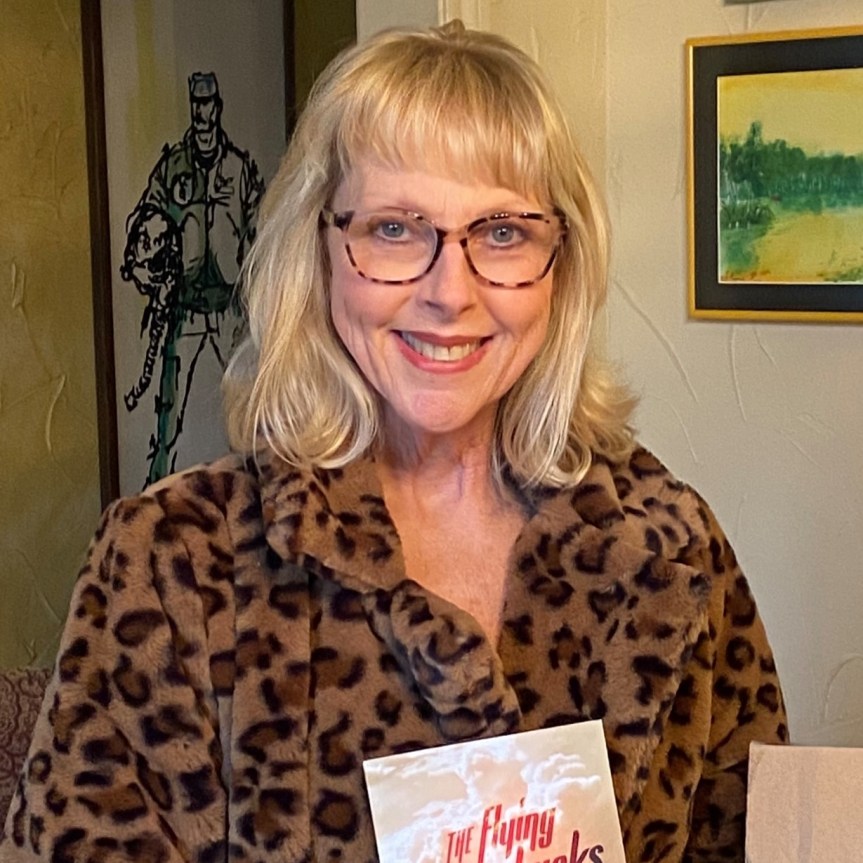
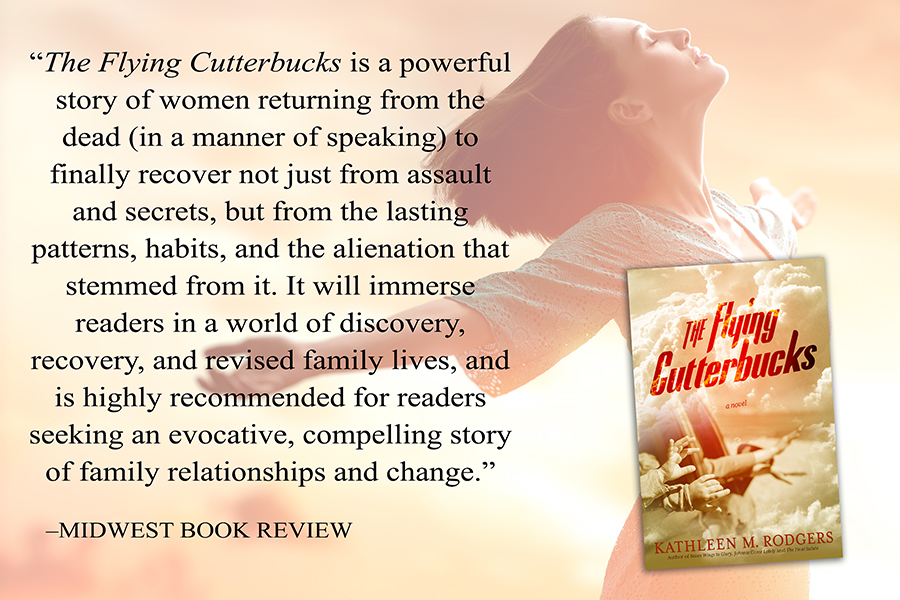
Kathleen Rodgers’ The Flying Cutterbucks is a wonderfully unusual, romp of a realistic ride through the tension of a presidential election. Author Kathleen Rodgers takes a firm stance and keeps it real with well-drawn women characters you won’t soon forget. Memories unfold, the past haunts and ghosts are laid to rest in this intricately woven story set on the outskirts of Pardon, New Mexico to such a nuanced degree that you’ll feel as if you’re there. A celebration of strong, resilient female characters, The Flying Cutterbucks roared onto my Kindle device and kept me riveted.
Book Description: Decades ago, Trudy, Georgia, and Aunt Star formed a code of silence to protect each other from an abusive man who terrorized their family. One act of solidarity long ago lives with them still. With the election of a president who brags about groping women without their consent, old wounds and deep secrets come alive again, forcing hard truths to be told and even harder truths to be left to the dead.
On the outskirts of Pardon, New Mexico, Trudy returns to her mother, Jewel, to navigate an old house filled with haunting mementos of her father who went missing in action over North Vietnam. As she helps her mother sift through the memories and finally lay her father to rest, Trudy will do her own soul searching to say goodbye to the dead, and find her way along with the other women in her family, and through the next election.
About the Author: Born and raised in Clovis, New Mexico, Kathleen M. Rodgers is a novelist whose stories and essays have appeared in Family Circle Magazine, Military Times, and in anthologies published by McGraw-Hill, University of Nebraska Press/Potomac Books, Health Communications, Inc., AMG Publishers, and Press 53.
Seven Wings to Glory, Rodgers’ third novel, deals with racism and war and won an Honorable Mention for War & Military in the 2017 Foreword Indies Book of the Year Awards and was shortlisted for the 2017 Somerset Awards. Her second novel, Johnnie Come Lately, has garnered multiple awards, including the 2015 Gold Medal for literary fiction from Military Writers Society of America.
Rodgers is also the author of the award-winning novel, The Final Salute, featured in USA Today, The Associated Press, and Military Times.
She and her husband, Tom, a retired USAF fighter pilot/commercial airline pilot, reside in a suburb of North Texas with two rescue dogs. After raising two sons, she became a grandmother and is at work on her fifth novel.
While I researched my novel, Little Tea, I visited three locations in the Deep South: Greer’s Ferry Lake in Heber Springs, Arkansas; Memphis, Tennesse, where I grew up; and Como, Mississippi, which is 45 miles south of Memphis. It was the month of July, in the high heat of summer, and if you’ve ever been to the Deep South in the month of July, you know the gauze-like, humidity is part and parcel to the experience.
I embraced it all from the second my plane from Southern California landed. Through the automatic, sliding glass doors, the humidity hit me with the life force of a raging inferno and followed me all the way to my friend’s waiting car.
In the Deep South, much thought goes into escaping the heat. People live in air-conditioned wind tunnels that drown out all sound and wear cotton sweaters inside, which seems, to me, utterly ironic, but there you have it.
There’s a specific character to the Deep South in the summertime that has much to do with the climate, a weighted sultriness that eases on the skin and slows everything down to the point that most things seem nice and easy. Nobody complains about the heat because it’s a regional given. Southerners live in harmony with the heat, build their houses with verandahs, put ceiling fans above, screens before their front doors, and rocking chairs out front because channeling the slightest of breeze is a cultural pastime.
It’d been a long time since I’d been to the South in the dead of summer, but I wanted to photograph Little Tea’s setting in the region’s full, resplendent nuance. I wanted the setting of the Little Tea to depict the South as character, and for that, I needed the trees in their fullness, the flowers in bloom, the sun’s glaring halo over Greer’s Ferry Lake, and the dirt roads fully shaded yet dry as a bone.
Photographing the setting of Little Tea, I knew, would anchor me to the South as I wrote the story, back home at my desk in California, but what I had in mind all along was a series of moving images with which I could gift the reader. After all, a picture tells a thousand words when it comes to a lasting impression. Included, here, is the book trailer of Little Tea I created. My hope is it will give Little Tea’s readers a good sense of place.
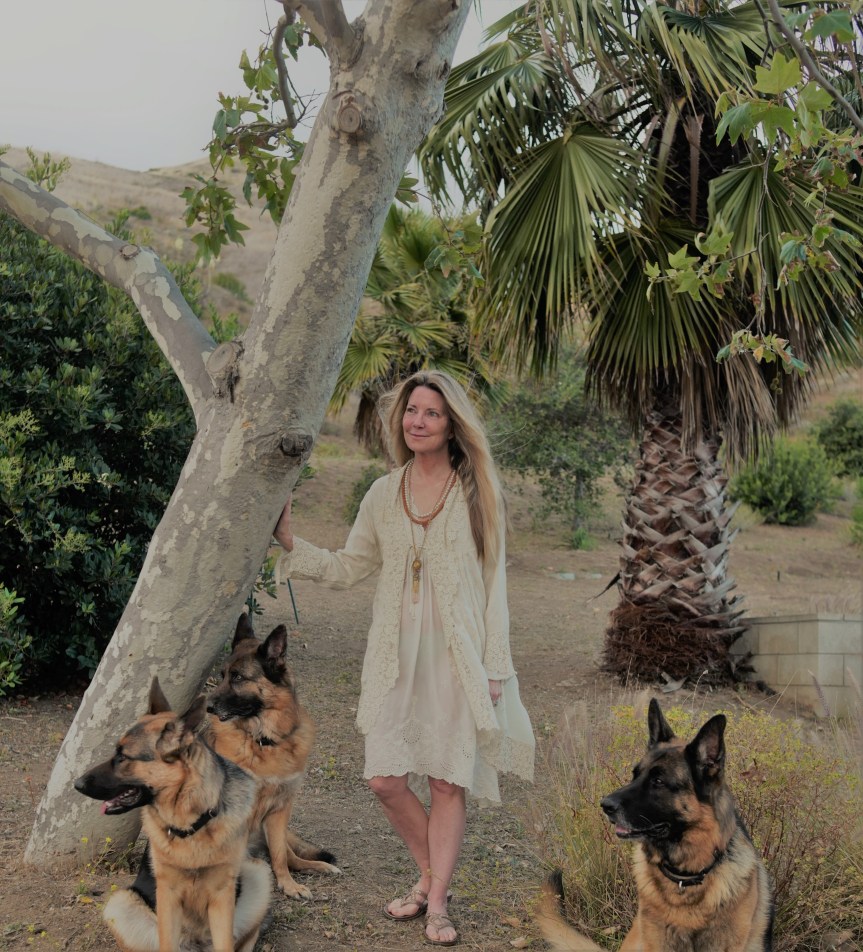
Here on the west end of Malibu, I spend most of my days writing. I’ve been at a particular pitch for twelve years or so, and what I’ve come to realize is, if a writer stays with it consistently, they’ll realize they’ve created a lifestyle that feels like a spinning wheel whose spokes include the writing of a book, the book’s pre-release promotion, post-release promotion, oftentimes travel to book events, and all the while, a work-in-progress that perpetuates the cycle.
I discovered long ago that balance is key to being a writer. I don’t think it’s healthy to spend too much time at my desk. I’m in the habit of stringing three or four hours in front of my computer then going outside to walk around, see if the sun is shining, put Groove Music on my headphones, and walk to the beach to watch the surfers. A little air and movement always does me good.
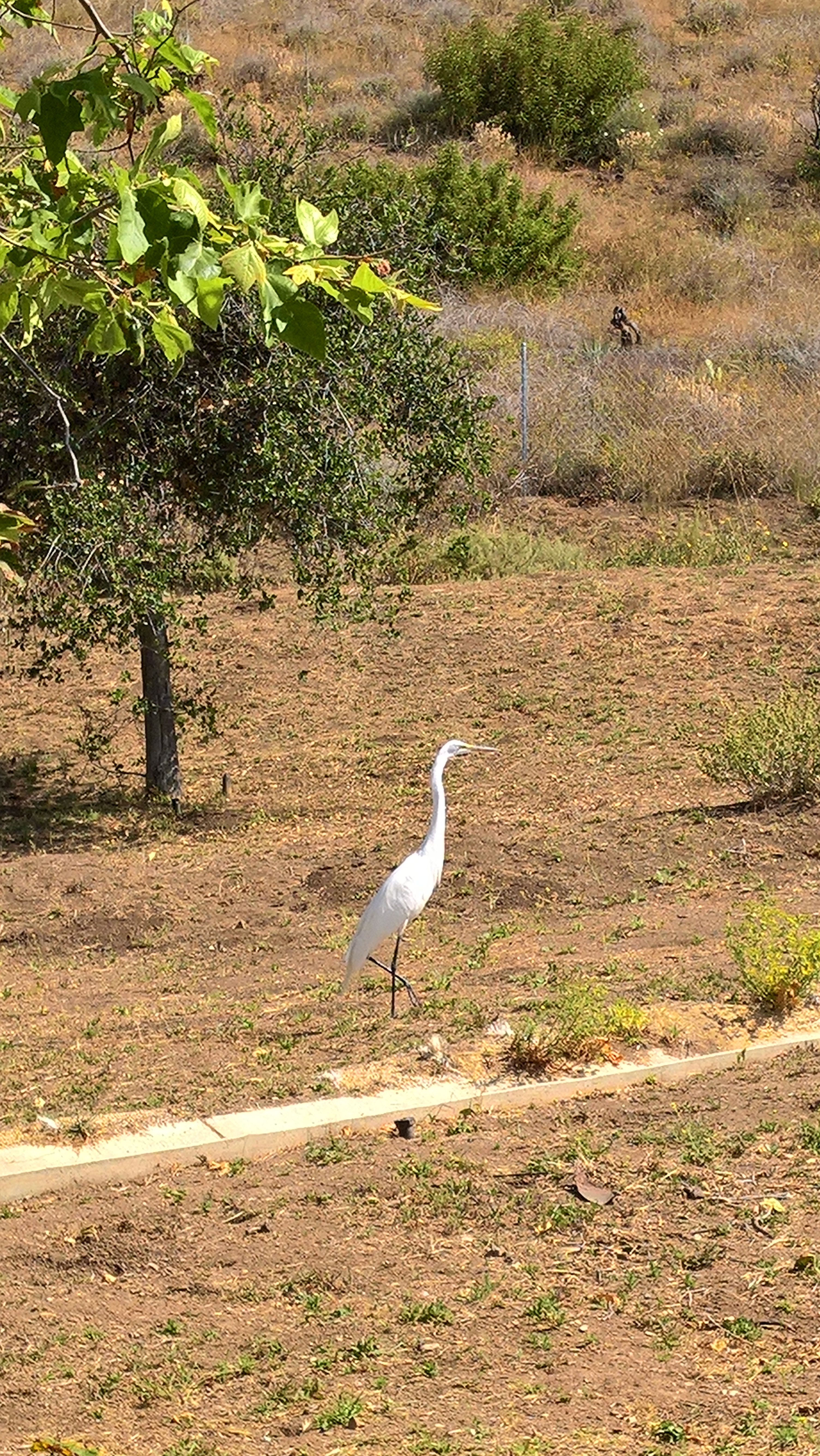
But it’s amazing what can happen from the simple act of walking outside while taking a break from my desk. Last week, it was this:
An egret walked around our backyard. It’s been seven days since this majestic bird appeared, and it shows no enthusiasm toward leaving. The Malibu terrain this time of year is hot and dry, and that means the prevalence of lizards, which, I suspect, is the egret’s draw.
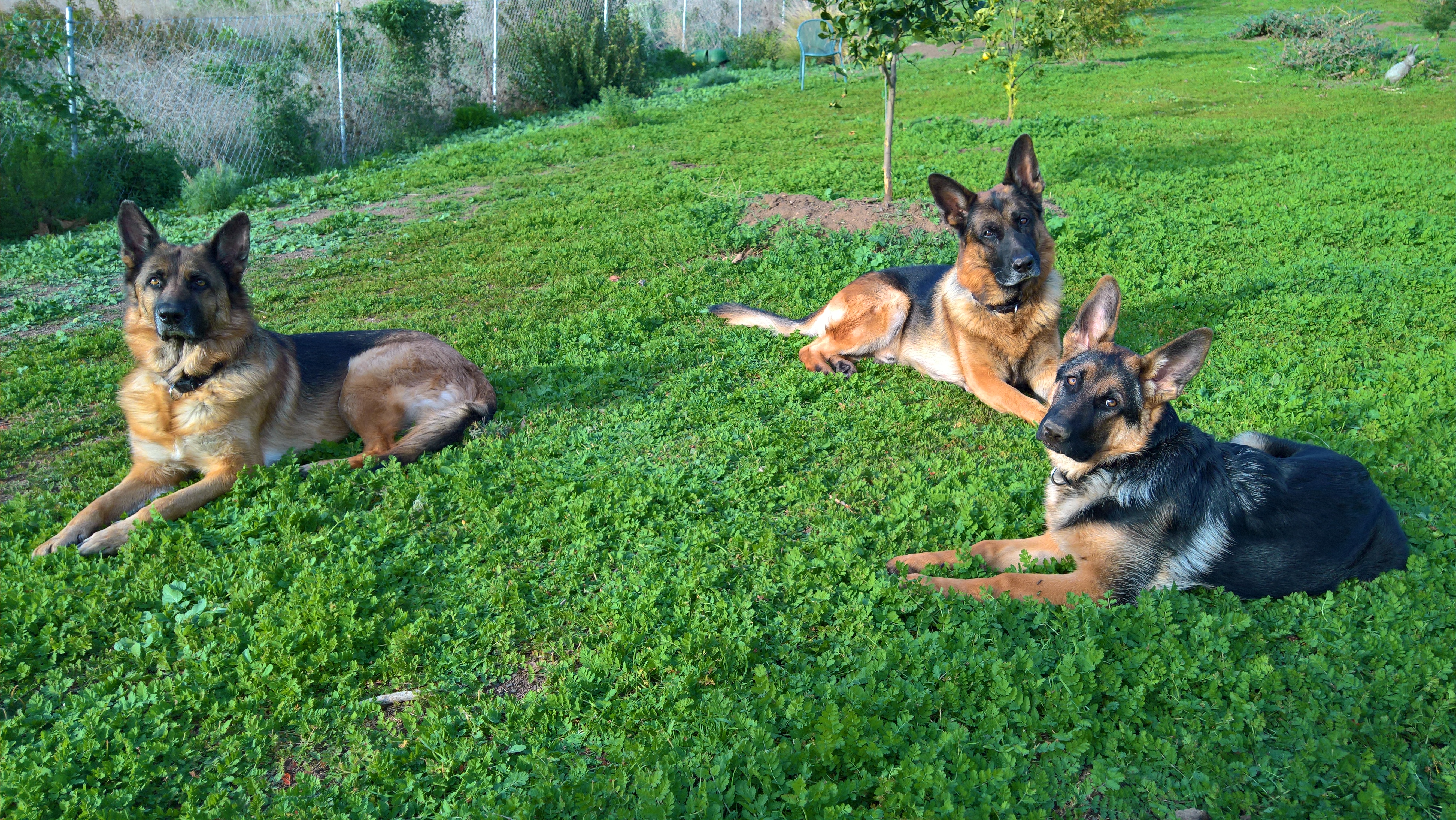
As you can see from the above photograph, the egret has made itself quite at home. Even our female, German shepherd, Ceili has grown used to it, though this isn’t always the case, especially when our other two shepherds are involved.
Here are Ceili, Ronin, and our 9-month-old puppy, Sorcha: three German shepherds with Irish names.
When it comes to seeking balance in my writing life, the environment I live in, and those that populate it give me a sense of balance.
I’m like may writers. I live on a wheel that constantly spins. It suits me, this combination of creativity, dedication, and purpose. Being a novelist is a fulltime job with no “there” to get to, only the commitment and perseverance it takes to stay on the path. As for the outcome of each book, beyond doing the very best I can do, it’s not my business. My business is to enjoy the process. I am grateful beyond measure when anything comes from one of my books, but it’s enough to enjoy the quality of my days; that I am spending time the way I like to, building something that matters to me, then walking outside to see what’s happening.
















 Claire Fullerton Author