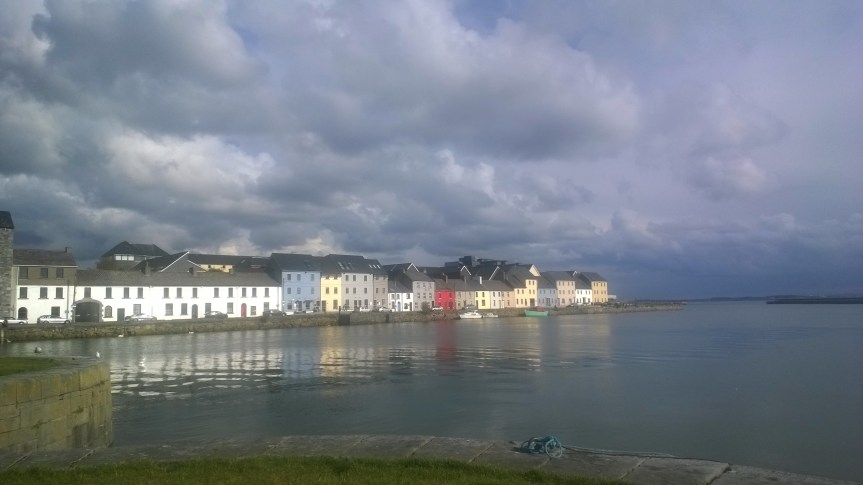
On an Irish Bus

He would have stood out anywhere, and standing in front of the entrance to a boutique hotel in Spiddal, wielding a black walking cane with an ivory handle two paces before made him glaringly incongruous to everything I’d come to know about the western coast of Ireland. He wore a three piece suit on his gentle frame: black, with gray stripes the width of angel’s hair, with a fitted vest, tailored trousers, complementary cravat, and a black Fedora angled just so.

I looked out from my window seat on the bus from Carraroe to Galway. It was one of those old kinds that looked as if it once had a life as an elementary school bus now put out to pasture. With aluminum rails on the seats before, the bus would take off noisily, gravel scattering beneath its wheels before I had a chance to sit down. The bus driver greeted me in awkward English. It took a few rounds of greeting me in Irish before he finally realized I am an American, and his guttural salutation now came out sounding like something a little to the left of “Hiya.”

The bus rolled to its customary stop on the coast road that runs through the heart of Spiddal. There is no sign there; the stop is force of habit because years of driving this rolling route through Connemara told the driver where travelers would be standing shielded from the vagaries of Irish weather.

Heads turned as the dapper, elderly man mounted the bus. He steadied his gait with his cane and favored his right foot up the three steps then halted beside the bus driver to beam his greeting. Out of the corner of my eye, trying not to stare, I saw the man tip his hat repeatedly to the right and left as he made his way down the aisle to the vacant seat beside me.

“Nice day,” he said to me as he took off his hat and placed it on his lap. “Going into town, is it? Where you go every day?”

“Yes,” I said caught by surprise and thinking nothing gets by anybody around here.

“Kearney’s the name, Seamus Kearney,” he offered himself. “You’re an American, yah?” he asked in that way the Irish have of answering their own question.

“Yes,” I answered.

“From the South, is it?” he continued.

“That’s a good ear you have. Yes, I’m from Memphis, Tennessee, but I spent the last five years living in Los Angeles,” I clarified.

“God helps us all,” he said with a wink. “And what is your name, then?” he prodded.

“Claire Fullerton.” I shook his offered hand.

“And your middle name then? Have you Irish connections?”

“Yes, I have Irish connections on both sides. My middle name is Ford,” I said.

“Ford,” he considered, wrinkling his brow. “That’s an odd middle name for a girl.”

“Yes, perhaps,” I said. “But I’m not an odd girl; I promise.”

“Now the Fords, they’re from around these parts. They’re old as the hills and Irish as the soil.  Many are up the road in that old graveyard by The Centra,” Seamus Kearney said. “So they called you here, they did,” he said in more of a statement than a question.

“No, actually it was a whim that brought me here. I never knew any of my Ford relatives. Most of them died before I was born.”

Seamus drew in his breath in that audible sigh the Irish do, when they’re getting ready to say something poignant. It is a sound with a world of understanding contained: one part camaraderie, the other commiseration. “So, they called you here, they did,” he reiterated patiently. His white eyebrows raised encouragingly, as if leading a child along the road to good reason.

“Yes, definitely,” I complied.

“Ah then, there it is, so. We in Connemara don’t see the need in being parted by a little thing like death,” he said.

I couldn’t wait a second longer; I couldn’t help but ask, “Do you always dress like this?”

“Like what?” he asked genuinely unaware, which made me wonder if I’d put my foot in my mouth.

“You look so nice; I was only thinking that,” I said, the heat rising to my face.

“Pride of person’s not an unpardonable sin,” he said. “Now let me ask you what it is you do in town.”

The next thing I knew, I was explaining everything I did at my job in Galway, while Seamus gave me his rapt attention, with a pleased look on his face. Had I still been living in Los Angeles, a conversation like the one I had with Seamus Kearney would never have taken place. One simply did not divulge personal information to a stranger in Los Angeles without thinking it would come back to haunt in some unexpected way. But this was Connemara, and the Irish have a way of exchanging pleasantries in a manner that is somewhere between an exploration of and commentary on this business of living. It is an art so subtle you have to narrow your eyes or you’ll miss it; it comes creeping softly wearing white cotton socks and sensible shoes.

The bus rolled to a stop at the Spanish Arch, down by the quays in Galway. I stood up to disembark. “Nice to meet you, Mr. Kearney,” I said.

“Call me Seamus, please,” he returned. “I live just by the church there in Spiddal. I’d love for you to call out any time for a cup of tea,” he said, with his blue eyes smiling.

“Thank you so much, I will,” I returned, and as I got off the bus to head over the River Corrib’s bridge, I turned to wave to Seamus Kearney and knew without question I would.
Reflections of a Southern Mother

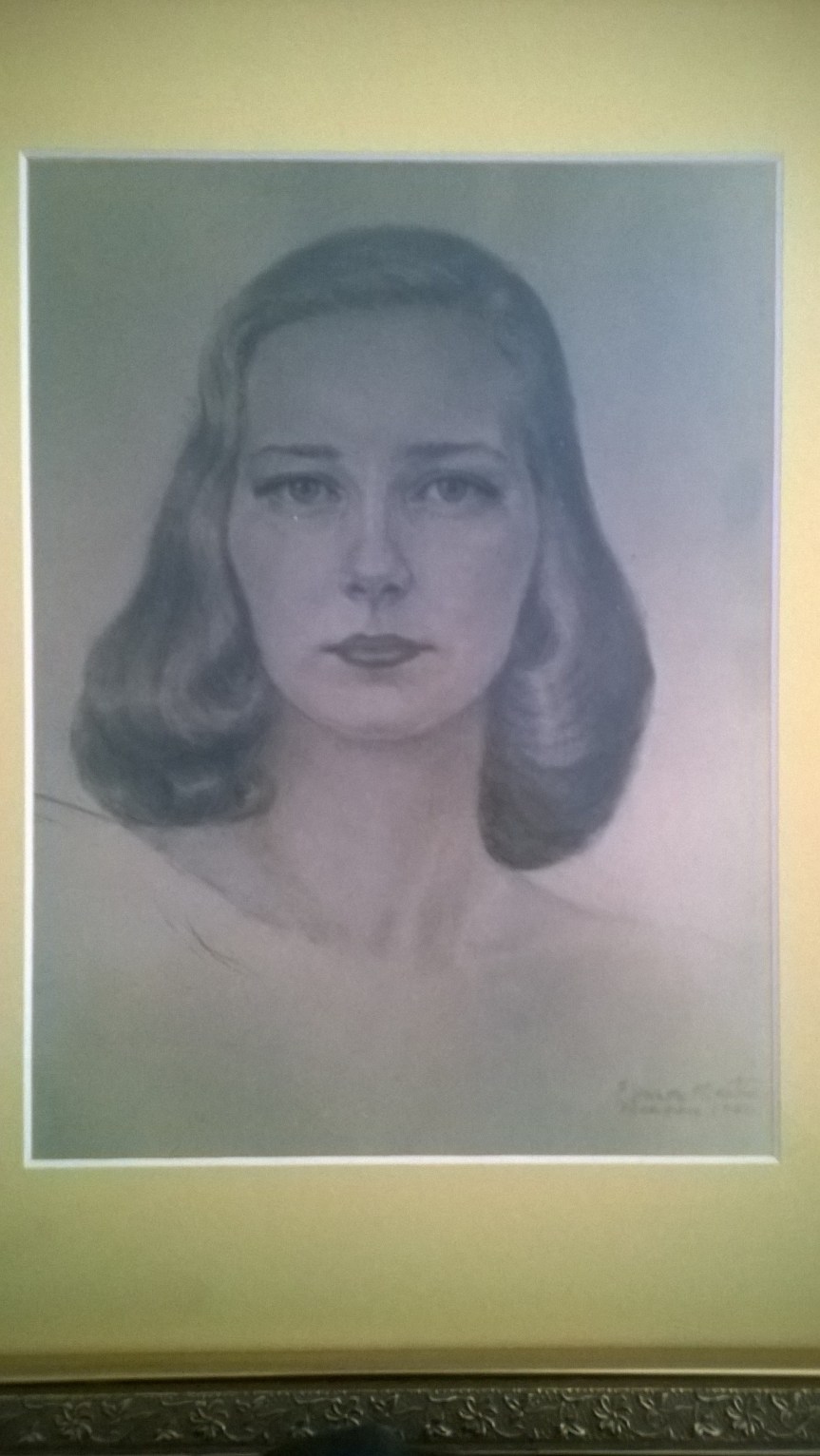
The first voice to caress my infant ears rolled with such lyrical beauty that I am offended by other accents to this day. It soothed in its quicksilver fluidity, lacked hard edges, and whispered in promises so compelling it could turn the most resistant of souls into a willing adherent. I know now that sound travels queerly and can reach back through time. I often hear the voice of my Southern mother when I least expect it; it comes to me more as reminder than recollection, and carries truth along the lines of a template so firmly etched by her feminine hand that its imprint is resounding, guiding, indelible. There was a time in my youth when I resisted this influence in pursuit of my self-sufficiency, but life is an ironic circle, and the process of maturity tempers to the point where my mother’s voice has victoriously come back around. It calls from the shelter of a wrought iron and stucco portico in my mind’s eye, where she stands saturated with the scent of magnolia blossoms and shaded from the summer sun that filters through Memphis’ oppressive humidity. I can barely hear her calling over the late afternoon’s deafening chorus of cicadas, yet she is there as the voice of reason, rising up as the music of consciousness, whose lines are now so blurred I can no longer discern which is hers, or which is mine. But I measure my life from the parameters of her spectral inflection; I am thoroughly capable of standing in witness of myself as I walk out to meet life’s vagaries. It is a gift to be bestowed with a standard so certain it shines like a beacon from the otherworld in the darkest of hours. Because my mother’s Southern ways were never overt, she held firmly to the cultural aversion to histrionics and wielded the power of suggestion like a finely tuned instrument that only sought the high notes of beauty in this world. And so it is for myself and my Southern contemporaries. We are the scion of the last of the great Southern belles, the daughters of a confederacy of women so regal and refined they left an impact that reverberates through the ages, beckoning us to hold on tight enough, strong enough, fast enough to a way of being in the world they found safe in its civility, even as the world around us changes. And what’s funny to me is realizing that the shadow these grand dames cast was so weighty; there’s a part of me now that waits for permission to step into any one of their delicate shoes. But too many are gone now, and there will be no rite of passage, so I will stand tall and rely on this voice in my head that reaches through the veil of time to offer guidance; a place from which my mother calls softly, ceaselessly, unerringly, in a dance that has become a perfect circle.

#BookReview of Levant Mirage by @OliverFChase

An astoundingly impressive review from Ronovan Writes on this action thriller!

Ronovan's avatarronovanwrites

Levant Mirage by Oliver F. Chase

You all know I don’t often cross my two sites over with each other. LitWorldInterviews is its own beast. I could count on one hand the times I recall having shared a book review here on RW, as it’s known behind the scenes. Today I wanted to share this one that I wrote for Levant Mirage by Oliver F. Chase. Why? Read on and you’ll see.

I received a copy of this book for an honest review and I’m glad I did. After having read it, I almost want to send him a check.

Levant Mirage takes snapshots from the headlines of the past few years to build a character and combines it with frighteningly realistic levant miragepossibilities to give a story you pray never happens.

35 year old U.S. Army Major Adam Michaels is no James Bond, nor did he ever set out to be. What is he? He’s a…

View original post 850 more words

Ten More ’79 Words Story’ Entrants…

Chris The Story Reading Ape's avatarChris The Story Reading Ape's Blog

79 WSC

Further to the fun 79 Word Challenge set byAuthor Andrew Joyce– clickHEREto check out HIS story AND click HERE to see the first seven great entries 😀

NOW READ TEN MORE ENTRIES BELOW:

(To visit the writers blogs, click on their names or photos)

〜〜〜〜〜

‘Found’ by Danny the Dog

Danny the Dog

The woods are dark, the cabin isolated.

In the distance, a bird cries into the night.

The only light, the fire in the hearth.

Not far off, a twig snaps underfoot.

Someone softly comes my way.

The dread in me rises.

Have I been found?

I am cut off from running; it is too late for that.

In pensive silence, I await my fate.

The door bursts open, Andrew is silhouetted against the stars.

SURPRISE!”

I so hate birthdays.

〜〜〜〜〜

I Live Here by Annette Rochelle Aben

Annette

All she kept emphatically telling everyone was…

View original post 820 more words

Excerpt from Literary Fiction, “Dancing to an Irish Reel.”

Chapter Seven

The distance between Inverin and Clifden is approximately sixty kilometers. It’s a visually inspiring hour-long ride through undulating midlands with grass as soft as velvet, gray stone walls that split the landscape, and bubbling intermittent streams as you glide along a two-lane road that cuts through a terrain devoid of street markers, stop signs, or any other indication the area has been previously trodden. There is little suggestion of civilization anywhere in sight and it is a quiet, unobstructed journey through the heart of Connemara with nothing in store, save for the destination of Clifden.

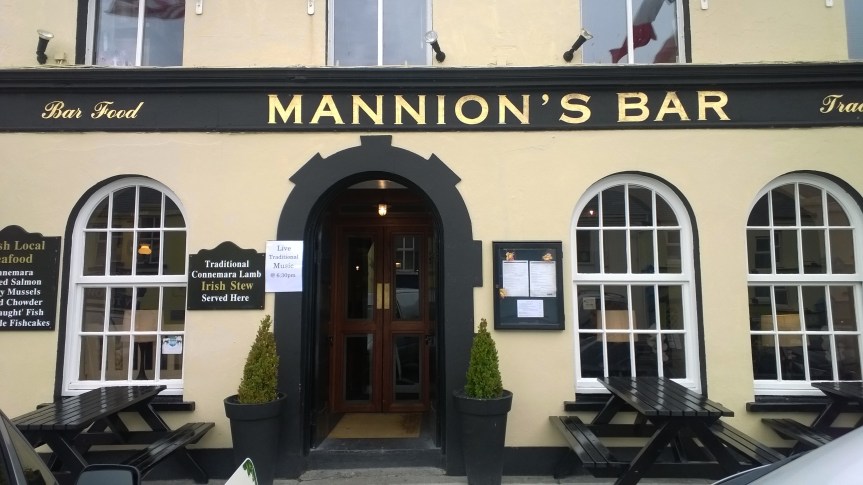
Driving into Clifden, one is abruptly thrust into the center of a thriving village that hosts an annual, three-day music festival wherein every pub door is invitingly open with signs outside announcing which Irish traditional musicians will be playing within the standing-room-only venues. A rudimentary chalkboard sat on the sidewalk outside of Mannion’s Pub with “Welcome Liam Hennessey” sprawled across in large, eye-catching cursive.

I followed Liam into the middle of a waiting crowd, which parted ceremoniously as he made his way to the old man seated against the wall across from the bar. Wind-tossed and toothless, the man sat on a battered wooden chair, tuning a fiddle and nodding his greeting while Liam opened his accordion case and settled in beside him. When a flute player joined them, the crowd fell into an anticipatory hush, ready for the music to begin. I stationed myself in front of the bar, minding my own business, but that soon became short-lived.

“Are you here with Liam?” asked a middle-aged man who was standing too close to me.

“Yes.” I took a step back.

“She’s here with Liam,” the man announced, turning to the man beside him.

“Ah,” the second man gasped, “she is, so!”

“Where did you get that blond hair on your head?” The first man eyed me.

“I brought it with me from America,” I said.

“She’s from America!” The man turned to the other man, his eyes opened wide.

“America indeed!” The second man drew in his breath.

“All I want in the world is for me brother to come in and see me standing here talking to you,” said the first man. “I wouldn’t care if a pooka came for me after that. Will you have a pint? Get her a pint, Tom,” he directed.

“Tom, make that a half-pint,” I said, trying not to laugh. I looked over at an obviously amused Liam, who smiled and winked as if to say he knew what was happening.

I looked toward the door and noticed an unusually small woman walking in with what appeared to be members of her family due to their similarity in stature. I’d met her in Galway before: she was a musician named Deanna Rader who played guitar and sang anything from Irish traditional music to her own compositions. I’d heard her sing in her low, husky voice a few times before, and because she was a friend of Declan’s, I’d exchanged pleasantries with her a few times as well. From the looks of things, she was in Mannion’s with her father and two sisters. She came smiling to my side instantly.

“Well then, you’ve made your way out here now, have you?” She looked up at me.

“I came here with Liam,” I said, grateful to know someone in the crowd.

“I knew you must have. So, it’s the two of you now, is it?”

“Well, I don’t know if I’d put it that way,” I said, diverting the implication. I couldn’t recall if I’d seen Deanna while I was out with Liam, or if she asked this because she’d heard people talking.

“You’re a long way from home yourself,” I said. “Is this festival a big deal?”

“Oh God, yes. People look forward every year. Luckily my parents live in Letterfrack, just up the road. I’ve been spending the last couple of nights with them. We’ve all come ’round tonight for the craic.”

“Well, it’s nice to know someone here,” I said.

“My sister came out to sing tonight. Would you mind asking Liam if she could give us a song?”

“Sure,” I said. “I’ll ask him when they take a break.”

“They probably won’t do that, so you’d be waiting for ages,” Deanna said. “You’ll just have to lean over and ask, like.”

“When?” I asked.

“How about now?” she said.

“Right now?”

“If it wouldn’t be too much trouble,” she smiled sweetly.

I looked over at the musicians, who were in full swing. There was no way I was going to butt in, even though Deanna kept standing there looking up at me expectantly. Just then, a man at the bar stepped forward enthusiastically. He leaned into the musicians circle, grabbed Liam by the arm, and shouted loudly, “The young lady here wants to give us a song.” With that, the music came to a screeching halt, and a whirlwind of preparation commenced. Liam leaned over and whispered to the two musicians beside him, instruments were set down, a microphone was raised, a path spontaneously cleared, and into the arena stepped Deanna’s sister. It was like the infamous scene of Marilyn Monroe singing “Happy Birthday” to President Kennedy.

There was a hush in the room as all eyes riveted upon the girl. She stood all of five foot two, but within that minuscule framework there was a lot going on: thick, raven hair fell in loose waves across her forehead and down her back. Large green oval eyes slanted and squinted catlike beneath thick, dark lashes. Turn by turn, her eyes focused and held one man in the room after another. She stood with her right hand on her hip and her voluptuous weight shifted to the left. With great histrionics, she crooned out a song in the Irish language I’d never heard before. When she finally stopped, she sashayed over to Liam, totally aware everybody was watching. With grand theatrics, she threw both her arms around his neck and kissed him square on the mouth, nearly knocking him over with her forward advance. All hands in the room clapped loudly, wolf whistles erupted, and a few eyes turned my way.

“I imagine you’d have something to say about this passionate display,” said Deanna’s father, who had materialized beside me.

“Not really,” I said. “Do you?”

“You have to watch that one is all. She’ll be the death of me one day, he said, cocking his head toward her.

“I hope not,” I said.

“No harm done then?”

“No harm at all,” I said.

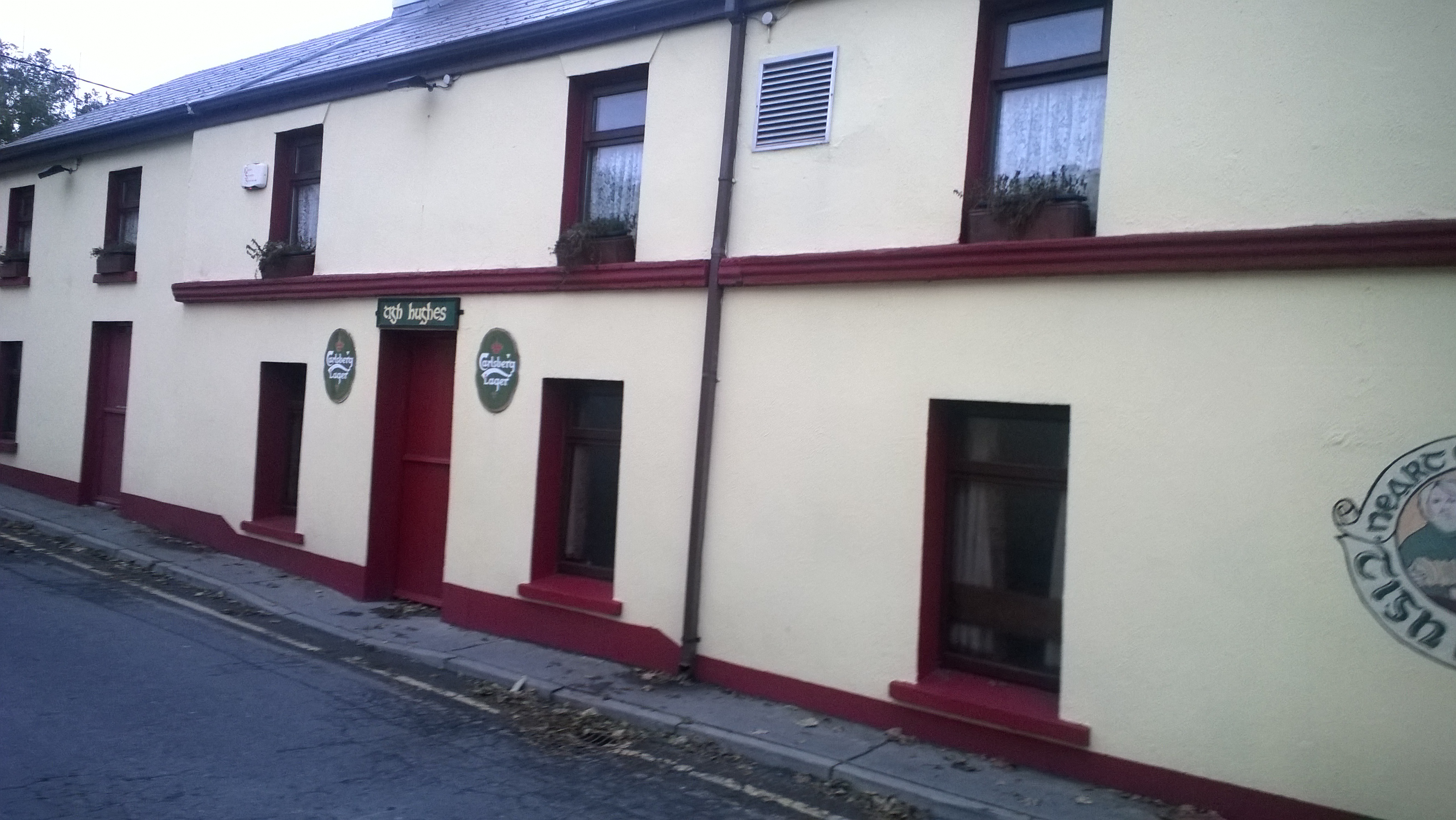
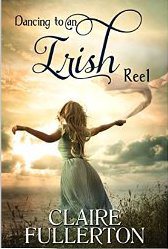
Dancing to an Irish Reel Excerpt: Spiddal Scene: Hughes Pub

WP_20141007_066WP_20141007_063There’s an energy that hangs between strangers even in a crowd. Call it interest, or attraction, or the knowledge of things to come. It is awareness, and I was aware to the exclusion of all activity around me that Liam Hennessey was watching me. He was sitting at the corner of the bar by himself, and because I could feel his gaze upon me like an electrical current, I froze. I did not move an inch because I sensed I didn’t have to, that something would come about with little prompting from me. I don’t know how I knew this, but I was right, it came about within the hour. It began as a series of introductions to people near Liam, and drew itself closer until Liam was introduced to me.

Right before Leigh left, claiming she had to get up early the next day to drive to Cork, Kieran pointed out that the Irish traditional musicians playing in the corner were the father and older brother of the lad sitting at the end of the bar.

“That’s Liam Hennessey at the bar there,” Kieran gestured to my right. “He’s the best box player in Connemara – even in the whole of Ireland, many say. His family is long in Connemara; they’re all players, so. That’s Sean Liam, his da, and his brother Anthony there on the guitar.” Kieran seemed proud to know the facts. He next took my arm and led me straight to Liam.

“I’ve the pleasure of knowing this American here, her name is Hailey,” Kieran announced to Liam.

I had an uneasy feeling. It’s one thing to suspect you’ll cross paths with someone again, and quite another to be fully prepared when it actually happens. For some unknown reason, I kept thinking it was strange to see Liam this far out in the country from Galway, but then again, what did I know? I didn’t know anything about him.

Liam looked at me with large dark eyes and smiled brightly. He was different than I had imagined: he was friendlier, more candid. I assumed because he looked so dark and mysterious, there would be a personality to match. I assumed he would be reserved, aloof, perhaps arrogant in an artistic sort of way. I was paying close attention, and there was none of that about Liam. In seconds, I realized he was a nice guy. I moved a step to my right as an older man approached the bar.

“Would ye give us a hand there,” the man said to Liam, and for the next few minutes, Liam handed pints over his head to a group of men too far from the bar’s edge to grab the glasses themselves. Just then, Kieran said something that set off a chain of events and put the rest of the night in motion.

“Liam, will you watch Hailey for me, I’m off to join the sessiun.” With that, Kieran produced a harmonica from his shirt pocket and walked off to join the musicians in the corner.

I stood at the bar and waited for the next thing to happen. The world seemed to operate in slow motion. All the noise in the room subsided, and the only thing I knew was I was looking directly at Liam Hennessey. I searched his face for imperfections. I had never before seen such beauty in the face of a man. I hoped my thoughts didn’t show on my face. He was so good looking, I wondered why other people in the room weren’t staring at him, then I realized most of Hughes’ patrons knew him and were probably used to the way he looked. I was reticent, unsure of how to speak to Liam, unfamiliar with how provincial he may or may not have been. Words tend to get in the way in moments like this, but they lay in wait just the same.

“You’re an American, yah?” he asked in that way the Irish have of answering their own question. “I’ve been to America,” he said.

“Where in America?” I encouraged.

“Boston, New York, Chicago. My cousins live in Chicago. I even went all the way to Niagara Falls,” Liam said.

“Believe it or not, I’ve never been to Niagara Falls. What’s it like?”

“Not much, mind you, it’s a nice enough place, but ten minutes after I saw the falls, I was asking where I could get a nice cup of tea.”

“I imagine it would take a lot to be impressed after living here,” I said.

“I’d never want to live anywhere else. Everything you could ever want is here in Connemara.”

And it is, I thought. Connemara has a sense of peace I’ve never felt before.

“Are you long in Ireland?” he asked.

“I live here,” I said. “I live in Inverin.”

“Ah, so you’re just up the road. Me too.”

Ireland and My Grandmother’s Faith

Ireland and My Grandmother’s Faith

This piece appears on the Wild Geese.Irish

My father’s mother was named Helen Ford. She was long and lithe, narrow and fluid, and gifted with a full head of wavy hair that turned, in her later years, to a color that by-passed gray completely to shine an enviable white. Her family hailed from Tuam, County Galway, and as I write, I’m glancing up at the photograph on my wall of her Irish family homestead, where three women stand before the white-washed, humble home, with arms entwined and blue eyes smiling. I’ve positioned the picture above my desk just so because it reminds me from whence I come.
I have no memory of Helen Ford, for she died the very year I was born. But there’s another photograph I have, which means the world to me because this seraphic woman is holding me in her arms. Even then, you could see our similarities. There’s the same shape to our heads, the same light colored eyes, and I’m told to this day of our striking resemblance.
I heard it told repeatedly, in my coming of age, that my grandmother was a devout Catholic; so devout, it seems, that when my father married my mother in a Presbyterian church in Memphis, she couldn’t bring herself to darken the threshold. It was as if a psychic force field existed that precluded her entrance, so during her only son’s wedding, Helen sat demurely outside on a garden bench, with her legs daintily crossed, and her green marble rosary in her hands, much to my mother’s infinite chagrin.
My father’s view on Catholicism was something he never shared, but surely he knew his way around the subject, as his Irish father was also Catholic. But my father was a nonconformist by nature. He found God in the great outdoors, where His mysteries were whispered in talisman’s and signs. And although he wasn’t a denominational observer, my father was the most pious man I’ve ever known.
All this explains why my three brothers and I were raised in my mother’s Presbyterian faith. Kind of. I say kind of because in as much as these things should influence, after I grew up, I realized my mother’s religion didn’t actually take. Yet my pied piper of a father had somehow managed to instill in me a sense of God’s awe and wonder. I feel His presence more often than not, and I’m wise enough to know whom I serve, I just don’t have a gift-wrapped box that pleases everybody.
But my life-long friend, Tama, does; she’s a Catholic, in no uncertain terms. I’ve always admired her clench- fisted devotion; I’ve seen it guide her unwaveringly through unspeakable times. This is how I came to visit at least a dozen Catholic churches during my last trip to Ireland: I had the good sense to bring Tama with me.
You have to know Tama. She’s of Irish blood on both sides, with an eternally young, impish look about her that’s always reminded me of a young Vivian Leigh. She is wickedly funny, maddeningly unpredictable, and I’d follow her anywhere.
“Stop,” Tama cried, “There’s another one!” I put my foot on the brake and backed up in the middle of a country road just outside Kinvara. We scratched up a gravel driveway, got out of the car, and I followed Tama inside a gray-stone, cavernous church. The church seemed older than the land itself. It had vaulted ceilings, stain-glass windows, it reeked of incense, and echoed with every step on its granite floor. I’ve already stated I don’t have a religious box, but I do have a grand respect for the civility of ritual and ceremony. I had a seat in a back pew as Tama made her way to the front of the church, where a wrought-iron stand housed endless tiers of red votive candles. Striking a match, then another and another, I knew what Tama was thinking. I know her family, I know her history, and it didn’t take much for me to intuit for whom the bell tolled. I was suddenly overwhelmed, watching this reverential gesture. It seemed so beautiful to me, so appropriate, so very perfect.
I thought of my brother in heaven, and rose unsteadily to my feet. For a moment, I stood questioning if I had the right to light a candle; then I thought of the woman I’ve referred to my whole life as Gaga Helen. I saw her standing before the candles, a white kerchief on her bowed head, performing an act that resonated in her bone marrow. I saw her pause for a reflective moment then turn and walk to the pews, where she kneeled, bowed her head, and folded her hands. It was in that moment that I suddenly knew I had the right to light a candle for Haines. When I was finished, I turned and spied Tama, in an alcove beneath a stain glass window. She held something flimsy, plastic covered, and book-size before her. She scrutinized it with such focus it caused me to intrude upon what was clearly a private moment.
“What is that?” I whispered to Tama.
“Shhh. It’s a prayer to St. Theresa.”
I stood for a moment, wanting in on the experience, and asked her to read it aloud. Tama moved closer and lowered her voice to recite the “Miraculous Invocation to St. Theresa,” and I wept all the way through it.
It may have been that I was standing not far from Helen Ford’s ancestral home, or it may have been that something in this ancient text spoke to me of a faith so strong it kept my grandmother from her only son’s wedding. Whatever it was, it brought a sigh to my heart and a deep-seated sense of relief. But perhaps it is Ireland itself that will do this to a person: it took Ireland and Tama, and an ancient church on a country road to understand the sanctity of my grandmother’s faith.WP_20141003_020

5 Star Review from Ronovan Writes of Dancing to an Irish Reel

on September 18, 2015
An L.A. exec escapes to Ireland for some soul and life searching and meets a young local Irish musician new to love. Claire Fullerton writes two stories with one theme. While Hailey learns about Ireland, the place she calls home, and comes to understand it, so does she slowly begin to understand Liam. Both of these have mysteries to her and she can’t help be drawn to them.

This story doesn’t fall into the traps of the usual romance that so many people think of. A lot of common sense in the leading lady of Hailey. I greatly enjoyed the way Fullerton teaches about Ireland the things we don’t normally get to learn and does so by having the characters tell us, not by her telling us.

I love this book for the layers of character development, the supporting cast and the way they are used to not only move the story along but help explain Ireland, not in in-your-face ways but through storytelling and life tellings.

I recommend this book to lovers of Ireland and reality love with a touch of what might be, and what could be yet to come.

I received a copy of the book for an honest review. The only thing that even remotely was a thorn to me was how Liam acts at times, but then again he’s Irish and I’m not, well wasn’t born there. Fullerton keeps the characters real, she stays true to them. I respect that.Neel graphicsDancing to an Irish Reel Review

5 Star Review of Dancing to an Irish Reel

5 stars
An awsome job at capturing the Irish spirit.
ByBrighid O’Sullivan on October 4, 2015

Format: Kindle EditionVerified Purchase

Loved this story. The beginning was slow for me but I was smart enough to stick with it and finished it in 3 days. You will too. The author explains in great detail the Irish landscape as well as the unpredictability and charming traits of some of the most eccentric Irish characters. I think it was important to write it this way and let the words flow. Her literary style makes the book that much more Irish and extremely authentic. I was pulled into the lives of the Irish characters and the 2 Americans who really keep things interesting, a sort of cat and mouse game at times. Its a very different kind of story and that is as it should be. If you’ve always wondered what Irish people are like, this is it in a nutshell. The author paints a splendid, canny and realistic picture of Irish people and their customs, idioms, language and social relationships. The story kept me turning pages and I just loved some of the characters. The book made me laugh as well. She does an awesome job at capturing the Irish spirit, which is not like any other people you will ever meet and I would read more of her work.