Miss Hazel and the Rosa Parks League

22548670

I cannot recall the last time I read a book set in the South wherein the personality and cadence of the dialogue was pitch-perfect. Jonathan Odell goes way deeper than Southern parlance in “Miss Hazel and the Rosa Parks League;” he delves right into the middle of Mississippi’s idiomatic speech, much of which is expressed by suggestion. The vernacular in this book tells half the story, and because of its spot-on attitude, we know more of the characters than any well-written descriptive paragraph could ever depict.
Set in the small Delta town of Delphi, it is the 1950’s, and segregation, prejudice and class division are an issue. After Hazel Ishee, who comes from little, meets the charismatic Floyd Graham in the Rexall Drug Store in Tupelo, they marry and move to Delphi because Floyd has big dreams of starting his own car dealership. Amidst a town set in its ways and customs, they begin a life together in which Hazel knows she does not fit in. As a loner in Delphi, her ways blossom into an eccentricity the entire town talks about, then the cruel hand of fate steps in to exacerbate her isolation, which doesn’t begin to mend until Floyd hires Vida as the family’s maid. Vida has an agenda in accepting the position, which has to do with her history with the local sheriff, who lives next door. As Hazel and Vida’s relationship evolves from one of mutual suspicion to friendship, the division between the races is explored and bridged, and the reader comes to learn that no one person exists in this small town without effecting its whole. This is a fast paced, thrilling book that takes a heavy era in time and infuses it with quirky humor. The characters are well drawn and representative of certain sects of society without being campy. It is a story of people who seek to be more than they are, only to realize they have been enough all along. 

http://www.clairefullerton.com

Book Review “The First Time She Drowned” by Kerry Kletter

Claire Fullerton’s Reviews > The First Time She Drowned

The First Time She Drowned by Kerry Kletter
The First Time She Drowned
by Kerry Kletter (Goodreads Author)

24890050

Claire Fullerton‘s review

Jul 18, 2016  ·  edit
 
Read from July 14 to 17, 2016


The First Time She Drowned is crowned with one of the better book titles I’ve come across in recent memory. It opens with a poetically metered prologue that sets the book’s searching tone, and progressively leads the reader through a story that could have been maudlin in the hands of a lesser writer. Author Kerry Kletter deftly gives voice to eighteen year old narrator Cassie O’Malley, in language both startlingly honest and languidly circumspect. This is a modern day, relevant story of the damage exacted in dysfunctional families, where there is so much hidden agenda that the only way to the light is to unearth the source. In layered chapters of past and present, Cassie O’Malley is the bearer of the cross in a family dynamic that victimizes her, lands her against her will in a mental hospital then springs her upon her acceptance to college, where she immediately discovers she is ill prepared to meet its predictable challenges: classes, new friends, and the simple logistics of just fitting in. At the core of this story is a mother-daughter dynamic built on the shaky ground of mistrust. Cassie carries
scars like an emotional latch-key kid, wrought from the hands of a mother so self-serving and narcissistic; she thinks the emotional and
physical neglect is her own fault. It is a long road to recovery in this well-crafted tale of a search for truth, and Kletter gives us a protagonist
we desperately want to see triumph. We understand Cassie’s interior life because the author leaves nothing unattended. Kletter dives down to the bone marrow of that which shapes an inchoate psyche and leaves an imprint, then leads the way through to an ending that shines with emotional intelligence. I read this gripping book as close to non-stop as I’ve ever read anything. It is a riveting read written with such maturity, I find it hard to grasp that it is Kletter’s debut novel. Read this book, tell your friends, and stand in line with me for Kerry Kletter’s next book!

Art for Art’s Sake?

Lately, I’ve been given cause to seriously consider my writing career and to ask myself why I’m truly engaged in the pursuit. Though I am an optimist by nature, it does occur to me that as a universal rule, one can only work with a situation successfully as long as it works with them.  When it comes to most things in life, there is an art to meeting things half-way, to staying in the middle, to watching the dynamic of cause and effect in one’s life, to not over-extending oneself, nor taking things personally. It’s helpful for a writer to keep this in mind when it comes to the experience of rejection. This is not to say that it’s a bad thing to be goal oriented, only that there is folly in putting a time frame on the long range goal. Many writers want to see measurable progress according to their time-table, but this is where we’re best shown that we are not in control. I think the adage of showing up, doing the work, and being unattached to outcome is the aim, but how to seriously achieve this stance of nonattachment; this acceptance of our lack of control? Artists tend to be emotionally involved in their creations. We want to see the fruits of our labors manifest, elsewise, what’s it all for? But I’m going to take this to a soul level and say the soul only wants to create; it wants the experience of creation as its reality, and if one considers art from this premise, then it is enough to create. So the fundamental question for any artist to ask themselves is do you want the glory of the experience, or do you want to reap a reward? The world will tell you success looks a certain way at a particular end and therein lies your validation, but what attitude are we to assume until that fateful day? What price happiness, and how are we to manage within an arena whose premise is to contribute then relinquish control? The thing is, we have no control, and  assuming we do sets us up for all kinds of false premises, wherein frustration, self-doubt, victimization, and all the rest are given license. As a writer, I think art for art’s sake is the answer because we can’t control our reception. We may or may not gain riches and recognition, but if we engage the artistic flow as a way of being in the world and are in the right relationship with its unpredictability,  then I think we can say we’re living a successful life.  It’s not necessary to be the choreographer of the show, it’s only necessary that we are wise enough to dance.

Author’s note: This post is in response to Jason Howell’s  question of the week on his blog, Howlarium, of which I am an avid fan:

Q: How often are you able to create a desired result for yourself by sheer force of will, or by arranging circumstances? Do you ever feel as though the reason you aren’t far enough along is that you haven’t pushed yourself hard enough, even though you’ve worked very hard? In your writing life or otherwise—is control really all it’s cracked up to be? 

Check into Howlarium @ http://www.howlarium.com/

Poetry Challenge: Dreaming Trees

Only Heaven Knows


Blue and Black, Sorrow and twilight

Moonlight treads, wary of sunlight

And tomorrow is no promise

Heaven knows only heaven knows


Secrets resound, swaying, growing

Upon us like destiny’s path

And we dream we are all-knowing

Heaven knows only heaven knows


Up in the steel gray dawn of light

Asleep in visions’ dark of night

And in between, we do not know

Heaven knows only heaven knows


What is it we dream we have learned

At the frail hands of each other?

Life and love, longing and laughter

Heaven knows only heaven knows.


This week’s poetry challenge on Jane Dougherty’s blog. Thank you to Jane Dougherty!


The Journey

I’m partial to the west coast of Ireland for its myriad wonders, which appear in small towns that are hidden like gemstones in neat grids of logic separated by rambling, idle roads. There are worlds within worlds in these Irish small towns: history and lineage and myth and folklore; meaning so resonate and full of discovery the very act of rounding a corner can haunt a person to the bone marrow. I’m a firm believer that the way to the soul of a place is best found on foot; it’s easier to raise your antennae to the uncanny when your feet are grounded, and this is just what I was thinking as I navigated the sidewalk in Kinvara, down to the docks on the water’s edge. There across the bay, deep on the horizon, County Galway stretched in all its heavenly promise. The next day, we’d be driving our rented car the forty five minutes it takes to get to Galway City, but for now there was the lure of County Clare in the opposite direction. My friend and I had decided to make a day of it; we’d make our way slowly to the Cliffs of Moher, for no other reason than it seemed the thing to do, and we’d park the car and explore wherever the fancy struck, along the forty nine kilometer route it takes to get to what seems the edge of the known world.

In the town of Kinvara, life teemed around us in all its natural rhythm: pub doors opened to the early fall sunlight, children roamed the streets in navy blue school uniforms, in pairs and in packs. A man ahead walked two border collies off-leash; they tacked side to side, noses sniffing, rounding back to me for a pet. Up from the docks, as the sidewalk rode the incline, art galleries and shops with T-shirts in their glass fronts reading “I’m a Galway Hooker” beckoned in praise of the town’s claim to fame. In the village center café, two men played vocal one-upmanship in guttural accents that dripped soggy with Guinness. We’d parked the car earlier, across from Dunghaire Castle; we’d already gone a few rounds with our cameras as we stood in the driveway of the accessible fortress, rising from a knoll abutted by water so tranquil it took calisthenics to consider who thought what, when positioning it just so.

Through the burren, we might have been on the other side of the moon, for all its otherworldly weariness. Though I’d read much of what has been written of the area, I’d never seen it, and its gray desperation felt so inhospitable as to be hospitable, so repellant as to be attractive, so world without end, amen. In the carpark of Poulnabrone dolmen, a disheveled man stood bearded behind a card table selling his jewelry. Were it not for the distraction of the couple behind us, my friend and I would probably still be standing there listening to this proud Irishman wax erudite rhapsody on the dolmen’s history and why we had to have one of his handmade commemorative pieces for ourselves. Up the windswept tor, we took turns standing in front of the dolmen while the other took a picture, until the couple behind us snapped us together, freezing us in a time where I can still feel the wind in my hair, the rock beneath my feet, the magic in the air.

Down from the burren, on the road to Doolin, an unmarked tower called my name, and I mean this literally. Were my mother alive, God rest her, she’d tell you she named me after her mother, Claire Crossan, whose family hailed from County Clare. But what she wouldn’t tell you is why she nick-named me Doona, and my thought has always been she thought Claire was too unwieldy, until I reached a certain age. When pressed, which I did repeatedly, my mother only confessed to making up a baby rhyme with the name Doona, which somehow became my moniker. But my mother was a dyed in the wool American Southerner, which is a breed of cat not in the habit of explaining themselves, ever. So you can imagine the enlightenment and sense of inevitability that descended in a road-side shop later, after we’d stopped the car and traipsed the hillside, coastal property of that crowned tower, which loomed sentry behind a walled enclosure overlooking Doolin Point. There on an aluminum stand beside the cash register, postcards of Doonagore Castle rested at eye-level. My friend took one in hand and said, “You’re not going to believe this.” We turned over the uncanniness, all the way to Lisdoonvarna then into Doolin, where the road flowed to a gray-stone bridge over water, and signs on hand-painted easels announced which traditional musicians would be playing that night, in one of the pastel colored thatched pubs that stand sandwiched together like ducks in a row set in an Irish Disneyland. Walking down the street, there wasn’t a soul who didn’t make eye-contact and extend a “hi-ya,” for such is the way of it on Ireland’s western shore. One aproned woman swept the sidewalk in front of a restaurant and called out, “If you’re on your way to the Cliffs of Moher, you’d be wanting to get a move on. The wind’s rising now; you’ll be wanting to beat it.” “Forewarned is forearmed,” I said to my friend. We got back in the car and went on our way, but it wasn’t without its obstruction. On the side of the road, in front of a cream colored house, an elderly, yellow retriever lumbered perilously close to the traffic. It took a few blinks for me to register that it wore a long linked chain, tethered to a post too close to the road. I pulled the car in the resident driveway, assessed the problem and knocked on the house door. When no joy came, I called the dog to me and wrapped its leash around the front door, spied a water bowl on the front porch, found a yard hose, and filled the bowl with water.

It was late in the afternoon, by the time we reached the Cliffs of Moher. We climbed the steep, paved road from the carpark to the visitor’s center, took an obligatory circle around inside then out to O’Brien’s Tower, from which we gazed south and stood in awe-struck wonder, for nothing prepares you for the sheer scale of size, nor the towering majesty of this world’s natural wonder.

“I’m never getting over this,” my friend said. ‘I can’t believe I’m standing here.”

“I can’t either,” I said, “though it occurs to me today has been just as much about the journey as it has been the end.”

For more Irish Stories: http://www.clairefullerton.com
“Dancing Companion.”
 

An Irish Lagnaippe

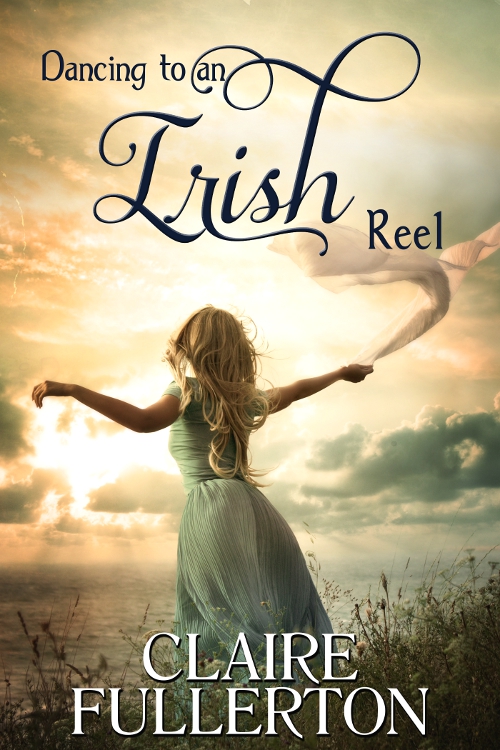
In Louisiana, they use the phonetically pleasing word lagniappe to denote a little something extra. Typically, a lagniappe is a small gift given with a purchase to a customer, by way of compliment or for good measure as a way of saying thank you. I’ve been so enamored with this word that it’s found its way into my psyche and influenced my behavior, where it prompts me to go the extra mile, when in deep gratitude. And deep gratitude I have for those generous souls who have posted reviews, written me, and recommended my second novel, Dancing to an Irish Reel. Some have done as I suspected; they’ve written me to ask how much of the book is true, for I made no secret in sharing that I actually lived on the western coast of Ireland, where the book is set, and most readers know that writers pull from their own life to one degree or another.

I’m a fan of the first person essay. I consider it the art of brevity whose aspiration is to create a whole world around a case in point. I could wax loquacious on how the pursuit thrills me, how the challenge ignites the deep-seated, smoldering embers of why I write in the first place, which is to say I experience life as a witness and write to decipher its nuances in a manner that seeks to compare notes.

Sometimes life itself will hand you a lagniappe when you’re not looking. This was the case for me when I came across the Irish on-line community, The Wild Geese. There lies a compatible fraternity of like-minded souls, who can never get enough of their favorite subject, which is themselves. Proudly, I say, I am one of them; I am one of the island folk by lineage, and I flew into formation the second I found the flock. I brought much of who I am to this union: a writer, a shanachie, a child of Eire. I started writing the stories behind the stories that were my inspiration in the crafting of Dancing to an Irish Reel and as time stretched on, I realized I’d created my own lagniappe to give to those who read my book.


On my website http://www.clairefullerton.com/, there are three tabs on the homepage titled “Dancing Companion,” where a collection of my first person Irish essays can be found along with attended photographs.


Please accept them as my lagniappe!


From a Writer’s Point of View

A writer’s life is a build, a constant state of becoming that begins with the secret, intuitive assumption that one must take a leap of faith and begin. There is no there to get to, only an unquenchable need that compels and drives on with inexplicable fervor. For me, it began with keeping a journal. I was young and fearful of admitting my internal mechanisms and uncertain of who would care to hear. But I felt the need to document my life in the hope that the singular act of private articulation would reveal to me who I was in the grand scheme of my self-involved adolescence. This is the prompting that leads a writer to the table; the need to explain oneself to oneself. Keeping a journal discredits all thoughts of life’s arbitrariness and puts the pendulum of cause and effect into clear perspective. One can keep current while they create a framework, then look back years later and chart the incremental construction of their personal history.
But what happens when one evolves from journal keeping to writing as a way of life? Certainly it’s an insular existence that cannot be shared. It’s like taking that running monologue we all have in our head and laying it down on purpose for no other reason than it seems the thing to do. The form of the dissertation is entirely incidental; some writers aim to inform, and others seek to enlighten or entertain. To me, it’s all the same thing: a way of communicating, and for this to happen, it takes time. And isolation. And commitment to following through no matter the length of the project.
I’ve heard it said that writers don’t write because they want to; they write because they must. What’s imperative for writers is the ability to write then throw caution to the wind. All that’s required is to say what you have to say, and then get out of the way to make room for the possibility that the devil may care after all.

The Thing about Galway

Even on the best of days, when the weather is temperate and the sky soft and cloudless, Galway City has a worn, secondhand feel to it: an historic, pensive, erudite quality everywhere you roam down its serpentine streets. But there’s also an energetic undercurrent to Galway that seems to thrive on the idea of opposites, which lends the atmosphere a certain air of unpredictability. In many ways, Galway seems like a lively college town, bordered on one side by the dark gray patina of Galway Cathedral, and the ever turbulent River Corrib on the other, which flows straight to Galway Bay on its way through the Claddagh. It’s an undefinable, mood-setting, soul-stirring town with a split personality; it is vividly animated by its youthful culture, yet deeply haunted by its storied past.

To Debra Wallace, who was born and reared in Letterfrack, fifty miles north in rural Connemara, Galway was the pinnacle of urban grandeur. At the age of twenty seven, she’d blown into town carrying her dreams and her guitar to set up house in a two-story rental, on the edge of lower Galway’s Henry Street. She was an accomplished musician with a whisky-edged singing voice, and her dreams involved joining Galway’s vibrant music scene. The second I met her, I thought she embodied everything it meant to be Irish: She was big eyed, russet-haired, quick-witted, nobody’s fool, howlingly funny, and spiritually attuned. She gave our friendship no probation period when we first met at The Galway Music Centre, for there was nothing suspicious or cynical about her, though she was disarmingly shrewd. Upon learning that I am an American, she put her hand on her hip, narrowed her eyes to a slit, and give me the once over. Then she set her guitar case down and invited me to call out to her house for a cup of tea.

I had no idea what to expect as I made my way to Debra Wallace’s blue painted door. It rose up from the sidewalk, sandwiched in a row of matching gray structures, each with a pitched roof emitting turf smoke that permeated the residential area in an aroma so redolent it made my eyes water. I rapped thrice on the door, and it swung wide immediately. Stepping onto the uneven cobbled brick floor, it took a minute for my eyes to adjust in the shadowy room, for it had only one window and it seemed the haphazardly arranged turf in the fireplace had reached its crescendo and now glowed in a burnt orange aftermath. The heat in the small room was stifling. I took off my raincoat and made to set it aside on the folded futon against the wall, just as I brought the four chairs before it into focus, where three figures looked up at me expectantly. Debra lowered herself onto the forth chair and motioned for me to take the futon as a voice disrupted the damp air.

“Well, you weren’t telling a tale about that blonde hair of hers, God bless it; must have taken ages to grow,” the voice said.

“Claire, this is my mother; Da sits there, and this is my sister Breda,” Debra introduced, handing me a cup of tea.

“Nice to meet you,” I said. It was then I recognized where Debra had acquired her penchant for the once over, for all three Wallace’s studied me head to foot.

“You’re an American,” Mr. Wallace stated. He was short and stout and leaned forward in his chair, with his hands on his knees and his steady stare beaming beneath his tweed flat cap.

“Yes, I’m from Memphis, Tennessee,” I confirmed.

“Ah, Elvis and all that,” Mrs. Wallace said, who looked to be, in tandem with her husband, the second installment of a pair of square, blue-eyed bookends.  

“That’s right,” I said, then I searched for a way to escape their scrutiny. I knew I could turn the tables if I could use the standard Irish conversational stand-by. “It looks like it’ll rain any minute,” I said, looking at Mr. Wallace.  

“It does, yah. We brought the weather with us all the way from Letterfrack, so we did. If you haven’t been there, you should come see us. It’s God’s country up there; not much chance for the young ones to run the streets.”

“So I moved here,” Debra said with a wink.”

“Speaking of streets, we should get going,” Breda said. “We’ve only come to town for the one day.”

We all stood simultaneously, making our farewells, and after Debra closed the door behind her family, she asked me if I wanted to accompany her to the epicenter of Galway City, which is an area known as Eyre Square.

“There’s a card reader up there, her name is Harriet,” she said. “As long as you’re one of us now, I think you should see her.”

“Don’t you have to make an appointment?” I asked.

“For what?” Debra said. “Don’t be so American. Let’s just walk up the road and call out.”

What could have been a ten minute walk up Shop Street took forty five minutes, for such is the nature of Galway. There is no way to set out from point A to point B within the confines of scheduled time because there are too many people milling around, everybody knows everybody, and it is a crime against Irish society not to stop and chat to the point of exhaustion. I stood idly by as Debra engaged in Irish banter time and again, which is to say that each exchange felt like joining a running joke that had been going on for a while, and we had simply stumbled into its midst. It is a game of wit-topping one-upmanship, this business of Irish banter, and as we made our way to Eyre Square, I was starting to catch the rhythm.

Two heavy wooden doors lead the way into the back of an atrium on the north side of Eyre Square. Debra heaved the doors apart and ushered me inside to where a canvas marquee had a chalkboard before it, which read, “Readings with Harriet: 12 euros.”

What happened next is another story.

But the thing about that day is that it was exemplary of the spirit of Galway, where anything can and does happen, on any given day. This wasn’t the first or last time I’d slid into the day thinking it would go one way only to discover it had seguewayed into quite another. Because there’s an energy to Galway that will catch the unsuspecting unaware. It emanates from the dichotomy of its nature, its marriage of opposites, its union of past and present, and at its foundation are the fluid Irish people, who know a thing or two about embracing the flow.   

https://www.clairefullerton.com

Claire Fullerton is the author of Mourning Dove, Dancing to an Irish Rel, A Portal in Time, and releasing in May 2020, Little Tea. She is represented by Julie Gwinn of the Seymour Literary Agency

Her fiction = my truth? Claire Fullerton’s #romantic DANCING TO AN IRISH REEL

Happy St. Patrick’s Day to Barb Taub. Slainte!

barbtaub's avatarBarb Taub

[Happy St. Pats! I’m celebrating with a repost of Claire Fullerton’s guest blog. Dancing to an Irish Reel might not be her story, but it’s an eerie echo of mine.]


Welcome Claire Fullerton, Author of Dancing to an Irish Reel

Today I’m excited to turn my blog over to an author who is new to me, Claire Fullerton. Not only is she taking the Page 69 Challenge with her excerpt below, but she’s graciously contributed this guest post. (Please read on to find why her fiction is so close to my own truth…)


Guest Blogger Claire Fullerton: Truth in Fiction?

Claire Fullerton is the author of “Dancing to an Irish Reel” (Literary Fiction) and “A Portal in Time,” (Paranormal Mystery), both from Vinspire Publishing. She is an award winning essayist, a contributor to magazines, a five time contributor to the “Chicken Soup for the Soul” book series, and a former newspaper columnist. Claire grew up in Memphis, and now lives in Malibu, CA with her husband, two German shepherds and one black cat. Currently, she is writing her third novel. Claire Fullerton is the author of “Dancing to an Irish Reel” (Literary Fiction) and “A Portal in Time,” (Paranormal Mystery), both from Vinspire Publishing. She is an award winning essayist, a contributor to magazines, a five time contributor to the “Chicken Soup for the Soul” book series, and a former newspaper…

View original post 1,563 more words

Hugh’s Weekly Photo Challenge: # 16, “Calm”

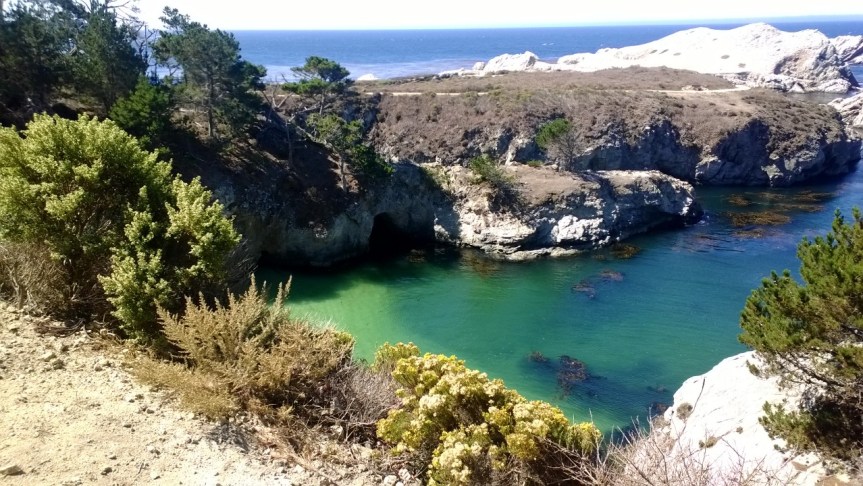
A significant variable to the calming effect of this photograph is due in part to the long walk it takes to get here. This is part of the coastline of California’s Monterey Peninsula, in an area known as Point Lobos, which is three miles south of Carmel-by-the-Sea. You see it all in this natural habitat: tide pools, sea lions, sea otters, grey whales, dolphins, divers, and all things aquatic. There are hundreds of acres of forest on the point replete with walking trails amidst cypress and pines, where you can see deer, foxes, rabbits, coyotes, bobcats, and all creatures great and small. The sheer magnitude and silence of the area is awe-inspiring, and this area has been a haven for painters, poets, writers, and nature lovers since the beginning of time. And the Pacific Ocean has a specific personality; there is a feel to it that differs from the Atlantic: whereas the Atlantic is heavy, histrionic, metal-gray and brooding, the Pacific is light and clear and dancing, with shades of emerald and aqua blue that are so unique, they seem God ordained. If you can imagine walking beside a scene such as this for hours, it will give you the reason why I chose this picture for Hugh’s photo challenge depicting the feeling of calm.