Review: Rebecca by Daphne Du Maurier

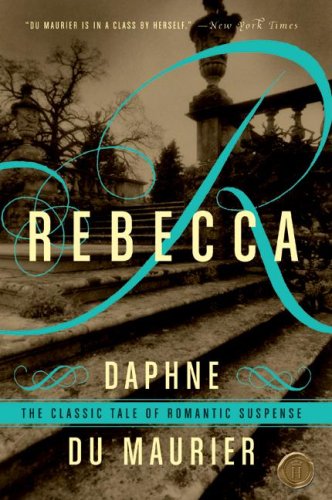
Rebecca


I’ve always been an admirer of the first person narrative. When handled deftly, it magnifies the complex variables that comprise us all. Rebecca is a psychological treatise with a confessional tone spawned from the narrator’s perception, and this is the story. That the narrator is young, inexperienced, and overwhelmed to the point of skittishness sets the dark tone of every paragraph in this cleverly paced mystery. Her vantage point is solidly built on assumption, suspicion and crippling self doubt. The plot is a simple one: the young narrator begins as a paid, personal companion to a domineering wealthy woman, who is on holiday in Monte Carlo, when fate places her in the dining room of a luxuriant hotel next to the table of the troubled widower, Max de Winter, who hails from the Cornish Coast. An awkward and unlikely alliance develops between the narrator and the worldly Max de Winter, which leads to a hasty marriage, in which the reader learns along with the narrator of de Winters’ disturbing past. Set in the house and rambling coastal grounds of de Winters’ stately Manderley, the narrator enters a dynamic firmly in play, whose tone was cast and exists still from the hand of Rebecca: the first Mrs. de Winter. Rebecca’s shadow looms imperiously, and brings to the fore the narrator’s insecurities. Having no background story on her predecessor, the inchoate narrator is tossed by the winds of assumption, half-truths and incomplete perceptions made all the more dark by the presence of Rebecca’s loyal personal maid, Mrs. Danvers, whose presence lends a disquieting air, due to her supercilious knack for comparison. Rebecca is an off-kilter mystery that unfolds along the road of the search for truth regarding what, exactly, happened to Rebecca. That the narrator stays in suspense until the sinister end lures the reader through a story elegantly told in language so poetic, it is its own experience.

Whistlin’ Dixie

I stood at the counter of my local grocery store exchanging pleasantries with the cashier, as I am wont to do, and this time it only took twenty seconds for the nice lady to ask what I’m always asked out here in Southern California, “Where are you from? Are you from Texas?” You have to pity the poor people in California; they don’t know any better than to assume if someone has a Southern accent, they’re from Texas ( as if the state of Texas counts as a Southern state, which I say is questionable because everyone knows Texas is its own animal.)
I’m a transplanted Southerner who hails from the Mississippi Delta, and although I am now long in another region, it is no influence on the armor I wear around my Southern DNA. It is its own protective shield, a source of self-identification, and I see the world and its people through the focused lens of my Southerness, which couldn’t be more convenient, for it simplifies everything.


To continue:

Claire Fullerton: Whistlin’ Dixie

The Pat Conroy Literary Festival

Because one has to follow what has resonance in life, I wound up on a plane, crossing the country from Los Angeles to Beaufort, South Carolina. I did this because the author Pat Conroy has always been my idea of the personification of what it means to be a writer. In life, he was the embodiment of language in its highest form. Pat Conroy took this business of being human, with all its frailties, heartbreaks, and nuances, and wrestled it into art. He was strong enough, brave enough, trusting enough to share his stories, and in so doing, he gave us all the gift of options by using writing as saving grace along life’s riddled path. That he wrote in the first person spoke to me, for I knew exactly to whom I was listening. I understood Pat Conroy, cared about him, identified with his human predicament, and applauded his uncanny ability to lift himself out of his own confusion by putting his tumultuous life into words.

And so I flew to South Carolina this past weekend to attend the inaugural Pat Conroy Literary Festival, in Conroy’s beautiful, lowcountry hometown. Just last year, I’d done the same to attend the celebration around his 70th birthday, which turned out to be the smartest move I made in 2015. Meeting Pat Conroy in person and watching him navigate the throngs of peers and readers humanized the diaphanous mystery of those lofty souls set upon this earth to interpret it for the rest of us. He walked among us, humble and smiling, posing for photographs and shaking hands like an overwhelmed child, grateful and surprised that so many had turned out for his party. His sincere, wide-eyed comportment shook me to my core and stayed with me long thereafter. I was well aware at the time that I was witnessing exactly what it means to be a celebrated writer and not have it go to your head.

I will digress here to say that In March of 2016, in a crisis that blindsided the literary world, Pat Conroy died of pancreatic cancer. It was such a profound loss, with baffled legions asking how this could possibly be that the outpouring of love continues to this day. My belief is it will go on forever, for Pat was so beloved that people will always be uneasy with the metal glare of letting him go.

 And so the town of Beaufort rebounded after Pat Conroy’s death. The fact that Hurricane Matthew blew through the region the week before deterred them not one iota. They assembled en masse to rise up and fuel the fire that Pat Conroy set. The inaugural Pat Conroy Literary Festival had the same tone and tenor of Pat Conroy’s 70th birthday; it carried on for him, because of him, in honor of his name. I had a feeling this would be the case, when the festival was announced, and did not hesitate to make arrangements to attend. To not have done so after being there last year seemed unthinkable; it would have flown in the face of all things Pat, and I wanted to uphold my end.

I’m going to go on and say it: It’s liberating to be a writer without personal agenda. Six years of promoting my books, myself, and everything all about me is exhausting, and frankly goes against my nature. This is why I took a big exhale when I got to The Pat Conroy Literary Festival in Beaufort. For four days, I was in witness of writers and readers assembled for all the right reasons: love of story. We all knew that Pat Conroy was the pivotal point, yet his absence did not overshadow the celebratory spirit of the weekend. The reason why is because Pat Conroy had shown us, the year before, how to dive right in and revel in the company of those who contribute to our chosen field. There seemed no hierarchy of value in those gathered for the weekend, just the impression that we are all on the same path; some ahead, others a few paces behind. For me, it was like visiting a foreign country and discovering that everybody spoke my first language. I sat in the audience of one panel discussion after another and was invigorated and informed by what the participating authors had to share. The thing about being a writer is there is no there to get to; there is only the process of personal growth, and what is invaluable to the momentum is allowing yourself to remain a student. This is what Pat Conroy did last year, and I say this because I could feel it. I’m pretty sure he was in the audience of every event of the Pat Conroy at 70 Festival, with his pen and paper in hand, for every time I turned around, I saw him, eyes focused on the stage with glee and rapt attention. I cannot adequately articulate what watching this world-renowned author taught me, except to say that it taught me everything. It has much to do with decency and camaraderie, and the willingness to celebrate those who create through the written word.

The Pat Conroy Literary Festival was like being in a bee-hive of literary heroes.  It was a four day celebration orchestrated “for the love of words and story,” which is a phrase Pat Conroy used, whenever he signed his books.  There was something so heartwarming and ceremonious about the entire weekend. It was a literary festival put on by those who loved Pat Conroy for those who loved Pat Conroy, and the overall feeling was that the celebration will never end.   


Book Review: Serena by Ron Rash

2815590


It is the slightly off-kilter, dark tone of this book that mesmerizes. Set in the year 1929, in the North Carolina mountains, George Pemberton arrives on a train from Boston with his cultured new wife, Serena. It is a rough-hewn, brass tacks timber camp dedicated to clearing the region of its trees for financial gain that Serena enters and assumes control. The daughter of a timber man from Colorado, Serena knows the business better than most men, and uses her wits and wiles to manipulate affairs to her liking as she plots to expand the business. With a mysterious background to her credit, both George and the reader come to know Serena through her ruthless, self-serving dealings; nothing is beneath her pursuit of expansion: no morals, ethics, nor even the law. In short order, George Pemberton becomes a man caught in a web, yet is so enamored of his wife, he is willing to go along as events spin out of his control and lead to the ultimate betrayal. This is the fifth book I have read by the author, Ron Rash, and I find his voice unlike any other. Ron Rash is a writer gifted with the poetics of economy. His settings exist in society’s underworld, which he compliments through the use of  language so pitch perfect in regional colloquialism it gives you the characters background and explains their individual mind-set.  Ron Rash’s Serena is a villain for the ages; she is canny, single-minded, attractive, and dangerous. This bone-chilling story is both  gripping and blind-siding. It is another fine example of Ron Rash’s deft handling of the darker notes of self-preservation at any cost.

A Southern Voice

A Southern Voice

The first voice to caress my infant ears rolled with such lyrical beauty that I’m offended by other accents to this day. It soothed in its quicksilver fluidity, lacked hard edges, and whispered in promises so compelling it could turn the most resistant of souls into a willing adherent. I know now that sound travels queerly and can double back upon itself in time. I often hear the voice of my Southern mother when I least expect it; it comes to me more as reminder than recollection, and carries a way of being in the world along a template so firmly etched that its resonance is guiding and indelible.

For Complete Piece:

Claire Fullerton: A Southern Voice

The Risen by Ron Rash:Book Review

The Risen


This is, yet again, another gripping Ron Rash novel.  Upon reflection, what stays with me most is that the premise of The Risen is tight and simple. Two brothers, in a small North Carolina town, are swimming in a creek in the summer of 1969 and meet a seventeen year old girl, an outsider who impacts their lives. But Ron Rash gives us a thorough psychological treatise, through the character of younger brother Eugene, on the desperation behind falling in love for the first time and the complexities of younger brother syndrome during one’s coming of age. Place is a character in this story, described in Rash’s keen vernacular, and it is the unsolved past that pulls us through this story. The reader lives in two time frames as the story unfolds, which gives us the experience of cause and effect. On the one hand, The Risen floats on the wings of the fruits of summer, on the other its tension builds through the guilt of a broken man. The Risen is a page-turning mystery with a twist, written in such a way that you can feel the guilt that haunts the two main characters’ involvement. It speaks of the repercussions of one false move that shadows lifetimes, and though the mystery may have been solved at the end, it suggests that nobody gets away with anything for long.

The Man from Derry

His name was Eoghan, and I never did catch his last name. A solid year spent with the desultory coming and going of this enigmatic man through the door of The Galway Music Center, and I came to accept him as Kieran’s friend from Derry. Kieran rarely explained himself, much less anyone attendant, and because he was the head of The Center, the rest of us were not in the habit of asking. They talked alike, Kieran and Eoghan, but half of the time I couldn’t discern what they were saying. In each other’s company, neither enunciated; they’d slip into a flat, guttural diction that lacked the singing high notes of the west of Ireland’s accent, and I confess it took too much effort to attune my ear to their patois. On Kieran’s lips, the name Eoghan was levelled to the convenience of “Own.” I figured it was a linguistic vortex from there, so I settled with gathering the essence.

Eoghan was older than the rest of us by a good 10 years, but this wasn’t what gave him his arresting gravitas. He had a way of standing that meant business: feet planted, weight centered, eyes with an unambiguous stare. And although I’m an innocuous little thing in stature, no threat to anybody in any conceivable way, the day I met Eoghan, he took his time looking me over. There was a nerve-wracking tenor to his streetwise swagger that seemed crouched and coiled between fight and flight. Kieran once hinted that Eoghan had, and I quote, “Northern Irish connections,” but I paid it no heed because Eoghan’s blue eyes settled the score between his tough-guy countenance and his poetic mind. His eyes were the color of liquid innocence, round and clear and all-knowing; the kind of eyes that saw between layers; the kind of eyes you knew you could trust.

And so it evolved that on a windswept, December’s Saturday, I took the bus into Galway and followed the directions Eoghan had given me to Scoil Lan-Ghaeilge. It was there I found him in the back of the room, wearing a Santa Claus costume and speaking to a passel of fresh-faced children in the Irish language, while a pack of smiling mothers stood by, cameras in hand. It was a scene so incongruous to everything I knew of Eoghan that I had to study it for a moment because he’d never bothered to tell me he taught the Irish language in his spare time. It turned out this was just the beginning of Eoghan’s love for all things Irish. He took a warrior’s pride in his country and possessed a knowledge so deep in its history you would have thought he’d been personally involved at every turn of Ireland’s storied past. Which is why he took it upon himself to invite me to the gentle fields of Oughterard, on the shores of Lough Corrib. He hadn’t divulged our destination; he simply told me to get in his blue Honda Civic, then sped out of Galway on the Headford Road. Twenty six cork-screw miles and 45 minutes later, Eoghan stopped the car on an uneven dirt road. A cattle grate lay before a rusted gate with a padlock, and climbing over it, we stood at the mouth of an unkempt field.

In my mind’s eye, I can still see it: the unfathomable immensity of winter-torn acreage, its wooded grassland beaten to a faded ochre beneath an overcast sky.  The earth was sodden beneath my boots as we trudged through the unmarked expanse. Blackbirds and hawks swooped above watching; they sailed in a majestic current with the rights of jurisdiction, and I knew myself to be an interloper in this dreary landscape, where the wind pitched and rolled with a chill that touched bone. Eoghan roved forward in his loose, ambling stride. He held his head with fierce intention, his eyes on the horizon between earth and sky. It was there beyond the rise that I saw it. It rose out of the earth and spread ominously, a thunderous ancient castle, in parts without a roof. A grey stone wall stacked around the manse declaring its prominence. At one time it must have been impressive, but now shrubbery defaced the castle walls, and tangled ivy and moss ravaged through the windows. But still, she upheld her imperious grandeur. There was something queenly in her stately elegance; safe in her desolation, and validating to the soul as we walked her interior then circled her venerable grounds. You simply cannot walk grounds such as this with any amount of Irish blood in your veins without it speaking to you. Something longing and haunting descends like the call of atavistic memory. Something turns in your blood that is probably DNA. I don’t think you can be Irish without Ireland’s history being part of your personal story. I started to say something to Eoghan about this, but from the way he was looking at me, he already knew. And the thing about that day was I half expected Eoghan to hold forth in erudite commentary, but he didn’t. There are some moments so sacred they require no words, and to share them with someone creates an unnamable intimacy best not disturbed. In that moment, I knew something, though I couldn’t tell you what I knew; I just knew. I was there and experienced something ineffably integral to being of Irish descent, and from the manner of his quietude, I thought Eoghan did, too. I suspected it was why he’d brought me here, to this place without a name. It was Eoghan’s way of sharing his homeland, and I am warmed to this day by the gesture. I took the above photograph as we walked towards the castle. It’s unfortunately small and lacks the impact the structure made, but I keep it in a standing frame just the same. It doesn’t capture much of what I saw that day, yet every time I look at it, it brings to mind the most important memory: a peacock proud Irishman in love with his country, that swashbuckling Derry man named Eoghan, whom I’ll never forget.

Claire Fullerton is the author of A Portal in Time and the 2016, Readers’ Favorite award winner for cultural fiction, Dancing to an Irish Reel.

http://www.clairefullerton.com


Temple Secrets by Susan Gabriel Book Review

25010741

I’m going to try to come near stringing the adequate words together that describe how much I loved this book. I’ll cut to the chase and say it was so good, I didn’t want it to end. Temple Secrets is the kind of well crafted book that, once closed, causes you to wonder what to do next with your life. Author Susan Gabriel created a story chock-full of Southern characters and never once condescended to anything campy, rather, she infused every character with soul as they walked the wire of a story so unique as to be plausible, of character nuance so defined, you understood the underlying motivation behind every thought and deed in this electrifyingly unusual gem of common history experienced individually by players so intertwined, their lives are domino effects wrought from the hands of each other. And oh, the tone of this book: it is bluntly in your face without being offensive. Susan Gabriel writes in a direct, brass tacks voice that is howlingly funny, for all its taboo subjects, and I relished every line. The premise of Temple Secrets is this: In blue-blooded, aristocratic Savannah, where the mansions are gothic and imposing as they retain the character of days gone by, supercilious eccentric, Iris Temple, is on her last leg. For decades, she has ruled the roost of everything and everyone around her. She is one of Savannah’s inflexible old guard and proud of it to the point that she wields her power position in society like a sword. Hers is a personality so full of controlling disdain that she is feared not only by her family and staff, but by the denizens of Savannah, whose tether she keeps tight by her family’s book of secrets, which details intimate, damaging facts best not publically revealed. Iris is estranged from her full-grown daughter, looks down on her mulatto half-sister, who lives with her, and is catered to beyond reason by a handful of staff, who prefer not to stir the waters of Iris’ own self-image. It is a dynamic changer, when Iris is incapacitated by a stroke, and suffice it to say the ghosts of her past come out to haunt, literally and figuratively, which wouldn’t happen in most places, but it can and does in Savannah. In chapters detailing the individual character’s connection to Iris, the story morphs into an incestuous web you didn’t see coming. And at the heart of this story is the Temple Book of Secrets; someone has taken it upon themselves to publish part of its content, but the mystery is nobody knows who or why. It’s hard to write more at this point, without needing a spoiler alert, and I don’t want to deprive the reader of the joy to be found in this bounding story, so I will summarize by saying this novel is so engaging, so thrilling and unique that I stand beside many clamoring for a sequel!

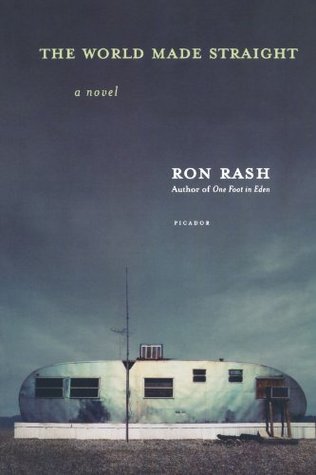
The World Made Straight by Ron Rash

44179   There’s a good reason the Atlanta Journal Constitution called Ron Rash “one of the major writers of our time.” To me, he is this and more. Ron Rash writes in a gritty, mountain vernacular that can’t be faked; one has to come from it and know it as their own voice of consciousness in order to wield it as plausibly as he. Rash’s language, therefore, is its own reasoning; it speaks of a clear-cut, hard-edged, uncompromising way of living in the world devoid of the illusion of optimism. One wonders, as they read Rash, if it is the jaded wrappings of cynicism or the unvarnished truth behind his tightly crafted novels. This is a writer who delivers the dark notes of beaten humanity in such a way that there is hope. In The World Made Straight, Travis Shelton comes from nothing, on the cusp of manhood in an unforgiving North Carolina mountain community, where drug-dealing is a viable livelihood, in this hardscrabble region with few opportunities outside of one’s own wits. It is the glimmer of something more that drives him to prove himself to his rough-hewed, hard-nosed father. Travis seeks to better himself after one fight too many; he leaves the tobacco fields on his family’s land and presents himself at the trailer of a local named Leonard, who is both drug-dealer and mentor, in that he is the only one in Travis’ sphere who, at one time, amounted to anything, though fate made it short-lived. Under Leonard’s influence, Travis pursues his high school GED, while shouldering the fall-out of the one false move he made, when he riled the shackles of local heavy-weight, Carlton Toomey, when he trespassed on his land. These are mountain characters who play by their own lawless rules, in a landscape where it’s every man for himself. In a climate still stinging from the horrors of the Civil War, the characters are born beneath the shadow of the ties that atavistically bind them, albeit through a sense of random tribal placement that haunts this story in an unfolding mystery, the impact of which the characters are not completely aware, until the looming puzzle work fits. It is a small world, in The World Made Straight, but it is universal in implication. Self-worth, justice, revenge, and hope against all odds flavors this story, which ends in notes of satisfaction and just deserves.

Eulogy for Shadow

The mornings without her are the worst, in that slip of time between the dream state and the metal glare of remembering Shadow’s not there—that she won’t be eye-level to the bed as she has been for years, drawing me impatiently from my slumber, anxious to start her day.
The world was a big, joyous place, according to Shadow, and I couldn’t help but see it through her eyes. Every morning she’d squeal and clamor as if time were wasting. There were scents outside with clues in the yard, and sticks and pine cones shaken to the ground that couldn’t wait another minute. Oh, get up, get up, she’d insist; the world awaits with endless possibilities!
I am listless in her absence. I do not want to rise from this bed. There is no comfort in this house, yet I cannot bear to walk outside where she used to play. I cannot put my shoes on without remembering how the act sent her into spinning rapture, and there is too much space around me without her underfoot.
I never knew silence could affect me physically, that it could start with a ringing in my ears then land so heavily on my heart. If I rise now, every gesture in the rhythm of my day will lack her, and every movement without purpose in this world now grown flat. I roll to my right and see her toys strewn around her fleece covered bed. I should get up and put her bear and her balls away, find some place to put that pine cone, but I can’t bring myself to disrupt her last arrangement. I want to leave everything as Shadow placed it because I still marvel at the single-mindedness with which she marked her place in the world.
I think I will lie here until her spirit comes wet-nosed to soothe me. I lack the strength to rise to a world that exists without her, and there will be no joy if her spirit does not come. I need to lie here until I remember what joy is; I’ve been too long following her lead and have forgotten how to find it on my own.
I am frozen in this bed with the thought of taking my heart back from Shadow. The prospect seems something I am incapable of, and right now I would rather lie in this pain forever than place one foot to a floor where she does not lay. She was ceaseless, constant, beautiful, unending. She came lovingly, unquestioning, every time I called her name.
Hear now, Shadow, my voice as I call you, “Here pretty girl; baby come home.”