What Price an Author’s Politics?


I don’t believe I’m the only one disenchanted with the current state of affairs on FaceBook. Rather than launching a campaign in broad strokes of generalities from a supercilious pulpit, I will keep things simple and try my best to articulate where I’m coming from as an artist, for writing, to me, is a high art.


Like legions the world over, I joined FaceBook to stay connected with many people I’d lost touch with over the years. I grew up in Memphis, which means I’m a Southerner, and Southerners are raised in packs attendant to other packs. The domino effect of this reaches into the hundreds. And I care about all my pack members, so I considered the advent of FaceBook a gift that kept me connected, now that I’m a transplanted Southerner living in California.


And then I cultivated a writing career. I, like other writers, was therefore obligated to do my share of marketing and promotion for my books, and Facebook is, perhaps, the most viable avenue to do so. In short order, my list of “friends” grew longer, and I, wanting to help my fellow writers, turned around one day to discover I was connected to unfathomable numbers of authors I would have never known otherwise. And it thrilled me. I will always be fascinated by those who create, be they a writer, musician, dancer or painter. Give me your art, says I; it softens the blow of the human experience. In my opinion, there is such beauty in this world, and it is the artist’s God-given aptitude that points this out. It has been my pleasure and honor to help promote other authors, and there is safety in numbers in this business of living, if one is lucky enough to come across others of their ilk. Like begets like, or so it seemed to me, but lately I’ve become soul-sick and heart-confused while looking at FaceBook, and I’m trying to get to the bottom of why.


I feel hoodwinked, led into the miasma of a bait and switch. I came to Facebook because of friendship and art, but now it seems I’m being held prisoner for political ransom. I know the arguments: freedom of speech, a forum for “voice,” and all the other rights people stand up for. I’m not suggesting any of this is wrong, but I do question its appropriateness. Just because one can doesn’t mean one should, and the irony for an author is pontificating politically automatically polarizes their followers. There’s no sense in not admitting this, and those that don’t might be assuming their followers completely agree with their views, yet if this is the case, then why preach to the choir?


I think authors should seriously think through posting their political view on FaceBook, and weigh it for the potential ramifications to their career. After all, the way an author shows up in the world begins with deciding how they want to be perceived. I had this question posited to me recently, when my literary agent asked me to articulate “my brand.” It’s going to matter when my next two novels come out, and currently there is wisdom in establishing and investing in my base. I’m thinking the more streamlined and specific I can be, the better.


Readers align with us for stories. Reading stories gives many suspended quarter in a hectic world. Readers don’t necessarily need to know who the person is behind the story. If an author is doing it right, their stories will speak volumes to answer the question, without detracting from the author’s mystique.


I’m not saying I long to be seen as mysterious, only that I like the idea of my stories speaking for themselves. As for who I am, I’ll let the readers decide, and willingly leave politics to the political pundits.



Whistlin’ Dixie

I stood at the counter of my local grocery store exchanging pleasantries with the cashier, as I am wont to do, and this time it only took twenty seconds for the nice lady to ask what I’m always asked out here in Southern California, “Where are you from? Are you from Texas?” You have to pity the poor people in California; they don’t know any better than to assume if someone has a Southern accent, they’re from Texas ( as if the state of Texas counts as a Southern state, which I say is questionable because everyone knows Texas is its own animal.)
I’m a transplanted Southerner who hails from the Mississippi Delta, and although I am now long in another region, it is no influence on the armor I wear around my Southern DNA. It is its own protective shield, a source of self-identification, and I see the world and its people through the focused lens of my Southerness, which couldn’t be more convenient, for it simplifies everything.


To continue:

Claire Fullerton: Whistlin’ Dixie

The Pat Conroy Literary Festival

Because one has to follow what has resonance in life, I wound up on a plane, crossing the country from Los Angeles to Beaufort, South Carolina. I did this because the author Pat Conroy has always been my idea of the personification of what it means to be a writer. In life, he was the embodiment of language in its highest form. Pat Conroy took this business of being human, with all its frailties, heartbreaks, and nuances, and wrestled it into art. He was strong enough, brave enough, trusting enough to share his stories, and in so doing, he gave us all the gift of options by using writing as saving grace along life’s riddled path. That he wrote in the first person spoke to me, for I knew exactly to whom I was listening. I understood Pat Conroy, cared about him, identified with his human predicament, and applauded his uncanny ability to lift himself out of his own confusion by putting his tumultuous life into words.

And so I flew to South Carolina this past weekend to attend the inaugural Pat Conroy Literary Festival, in Conroy’s beautiful, lowcountry hometown. Just last year, I’d done the same to attend the celebration around his 70th birthday, which turned out to be the smartest move I made in 2015. Meeting Pat Conroy in person and watching him navigate the throngs of peers and readers humanized the diaphanous mystery of those lofty souls set upon this earth to interpret it for the rest of us. He walked among us, humble and smiling, posing for photographs and shaking hands like an overwhelmed child, grateful and surprised that so many had turned out for his party. His sincere, wide-eyed comportment shook me to my core and stayed with me long thereafter. I was well aware at the time that I was witnessing exactly what it means to be a celebrated writer and not have it go to your head.

I will digress here to say that In March of 2016, in a crisis that blindsided the literary world, Pat Conroy died of pancreatic cancer. It was such a profound loss, with baffled legions asking how this could possibly be that the outpouring of love continues to this day. My belief is it will go on forever, for Pat was so beloved that people will always be uneasy with the metal glare of letting him go.

 And so the town of Beaufort rebounded after Pat Conroy’s death. The fact that Hurricane Matthew blew through the region the week before deterred them not one iota. They assembled en masse to rise up and fuel the fire that Pat Conroy set. The inaugural Pat Conroy Literary Festival had the same tone and tenor of Pat Conroy’s 70th birthday; it carried on for him, because of him, in honor of his name. I had a feeling this would be the case, when the festival was announced, and did not hesitate to make arrangements to attend. To not have done so after being there last year seemed unthinkable; it would have flown in the face of all things Pat, and I wanted to uphold my end.

I’m going to go on and say it: It’s liberating to be a writer without personal agenda. Six years of promoting my books, myself, and everything all about me is exhausting, and frankly goes against my nature. This is why I took a big exhale when I got to The Pat Conroy Literary Festival in Beaufort. For four days, I was in witness of writers and readers assembled for all the right reasons: love of story. We all knew that Pat Conroy was the pivotal point, yet his absence did not overshadow the celebratory spirit of the weekend. The reason why is because Pat Conroy had shown us, the year before, how to dive right in and revel in the company of those who contribute to our chosen field. There seemed no hierarchy of value in those gathered for the weekend, just the impression that we are all on the same path; some ahead, others a few paces behind. For me, it was like visiting a foreign country and discovering that everybody spoke my first language. I sat in the audience of one panel discussion after another and was invigorated and informed by what the participating authors had to share. The thing about being a writer is there is no there to get to; there is only the process of personal growth, and what is invaluable to the momentum is allowing yourself to remain a student. This is what Pat Conroy did last year, and I say this because I could feel it. I’m pretty sure he was in the audience of every event of the Pat Conroy at 70 Festival, with his pen and paper in hand, for every time I turned around, I saw him, eyes focused on the stage with glee and rapt attention. I cannot adequately articulate what watching this world-renowned author taught me, except to say that it taught me everything. It has much to do with decency and camaraderie, and the willingness to celebrate those who create through the written word.

The Pat Conroy Literary Festival was like being in a bee-hive of literary heroes.  It was a four day celebration orchestrated “for the love of words and story,” which is a phrase Pat Conroy used, whenever he signed his books.  There was something so heartwarming and ceremonious about the entire weekend. It was a literary festival put on by those who loved Pat Conroy for those who loved Pat Conroy, and the overall feeling was that the celebration will never end.   


A Southern Voice

A Southern Voice

The first voice to caress my infant ears rolled with such lyrical beauty that I’m offended by other accents to this day. It soothed in its quicksilver fluidity, lacked hard edges, and whispered in promises so compelling it could turn the most resistant of souls into a willing adherent. I know now that sound travels queerly and can double back upon itself in time. I often hear the voice of my Southern mother when I least expect it; it comes to me more as reminder than recollection, and carries a way of being in the world along a template so firmly etched that its resonance is guiding and indelible.

For Complete Piece:

Claire Fullerton: A Southern Voice

The Man from Derry

His name was Eoghan, and I never did catch his last name. A solid year spent with the desultory coming and going of this enigmatic man through the door of The Galway Music Center, and I came to accept him as Kieran’s friend from Derry. Kieran rarely explained himself, much less anyone attendant, and because he was the head of The Center, the rest of us were not in the habit of asking. They talked alike, Kieran and Eoghan, but half of the time I couldn’t discern what they were saying. In each other’s company, neither enunciated; they’d slip into a flat, guttural diction that lacked the singing high notes of the west of Ireland’s accent, and I confess it took too much effort to attune my ear to their patois. On Kieran’s lips, the name Eoghan was levelled to the convenience of “Own.” I figured it was a linguistic vortex from there, so I settled with gathering the essence.

Eoghan was older than the rest of us by a good 10 years, but this wasn’t what gave him his arresting gravitas. He had a way of standing that meant business: feet planted, weight centered, eyes with an unambiguous stare. And although I’m an innocuous little thing in stature, no threat to anybody in any conceivable way, the day I met Eoghan, he took his time looking me over. There was a nerve-wracking tenor to his streetwise swagger that seemed crouched and coiled between fight and flight. Kieran once hinted that Eoghan had, and I quote, “Northern Irish connections,” but I paid it no heed because Eoghan’s blue eyes settled the score between his tough-guy countenance and his poetic mind. His eyes were the color of liquid innocence, round and clear and all-knowing; the kind of eyes that saw between layers; the kind of eyes you knew you could trust.

And so it evolved that on a windswept, December’s Saturday, I took the bus into Galway and followed the directions Eoghan had given me to Scoil Lan-Ghaeilge. It was there I found him in the back of the room, wearing a Santa Claus costume and speaking to a passel of fresh-faced children in the Irish language, while a pack of smiling mothers stood by, cameras in hand. It was a scene so incongruous to everything I knew of Eoghan that I had to study it for a moment because he’d never bothered to tell me he taught the Irish language in his spare time. It turned out this was just the beginning of Eoghan’s love for all things Irish. He took a warrior’s pride in his country and possessed a knowledge so deep in its history you would have thought he’d been personally involved at every turn of Ireland’s storied past. Which is why he took it upon himself to invite me to the gentle fields of Oughterard, on the shores of Lough Corrib. He hadn’t divulged our destination; he simply told me to get in his blue Honda Civic, then sped out of Galway on the Headford Road. Twenty six cork-screw miles and 45 minutes later, Eoghan stopped the car on an uneven dirt road. A cattle grate lay before a rusted gate with a padlock, and climbing over it, we stood at the mouth of an unkempt field.

In my mind’s eye, I can still see it: the unfathomable immensity of winter-torn acreage, its wooded grassland beaten to a faded ochre beneath an overcast sky.  The earth was sodden beneath my boots as we trudged through the unmarked expanse. Blackbirds and hawks swooped above watching; they sailed in a majestic current with the rights of jurisdiction, and I knew myself to be an interloper in this dreary landscape, where the wind pitched and rolled with a chill that touched bone. Eoghan roved forward in his loose, ambling stride. He held his head with fierce intention, his eyes on the horizon between earth and sky. It was there beyond the rise that I saw it. It rose out of the earth and spread ominously, a thunderous ancient castle, in parts without a roof. A grey stone wall stacked around the manse declaring its prominence. At one time it must have been impressive, but now shrubbery defaced the castle walls, and tangled ivy and moss ravaged through the windows. But still, she upheld her imperious grandeur. There was something queenly in her stately elegance; safe in her desolation, and validating to the soul as we walked her interior then circled her venerable grounds. You simply cannot walk grounds such as this with any amount of Irish blood in your veins without it speaking to you. Something longing and haunting descends like the call of atavistic memory. Something turns in your blood that is probably DNA. I don’t think you can be Irish without Ireland’s history being part of your personal story. I started to say something to Eoghan about this, but from the way he was looking at me, he already knew. And the thing about that day was I half expected Eoghan to hold forth in erudite commentary, but he didn’t. There are some moments so sacred they require no words, and to share them with someone creates an unnamable intimacy best not disturbed. In that moment, I knew something, though I couldn’t tell you what I knew; I just knew. I was there and experienced something ineffably integral to being of Irish descent, and from the manner of his quietude, I thought Eoghan did, too. I suspected it was why he’d brought me here, to this place without a name. It was Eoghan’s way of sharing his homeland, and I am warmed to this day by the gesture. I took the above photograph as we walked towards the castle. It’s unfortunately small and lacks the impact the structure made, but I keep it in a standing frame just the same. It doesn’t capture much of what I saw that day, yet every time I look at it, it brings to mind the most important memory: a peacock proud Irishman in love with his country, that swashbuckling Derry man named Eoghan, whom I’ll never forget.

Claire Fullerton is the author of A Portal in Time and the 2016, Readers’ Favorite award winner for cultural fiction, Dancing to an Irish Reel.

http://www.clairefullerton.com


Eulogy for Shadow

The mornings without her are the worst, in that slip of time between the dream state and the metal glare of remembering Shadow’s not there—that she won’t be eye-level to the bed as she has been for years, drawing me impatiently from my slumber, anxious to start her day.
The world was a big, joyous place, according to Shadow, and I couldn’t help but see it through her eyes. Every morning she’d squeal and clamor as if time were wasting. There were scents outside with clues in the yard, and sticks and pine cones shaken to the ground that couldn’t wait another minute. Oh, get up, get up, she’d insist; the world awaits with endless possibilities!
I am listless in her absence. I do not want to rise from this bed. There is no comfort in this house, yet I cannot bear to walk outside where she used to play. I cannot put my shoes on without remembering how the act sent her into spinning rapture, and there is too much space around me without her underfoot.
I never knew silence could affect me physically, that it could start with a ringing in my ears then land so heavily on my heart. If I rise now, every gesture in the rhythm of my day will lack her, and every movement without purpose in this world now grown flat. I roll to my right and see her toys strewn around her fleece covered bed. I should get up and put her bear and her balls away, find some place to put that pine cone, but I can’t bring myself to disrupt her last arrangement. I want to leave everything as Shadow placed it because I still marvel at the single-mindedness with which she marked her place in the world.
I think I will lie here until her spirit comes wet-nosed to soothe me. I lack the strength to rise to a world that exists without her, and there will be no joy if her spirit does not come. I need to lie here until I remember what joy is; I’ve been too long following her lead and have forgotten how to find it on my own.
I am frozen in this bed with the thought of taking my heart back from Shadow. The prospect seems something I am incapable of, and right now I would rather lie in this pain forever than place one foot to a floor where she does not lay. She was ceaseless, constant, beautiful, unending. She came lovingly, unquestioning, every time I called her name.
Hear now, Shadow, my voice as I call you, “Here pretty girl; baby come home.”

The Journey

I’m partial to the west coast of Ireland for its myriad wonders, which appear in small towns that are hidden like gemstones in neat grids of logic separated by rambling, idle roads. There are worlds within worlds in these Irish small towns: history and lineage and myth and folklore; meaning so resonate and full of discovery the very act of rounding a corner can haunt a person to the bone marrow. I’m a firm believer that the way to the soul of a place is best found on foot; it’s easier to raise your antennae to the uncanny when your feet are grounded, and this is just what I was thinking as I navigated the sidewalk in Kinvara, down to the docks on the water’s edge. There across the bay, deep on the horizon, County Galway stretched in all its heavenly promise. The next day, we’d be driving our rented car the forty five minutes it takes to get to Galway City, but for now there was the lure of County Clare in the opposite direction. My friend and I had decided to make a day of it; we’d make our way slowly to the Cliffs of Moher, for no other reason than it seemed the thing to do, and we’d park the car and explore wherever the fancy struck, along the forty nine kilometer route it takes to get to what seems the edge of the known world.

In the town of Kinvara, life teemed around us in all its natural rhythm: pub doors opened to the early fall sunlight, children roamed the streets in navy blue school uniforms, in pairs and in packs. A man ahead walked two border collies off-leash; they tacked side to side, noses sniffing, rounding back to me for a pet. Up from the docks, as the sidewalk rode the incline, art galleries and shops with T-shirts in their glass fronts reading “I’m a Galway Hooker” beckoned in praise of the town’s claim to fame. In the village center café, two men played vocal one-upmanship in guttural accents that dripped soggy with Guinness. We’d parked the car earlier, across from Dunghaire Castle; we’d already gone a few rounds with our cameras as we stood in the driveway of the accessible fortress, rising from a knoll abutted by water so tranquil it took calisthenics to consider who thought what, when positioning it just so.

Through the burren, we might have been on the other side of the moon, for all its otherworldly weariness. Though I’d read much of what has been written of the area, I’d never seen it, and its gray desperation felt so inhospitable as to be hospitable, so repellant as to be attractive, so world without end, amen. In the carpark of Poulnabrone dolmen, a disheveled man stood bearded behind a card table selling his jewelry. Were it not for the distraction of the couple behind us, my friend and I would probably still be standing there listening to this proud Irishman wax erudite rhapsody on the dolmen’s history and why we had to have one of his handmade commemorative pieces for ourselves. Up the windswept tor, we took turns standing in front of the dolmen while the other took a picture, until the couple behind us snapped us together, freezing us in a time where I can still feel the wind in my hair, the rock beneath my feet, the magic in the air.

Down from the burren, on the road to Doolin, an unmarked tower called my name, and I mean this literally. Were my mother alive, God rest her, she’d tell you she named me after her mother, Claire Crossan, whose family hailed from County Clare. But what she wouldn’t tell you is why she nick-named me Doona, and my thought has always been she thought Claire was too unwieldy, until I reached a certain age. When pressed, which I did repeatedly, my mother only confessed to making up a baby rhyme with the name Doona, which somehow became my moniker. But my mother was a dyed in the wool American Southerner, which is a breed of cat not in the habit of explaining themselves, ever. So you can imagine the enlightenment and sense of inevitability that descended in a road-side shop later, after we’d stopped the car and traipsed the hillside, coastal property of that crowned tower, which loomed sentry behind a walled enclosure overlooking Doolin Point. There on an aluminum stand beside the cash register, postcards of Doonagore Castle rested at eye-level. My friend took one in hand and said, “You’re not going to believe this.” We turned over the uncanniness, all the way to Lisdoonvarna then into Doolin, where the road flowed to a gray-stone bridge over water, and signs on hand-painted easels announced which traditional musicians would be playing that night, in one of the pastel colored thatched pubs that stand sandwiched together like ducks in a row set in an Irish Disneyland. Walking down the street, there wasn’t a soul who didn’t make eye-contact and extend a “hi-ya,” for such is the way of it on Ireland’s western shore. One aproned woman swept the sidewalk in front of a restaurant and called out, “If you’re on your way to the Cliffs of Moher, you’d be wanting to get a move on. The wind’s rising now; you’ll be wanting to beat it.” “Forewarned is forearmed,” I said to my friend. We got back in the car and went on our way, but it wasn’t without its obstruction. On the side of the road, in front of a cream colored house, an elderly, yellow retriever lumbered perilously close to the traffic. It took a few blinks for me to register that it wore a long linked chain, tethered to a post too close to the road. I pulled the car in the resident driveway, assessed the problem and knocked on the house door. When no joy came, I called the dog to me and wrapped its leash around the front door, spied a water bowl on the front porch, found a yard hose, and filled the bowl with water.

It was late in the afternoon, by the time we reached the Cliffs of Moher. We climbed the steep, paved road from the carpark to the visitor’s center, took an obligatory circle around inside then out to O’Brien’s Tower, from which we gazed south and stood in awe-struck wonder, for nothing prepares you for the sheer scale of size, nor the towering majesty of this world’s natural wonder.

“I’m never getting over this,” my friend said. ‘I can’t believe I’m standing here.”

“I can’t either,” I said, “though it occurs to me today has been just as much about the journey as it has been the end.”

For more Irish Stories: http://www.clairefullerton.com
“Dancing Companion.”
 

An Irish Lagnaippe

In Louisiana, they use the phonetically pleasing word lagniappe to denote a little something extra. Typically, a lagniappe is a small gift given with a purchase to a customer, by way of compliment or for good measure as a way of saying thank you. I’ve been so enamored with this word that it’s found its way into my psyche and influenced my behavior, where it prompts me to go the extra mile, when in deep gratitude. And deep gratitude I have for those generous souls who have posted reviews, written me, and recommended my second novel, Dancing to an Irish Reel. Some have done as I suspected; they’ve written me to ask how much of the book is true, for I made no secret in sharing that I actually lived on the western coast of Ireland, where the book is set, and most readers know that writers pull from their own life to one degree or another.

I’m a fan of the first person essay. I consider it the art of brevity whose aspiration is to create a whole world around a case in point. I could wax loquacious on how the pursuit thrills me, how the challenge ignites the deep-seated, smoldering embers of why I write in the first place, which is to say I experience life as a witness and write to decipher its nuances in a manner that seeks to compare notes.

Sometimes life itself will hand you a lagniappe when you’re not looking. This was the case for me when I came across the Irish on-line community, The Wild Geese. There lies a compatible fraternity of like-minded souls, who can never get enough of their favorite subject, which is themselves. Proudly, I say, I am one of them; I am one of the island folk by lineage, and I flew into formation the second I found the flock. I brought much of who I am to this union: a writer, a shanachie, a child of Eire. I started writing the stories behind the stories that were my inspiration in the crafting of Dancing to an Irish Reel and as time stretched on, I realized I’d created my own lagniappe to give to those who read my book.


On my website http://www.clairefullerton.com/, there are three tabs on the homepage titled “Dancing Companion,” where a collection of my first person Irish essays can be found along with attended photographs.


Please accept them as my lagniappe!


Magic Moments with Pat Conroy

I had a few magic encounters that can only be described as “Pat moments” at the 2015 “Pat Conroy at 70” celebration” in Beaufort, South Carolina. And there I was a complete stranger to Pat, but by the end of the three day festival, you wouldn’t have thought this. Sometimes in life you just flat connect with someone through mysterious forces, and when you do, it feels something like recognition. I felt this way the first time I locked eyes with Pat Conroy, and although I was decidedly star-struck, he wasn’t having any of it.

I was late to the screening of “The Great Santini.” Most everyone was seated in the auditorium, and the film was set to begin any minute. I rushed into the scantily populated lobby of the USCB’s Center for the Arts, flustered and apologetic to the nice woman behind the table, who took my name and handed me my event tickets for the following two days. As I turned to head for the auditorium, there was Pat, wearing a red t-shirt, a big smile, and walking straight towards me. His face was aglow with child-like delight and his blue eyes beamed with the kind of enthusiasm you’d jump to upon spotting a friend. Now, mind you, I’d rushed to the conference all the way from California, and in that moment I had yet to find my bearings. I’d hoped at some point during the conference I’d be lucky enough to exchange a few words with Pat, get it off my chest how much his writing affects me, tell him that he’d singlehandedly shown me what is possible with the written word, and illustrate his impact upon me by saying if I were a musician, he’d be my Mick Jagger. I didn’t expect to walk through the door and find him there like a one man welcoming committee. In that destabilizing moment that caught me off-guard, I was so startled to see my literary hero in the flesh that my text book Southern manners flew out the window and speech completely failed me. So I did what anybody would do: I looked Pat Conroy straight in his Irish eyes and said, “I love you.” To which he threw back his head and laughed.

“I flew all the way from California to see you, “I gushed, and without skipping a beat, Pat said, “You’re crazy,” to which I replied, “I know.”

“My daughter lives in California, let me go get her,” Pat said, then he walked away and returned with his daughter, Megan. As Megan and I stood talking about California, Pat sauntered off then reappeared with his brother, Tim. I couldn’t tell you now if Tim wondered who I was or why Pat found me worthy of introduction, but all three Conroy’s stood friendly and smiling, as if they were legitimately thrilled to see me.

“Let me ask you something,” Pat said. He spoke haltingly, searchingly, as if he were thinking something through, though he gave me a look that shot straight through me as if willing the power of his steady gaze to sear something into me. “Can you remember this street address? I want you to come over to the house for a drink or something.”

“When?” I said. It was all I could think to ask.

“Sometime during all this,” he said, waving his hand. “Whenever there’s downtime,” he said, as if it’d be obvious, as if I’d know when there’d be a lull in the conference and could just mosey on over to find him lounging around.

“Oh, wait, they’re telling me it’s time to go in,” Pat said, “Let’s go.” I trailed behind Pat into the auditorium, and when the room rose to its feet in reverence at the sight of him, I ducked discretely out of the way and made for the auditorium’s back row, dumbfounded and lit by the fire of Pat’s personal attention.

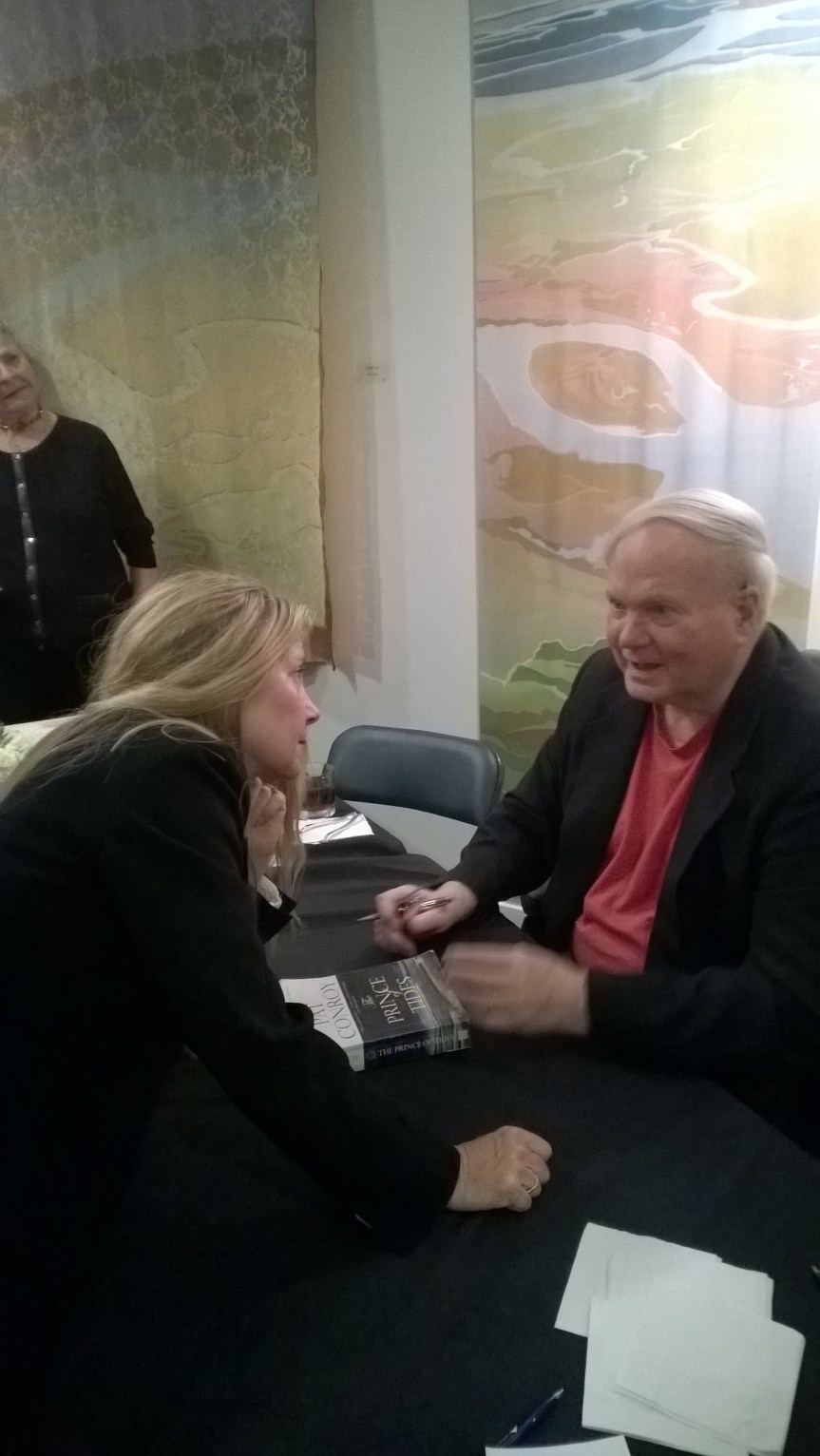
Another of my “Pat moments” occurred while standing in line, holding my copy of “The Prince of Tides” in the creeping queue that snaked along in slow motion. Nobody seemed to mind that it took forever to reach Pat; we were all so animated to be in his jurisdiction, we didn’t begrudge a soul their moment in his sun. The air was charged with Pat fever. We were a chatting, laughing, fraternizing assembly linked by a warm inner knowing that we were all members of a secret society, waiting our turn for a moment in Pat Conroy’s sphere of luminosity. Eventually, the line progressed, and I got within clear sight of Pat. There were only three people ahead of me when I spied a regal, chestnut haired woman rounding the banquet table to stand beside him. She held a drink in her hand as she leaned down to say something, and I saw Pat rear back in blindsided astonishment at her appearance. His face flushed adolescent pink, there was glee in his smile and joy in his eyes, which cast around excitedly as if looking for someone to say something to, and I knew in that moment Pat Conroy was bursting with story. I looked around to see if anyone else was paying attention then leaned forward to say, “What is it, Pat?” and he spilled forth with, “You’re not going to believe this story!”

Never before have I been a more willing audience than I was as Pat launched into his story, which was a humorous take on unrequited love.

“Twenty five letters I wrote to this woman when I was in college, and not once, not once did she ever respond,” he shared, as the object of this story shook her head and protested. It was then I pulled out my camera. I ran into her much later, at the catered party the festival had on the last night of the weekend. Her name was Terry, and she felt moved to straighten me out with the facts.

“Already he could write better than anyone else, how in the world could I ever respond?” she insisted.

My Pat moments didn’t end there, nowhere near it. During what turned out to be a three-day love fest in honor of Pat Conroy, it seemed every time I turned around, he was there exuberant and smiling. We were friends now and he wanted my story; he wanted to know what I thought about the poetry panel, and he told me the panel discussions by the authors of “Story River Books” would be right up my alley. And they were, and it all was. Every moment of each day during the “Pat Conroy at 70” celebration was a gift that keeps on giving for many reasons, but mostly because of my magic moments with Pat.

I understand the USC Press and the USCB Center for the Arts will hold its first annual literary conference this October in honor of Pat Conroy, where his spirit, no doubt, will be hovering. To this I have one thing to say:

I’m looking forward.

An Irish Story, “The Goat”

As it appears on The Wild Geese!