All Night and All Day: an Anthology on Life, Death & Angels.

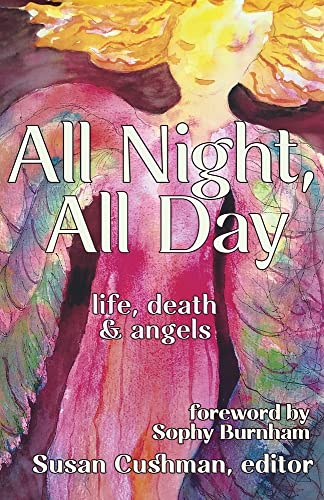
Author and editor Susan Cushman of Memphis Tennesse had a wonderful idea, and made a call out to some of her literary friends to ask if they would contribute to an anthology on the subject of life, death and angels. Susan wanted to read our stories, and assemble them in the book whose cover you see above. The anthology was just released by Madville Publishing, and it’s available where all books are sold.

It was my pleasure to contribute an essay to the anthology, All Night, All Day. My essay is titled, The Power of Three, and in it I tell the story of meeting the author, Anne Patchett, who, along with two of her friends, arranged for the first art exhibit of their friend, Sooki Raphael’s work. The art show was at Santa Monica, California’s Bergamot Station, and its staging was an act of love by Ann Patchett and her two friends, for at the time, Sooki Raphael was battling the pancreatic cancer to which she would ultimately succumb. Sooki Raphael’s art show was extraordinary, but what impressed me most about going to Bergamot Station that day was being in witness of the supportive power of female friendship.

The anthology is an inspirational collection of personal essays, stories, and poems by outstanding women authors who write about the appearance of the divine in their lives. Some of these angels come to save a life or change a flat tire. Some appear to warn people, tell them what to do, suggest more vegetables and maybe better shoes. They appear as a tap of intuition, a whisper, a whoosh of warmth, a rainbow, or an act of kindness. They are the stranger ministering to you in the hospital, the sound of voices singing in the attic, the sudden light at the window, the man by the side of the road. They are nurses and sometimes they are you. In this stunning anthology which explores so many heartwarming brushes with celestial beings, all these angels are messengers come to assure us we are not alone, and we are loved.-Margaret McMullan, author of Where the Angels Lived

___________________________________________________________________

… an anthology to be savored. This collection includes powerful first-hand accounts, interwoven with short fiction and poetry, beautifully exploring the themes of life, death, and angels. Jewels include Cassandra King Conroy’s unforgettable tale. It takes courage to write the raw truth of last moments, as Renea Winchester did in her touching story of her mother’s death titled “Waiting for Her Angel.” I loved Mandy Haynes’ heartwarming story, “Rose’s Angel” (plus, she’s a lovely person!). “The End” by Lisa Gornick is an intimate, touching tale. I shed tears over Susan Cushman’s “Hitting the Wall.” Within this collection are remembrances and memorials, which pay homage to a loved one or to a mystical experience. At the end, Claire Fullerton’s beautiful, final words offer the hope of peace. Crafting an anthology is an art. Susan Cushman has done a big topic justice-the sum of the parts is greater for having been compiled together. Savor this book…for its wisdom, humor, and truth.-Carol Van Den Hende, author of Orchid Blooming and Goodbye, Orchid

___________________________________________________________________

Stories that evoke a sense of peace, reassurance, and safety, as well as strength and encouragement through reported angelic activities. These stories tell of unexpected humanity and love in the lives of those who needed affirmation of spirituality in the human world. The presence of angels is recounted through brilliant and descriptive imagery and intriguing yet identifiable characterization.-Francine Rodriguez, author of A Woman’s Story

___________________________________________________________________

Life, death, and angel stories are usually only shared with those whom we trust and only during the quiet hours of our souls. Susan Cushman is the finder and sharer of these stories…. She has collected a wide spectrum of authors and encouraged them to contribute their personal stories and poems, thereby giving us a glimpse into their souls and the unspoken truths of our universal beliefs.-Donna Keel Armer, author of Solo in Salento: A Memoir

Here is a recent photograph of the tireless Susan Cushman at Lemuria Books in Jackson, Mississippi as she moderates a panel of contributors to All Night and All Day before a full house of readers!

All Night and All Day is a heartwarming collection of first person essays written by a collective of authors who have wonderful stories to tell. It’s general tone is sensitive and optimistic, deep-probing and thoughtful, and I know you’ll enjoy reading each and every essay as much as I have!
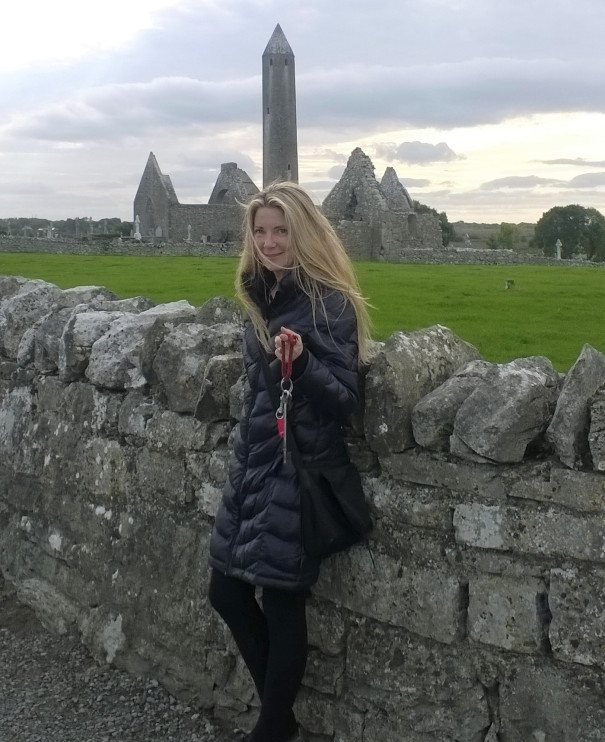
Irish Keys


I’ve had many people ask me about a certain picture on my website, where I’m standing against a gray stone wall on a windswept day in the middle of an Irish field, with what are obviously the ruins of a monastery behind me. Observant people have thought, “Wait, there’s a ruined monastery behind her, why is her back turned as she looks into the camera, holding a set of keys in her hand as if it were the bigger focal point?” I’m glad for the opportunity to explain that picture here.

We kind of knew where we were heading, my friend Tama and I, and by this I mean we had a loose plan with regard to how we were going to spend the afternoon in Gort, Ireland. We’d been freewheeling across the countryside in a rented car the size of a matchbox,  its steering wheel on the right side while we drove on the left of the two-lane road as if trying to best a test for dyslexia.
Tama is a devout Catholic, who has a thing about historic churches, which is why we couldn’t have adhered to a plan had we made one. “Stop,” Tama would shout each time we spied one of the dim, ominous structures in the distance. We’d scratch the gravel driveway and wander inside, our solitary footsteps crossing the marble floor in a tread lightly and humble yourself echo off the cavernous vaulted ceiling. We did this so many times that after yet another sweep inside a church, I’d leave Tama to light a red votive candle and fall to her pious knees while I wandered the graveyards and read the tombstone inscriptions thinking about impermanence;  knowing I was passing through in more ways than one.

I thought I was alone in the graveyard when a voice sailed from behind me. “Have you found your way to Kilmacduagh monastery?” it queried. I turned to find a young woman taking in my outlander attire of all-weather jacket and rubber-soled shoes. “It’s just up the road there,” she pointed. “You’ll want to knock on the door of the middle house across the road and ask Lily for the keys.”
I was standing behind Tama when she knocked on the front door of a low slung house on a sparsely populated lane. Across the lane, placid fields of damp clover shimmered in the afternoon mist as far as the eye could see. On one verdant field, a series of interspersed ruins jutted in damp metal-gray; some without roofs, some with wrought-iron gates, one in particular beside a towering stone spire with two windows cut in vertical slashes above a narrow door.  When the front door opened, a pair of blue water eyes gave us the once over with a suspicious, “Yes?”

“Are you Lily?” Tama asked.

“I am,” the woman stated.

“We’re here for the keys,” Tama said.

“The keys, is it? Just a moment there,” Lily said, and after she closed the door, Tama and I stood on the doorstep wordlessly, waiting for the next thing to happen.  Seconds later, the door opened and Lily handed us a set of long metal keys. “Just slip them through the door slot when you’re through,” she said with a quick nod and closed the door.

There was no indication of which key went to what, among the cluster of gates and doors throughout the 7th-century monastery called Kilmacduagh, but after enough scrambling, we figured it out. I was so tickled over being given the keys that I couldn’t get over it. “Is this weird?” I said to Tama. “We could be anybody. It feels like we’ve been given the keys to the kingdom without being vetted. It’s not that there’s anything anybody could steal, but that’s not the point.

I could wax rhapsody over the hours we spent unlocking gates,  pushing through doors and climbing the ruins of the eerie, hallowed grounds, but that’s not my point either. My point is that’s Ireland for you: a stranger offering directions without being asked, Lily handing over the keys like an afterthought, and Tama and I trolling the grounds of historic, sacred space when nobody else was around.

A German couple appeared as we made our way back up the lane. They looked at us wide-eyed and queried, “What is this place?”

“It’s a 7th century monastery,” I said, “here, take these keys and slip them through Lily’s door when you’re through.”


Claire Fullerton is the author of Dancing to an Irish Reel, A Portal in Time, Mourning Dove, and coming May 1st, Litle Tea.

https://www.clairefullerton


Malibu Burning: Nonfiction book review

47975600. sy475
I’m sharing my book review here of the wildly popular book, Malibu Burning: the real-life Story Behind LA’s Most Devastating Wildfire. This book is making waves in my seaside, hometown.
I live in Malibu, and this time last year, my husband and I, our two German shepherds and our 15-year-old black cat evacuated in haste, when the Woolsey Fire, which started in Thousand Oaks, California, traveled through the Santa Monica Mountains behind our house and reached the ridge of our property. In frantic urgency, we turned left on the Pacific Coast Highway and headed north, away from Malibu’s town center. It was here we discovered that the 320 acres of the state park near our home were violently up in flames. We were evacuated for 24 days, the first four of which we had no information as to whether our house was standing. It was total chaos in Malibu. The small coastal town was overwhelmed and ill-prepared for a wildfire of such swift, epic proportions. In some ways, it was every man for himself. In others, it was the ultimate exercise of a heroic feat as neighbor helped neighbor.
Once they allowed Malibu’s anxious and traumatized citizens back to their homes to assess the fallout, locals assembled at relief centers, sharing their stories. Among them, writer Robert Kerbeck, who took it upon himself to do a bit of investigative reporting as to how the fire started, then set about the business of collecting the first-person stories of many who refused evacuation orders and remained in the thick of the heinous drama in an effort at protecting their neighborhood.
The stories in Malibu Burning are staggering. Malibu local, Robert Kerbeck, has done a magnificent job in writing this book and getting it published in such a short span of time. Many in Malibu were so independently blindsided, there was little way of telling what went on behind our backs. We now have a larger story.
Book Review:


When tragedy engulfs a community, the media report the overarching highlights, typically from an aerial view. In Malibu Burning, author Robert Kerbeck portrays the hidden story—the nuanced blow-by-blow minutia told with such investigative reporting skills as to lend immediate urgency with a sense of present tense. It can’t be easy to shake oneself off and get organized, after surviving what can only be called the surreal worst, which is what Kerbeck basically did in writing this riveting book. Malibu Burning is a boots-on-the-ground story; an impassioned order from chaos, cohesive treatise told with a clear-eyed, objective voice. Weaving facts with vivid personal accounts in this cause and effect human interest story, this is a book so well-wrought as to hold one’s attention with all the characteristics of a gripping novel. It takes a deft hand to avoid judgment or accusation in a painstakingly researched nonfiction book. Robert Kerbeck’s Malibu Burning is a book with a resonating heartbeat. It sobers by threading the true stories of Malibu’s citizens who navigated the devastating Woolsey wildfire and simultaneously warms the heart by depicting the power of spirit.

Malibu Burning by Robert Kerbeck is available at independent book stores and all online book outlets.


https://www.clairefullerton.com


News from the Malibu Frontlines

Good Morning from Malibu:

I imagine most of you are aware of the Southern California fires. As of mid-day yesterday, all’s quiet on the western front, though last night around 10:30, my husband looked online to discover there were fires in an agricultural area named Somis, where the lion share of Sunkist lemons and Haas avocados are grown, twenty-some-odd minutes from where I live. Somis is a gorgeous area, and one we go to every so often because of the bountiful, road-side produce stands that defy description and the multitude of serene walking areas. To think of it now in flames breaks my heart.

To a greater or lesser degree, the Santa Ana winds are predictable. They come from the desert and blow to the ocean every year around this time, in hot, erratic gusts like the demonic breath of the hounds of hell. Typically, the Santa Ana winds go on for two days or so, maybe cease for a week or two before they rise up again. Those of us in Malibu are used to the cyclical occurrence, but this go-round was different—it was a stressful 5 days of living in the center of the great unknown. I can best liken the feeling to severe airplane turbulence: one never knows when or how it will end. It’s been the nerve-wracking unpredictability that kept me white-knuckled and gripping onto my own brand of blind faith. And because we live in a glass house on a 60-foot rise facing the ocean, we’re smack in the middle of the Santa Ana wind’s course. It being just after the summer drought and the terrain so tinder-brittle, all I’ve been thinking for the past few days is conditions are the right fodder for a serious fire.

But we’re ones that take brush-clearance seriously. There’s nary a tree close to our house save for two we’re well aware shouldn’t be where they are, but the need for shade in certain areas overrode logic. The trees are a mature nineteen years old now, and the simple truth is I haven’t the heart to remove them. Our scrupulous brush clearance worked in our favor this time last year. We share a property line with a wooded State Park that housed 320 acres of indigenous trees and shrubbery and who knew what all—we were never quite sure because the acreage was so dense. You might have noticed I used the past tense, there. Last November, the Malibu fires burned down the entire state park, raged to our yard’s lower slope, took out 12 pine trees along with our front gate’s electrical system then literally stopped in its path because the summer drought rendered the ground so barren. This explains why the fire never touched our house. Many Malibu friends were not as lucky. The 2018 Woolsey fire started in an area separated from our property by the foothills of the Santa Monica mountains. The area is called Thousand Oaks, and between Thousand Oaks and Malibu is a canyon area called Calabasas, resplendent with houses, for all its hilly, wooded area boasting serpentine vineyards and ocean views. When I heard on the news that the fires were in Thousand Oaks, I knew in my bones that the mountain passes of Kannan Dume Road and Malibu Canyon would go up like a torch, and they did. When my premonition manifest, it was on the ridge behind our house, as we evacuated for what turned out to be 24 days, in an adrenalin fueled flight of terror.

You can probably imagine why the past 5 days have been nerve-wracking. For me, it hasn’t been so much about the unknown as it has been the known. I’d fancied myself above PTSD. I was wrong. I’ve rattled around my glasshouse watching the news and looking for where I just put my hat. It’s been like living in the middle of the very definition of the word disorienting.

It’s 7:21 AM, as I write. I’m now going to get it together and join “the girls” at Westward Beach for an 8:00 AM walk, as is our habit. We’re regrouping at the beach for the first time in days. My guess is we’ll be like blinking moles coming out of our mole-holes to greet the light of day.

The Santa Ana winds have ceased, for now. Please keep your fingers crossed that the worst is behind us!

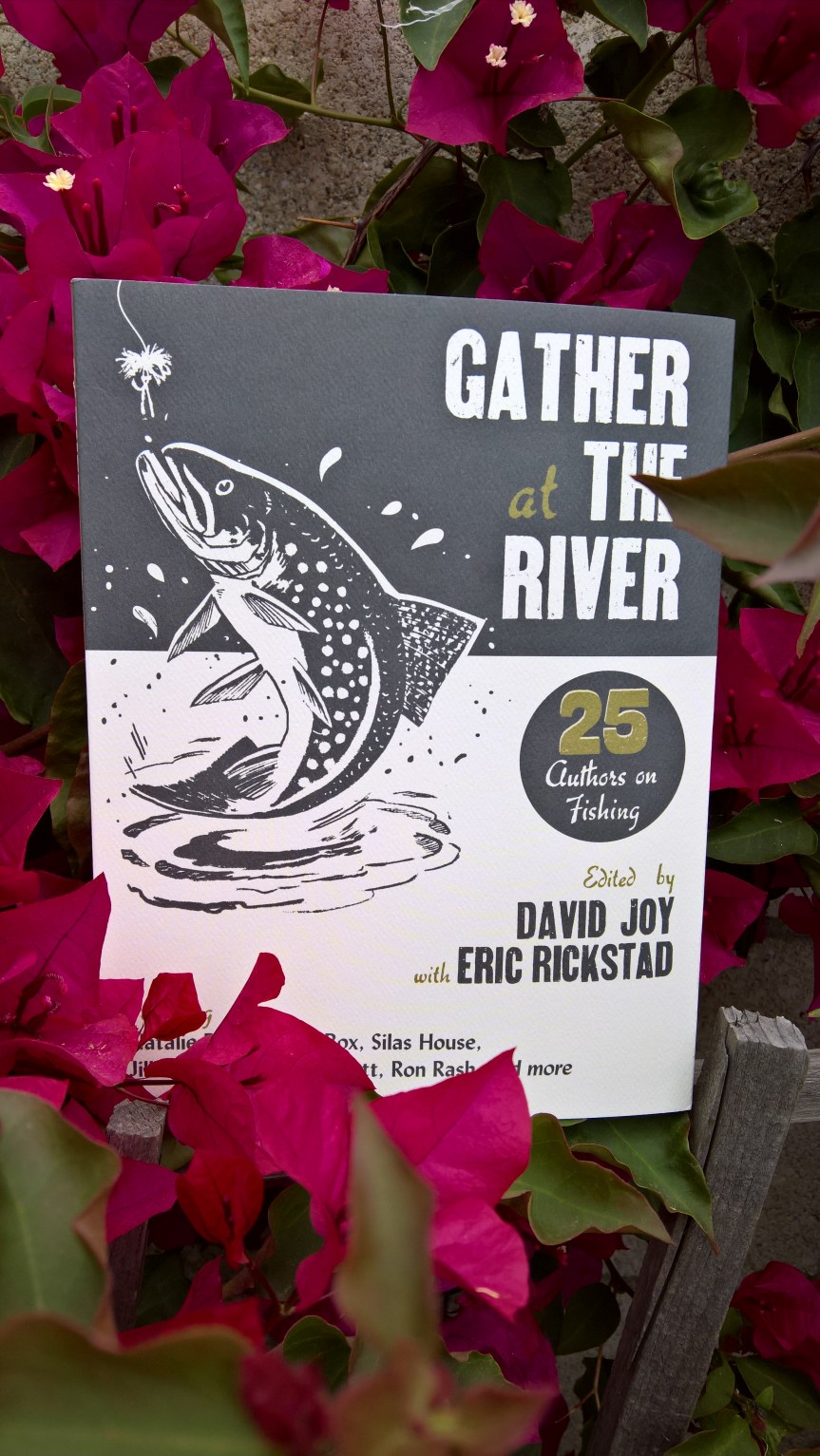
Gather at the River: 25 Authors on Fishing ( Edited by David Joy with Erick Rickstad)

At the heart of every well-beloved novel is that one riveting scene that verges on transcendence and stays in the reader’s memory as the very soul of the book. Gather at the River is a collection of those resonant moments, one right after another, and there’s not a weak story in the assembly. I use the word story, instead of essay, on purpose. These are first person accounts rife with insider’s knowledge in the hands of those that know nuance and how to describe it down to the last rock in the river. These writers know what from the woods as they recount their individual fishing stories and gift the reader with their own version of universal nostalgia. They work the depths of the seemingly simple themes of family connections, childhood innocence, and pivotal moments all within a bucolic setting that expands the visceral margins of character as place. You can see, hear, and feel the mood of every setting, and though fishing is the common premise, the central experience in each is so much more. There’s such art in the craft of a briefly told story. The sure sign of success is when the reader, in this case, yours truly, is so moved by the reading experience that they wish for more.

Author Interview on The Reading List

Claire Fullerton is an author who was born in Wayzata, Minnesota and transplanted at the age of ten to Memphis, Tennessee. Although Claire Fullerton now lives in Malibu, California, she says that she’ll always consider herself a Southerner. Claire first found her niche in music radio as a member of the on-air staff of five different stations, during a nine-year career. Music radio led Claire to the music business, and the music business led her to Los Angeles, where she worked for three years as an artist’s representative, securing record deals for bands. Claire Fullerton would go on to write a creative, weekly column for The Malibu Surfside News, and submitted to writing contests and magazines as she focused on developing her craft. Claire Fullerton then wrote a paranormal mystery about a woman who suspects she has lived before, and titled it A Portal in Time. Vinspire Publishing published the book, so she decided to show them the manuscript of a novel she had written in previous years, which they also published under the title Dancing to an Irish Reel the following year. Her third novel is titled, Mourning Dove. It’s a sins-of-the-father, Southern Family Saga, set in 1970’s and 1980’s Memphis, and it will be released in June of 2018. Please enjoy my interview with Claire Fullerton.

How do you describe your occupation?
I am a full-time writer.
What is something about you that people might find surprising?
On the side, to keep myself engaged in humanity (because writers spend much time in isolation,) I teach ballet and Pilates. I’ve been doing this for years.
What are you reading at the moment and what made you want to read it?
I have a friendship with the most artistically, off-beat woman I’ve ever had the good fortune to come across. She is fifteen years my elder, from New York City, and erudite at an impressive pitch. Out of nowhere, she brought me Nutshell by Ian McEwan. Since I’m a Southerner from Memphis, now living in Southern California, I’ve been on a Southern writer kick for a long time now. Southern writers write in a language I’m comfortable with, but I was starting to feel myopic. When I read the Washington Post’s blurb on Nutshell (“No one now writing in the English language surpasses Ian McEwan) I dove right in and was enthralled by this author’s genius.
What was your favourite book as a child and why?
Goodnight Moon by Margaret Wise Brown as read to me by my father. I can still hear his voice reading this classic. The book gave me a sense of connection to everything around me and taught me about the importance of interacting in the world from a premise of awe-struck wonder.
Can you remember the first story you ever wrote?
I wrote a first-person story for my college English class based on personal experience. It was about two young girls on a beach in California, suffering the unwanted attention of a strange man. Unbeknownst to the girls, a local surfer watched from the water. He rose like Poseidon from the waves and placed his surfboard between the man and the girls as a blockade. The moral of the story was chivalry isn’t dead. The teacher read my story aloud in class and gave me an A.

What was the last book you purchased, and why did you buy it?
I bought An American Marriage by Tayari Jones because of the hype. It deserves every bit of praise it’s been given.
For someone starting out in your career, which three books would you make required reading and why?
A Separate Peace by John Knowles for its character-driven, coming of age elements, which plummet the very heart of human, baser instincts, such as jealousy and feelings of inferiority. Rebecca by Daphne du Maurier, for its narrative, atmospheric suspense, and The Ron Rash Reader by Ron Rash, because this book has short stories, novel excerpts, and poetry by the man many call the most gifted and accomplished poet and storyteller of our time, or any time.
What book have you found most inspiring, what effect did it have on you?
The Prince of Tides by Pat Conroy. Conroy was a master story-teller who made a forty-year career out of his own personal narrative. In writing The Prince of Tides, Conroy gave all writers the keys to the kingdom. He showed us how to take pain and turn it into art. What I learned from this book is that there is great beauty in the scars of the most dysfunctional family. In reading this book, it occurred to me that a writer need not look further than their own life for inspiration.
What’s the most obscure book you own; how did you discover it?
The Dead House by Billy O’Callaghan. I have an author crush on this forty-something-year-old man, who lives in the wilds outside of Cork, Ireland. Talk about a unique voice and uncanny turn of phrase. I think this author is the best writer to come out of Ireland since Clare Keegan. He floors me, and my suspicion is this book is only obscure for now, as it was recently licensed in America. I came across O’Callaghan accidently on LinkedIn. It was the incongruous look of this quintessential looking, rural Irishman packed into a tuxedo at an awards ceremony that caught my eye. I once lived in the west of Ireland, so I didn’t miss the irony. Upon looking into O’Callaghan, I discovered he had three short story collections published. I bought each one and ordered The Dead House straight from the press.
What’s the best book you’ve read in the last 6 months?
Before We Were Yours by Lisa Wingate.
What is your proudest achievement?
That I’ve stayed the course of a creative life. I believe there are many incarnations in an artist’s life. My path has seen me, in one form or another, in the communicative arts. I worked on-air in Memphis radio for nine years and loved every minute of it. I was an artist and repertoire representative in the Los Angeles music business, which basically meant I discovered bands and took them to record companies. Ballet is a communicative art. All the while, I’ve engaged in writing because it comes to me as second nature. And the thing with an artistic life is there is no “there” to get to. There is only the process of living it.
Can you talk us through your writing process, from the first spark of an idea, to having your first completed draft?
Thus far, I’ve written the stories I had to tell, as opposed to manufacturing something out of thin air for the sake of writing something/anything. Always, there is a point I want to make. I have a reason for wanting to tell the story, usually, it is to make some comment on this business of living as I experience and interpret it. I write to compare notes, so to speak. I always know the beginning, middle, and end of a novel, and I typically make an outline after I’ve started. Because I know the ending, I ask myself where my novel should go next as I’m writing. I’m mindful of what will be a case in point along the way to the bigger point. It helps that I write in scenes. I can “see” the story as if it were on screen. When I think I’ve told the story, I walk away for a week, then revisit. I read it all and look to see if it’s balanced, then re-read to look at dialogue and continuity. When I believe I’ve finished, I send the manuscript to my editor.
If you were trying to impress a visitor, which book that you own would you leave on the coffee table?
I have this on my coffee table now: Huger Foote, My Friend from Memphis. Huger (pronounced yoo-gee; soft G) is the son of author and Civil War historian, Shelby Foote, whom all of us who come from Memphis revere. Huger’s nickname is Huggie, and he is now a world-renowned photographer of the most creative, beautiful shots of what many would consider common objects. His photographs are sheer poetry.
What two pieces of advice would you give a young aspiring writer?
Never compare yourself with another writer and resist the temptation to look over your own shoulder as you write.
If an alien landed in your garden; which three books would you gift them to showcase humanity in the best possible way?
Peachtree Road by Anne Rivers Siddons, The Prince of Tides by Pat Conroy, and The Mermaids Singing by Lisa Carey. I wouldn’t say they showcase humanity in the best possible way, only that they, indeed, showcase humanity!

Are there any books you haven’t mentioned that you feel would make your reading list?
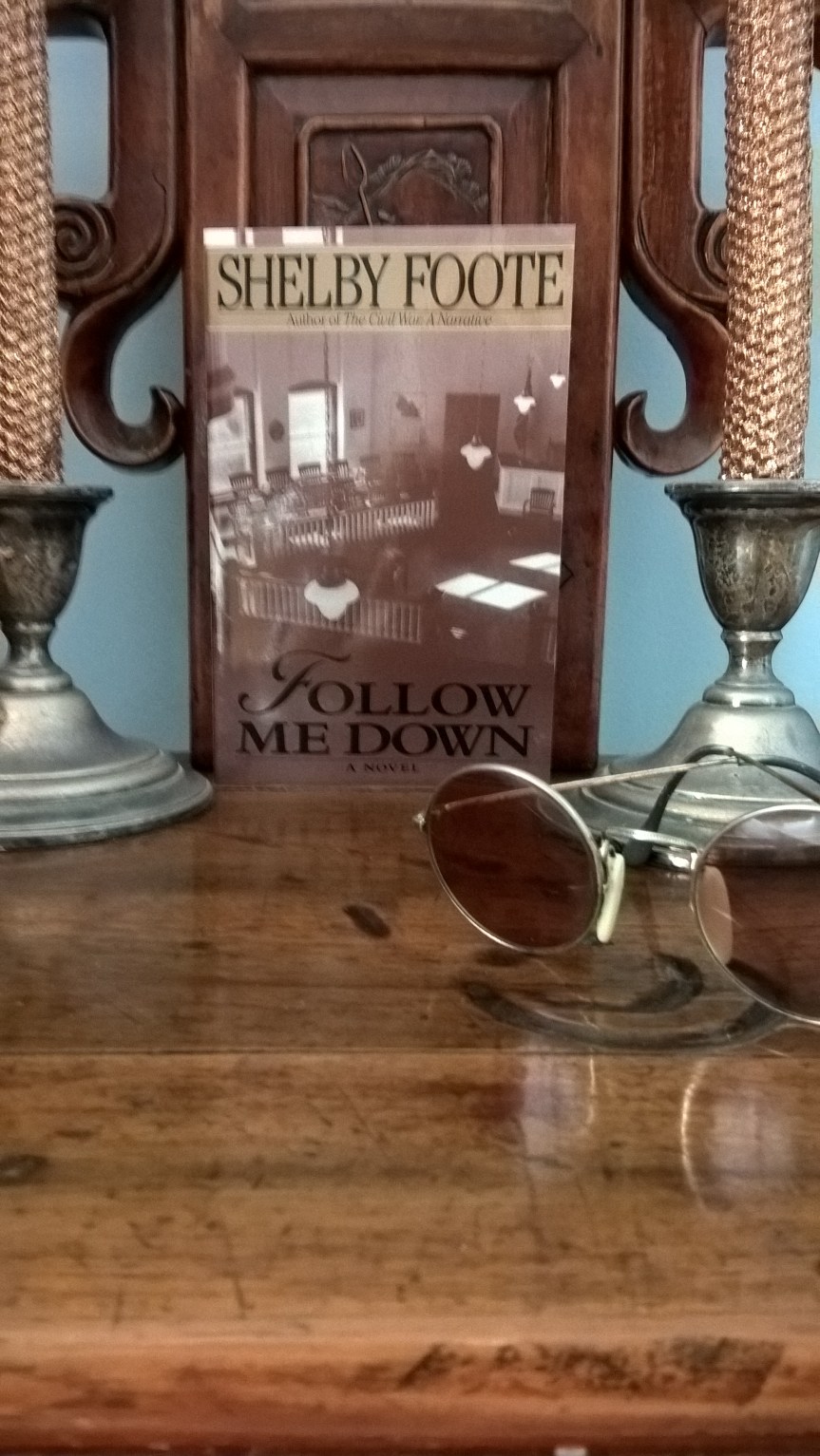
I am satisfied that I’ve mentioned the books that stand out for me, and I did mention Shelby Foote, but I’m going to go deeper with him. I recently read Foote’s book, Follow Me Down and I startled to realize what an incredible fiction writer he was. I, like many, equated Shelby Foote with his three volumes on the Civil War and had yet to read his fiction. Follow Me Down is a Southern classic about the murder trial of a white man in 1960’s Mississippi, who has already confessed to the crime. The book’s language thrilled me!
Which book sat on your shelf are you most excited about reading next and why?
I am looking forward to reading A Gentleman in Moscow by Amor Towles. I loved his novel, The Rules of Civility.
If you’d like to learn more, you can find Claire Fullerton on her website, Facebook and Twitter.

Roundabout way to Publication: Gratitude to Chris, The Story Reading Ape for this!

Like a sailboat tacking obliquely through opaque mists with little to guide the course beyond hope and blind faith, my third novel,Mourning Dove, will be released at the end of June. It has been unequivocally the most roundabout way to publication I’ve ever heard of, and therefore I want to share my story. Let this […]

via Mourning Dove – Guest Post by Claire Fullerton… — Chris The Story Reading Ape’s Blog

My Exaggerated Life: Pat Conroy, as Told to Katherine Clark.

Oh, the gift of this delightful book. The thing about Pat Conroy is those who get him really get him and can never get enough. It has been repeatedly written that readers feel as if they know him. That he wrote in the first person was part of what spawned the relationship between Conroy and his readers, the rest of it is that he had an uncanny way of unabashedly calling things by name and spoke for us. And any Conroy devotee knew he was healing his shattered history by veiling it in fiction. We knew it and didn’t care because not only was he charming, he was a master storyteller. Conroy wrote from the center of his sardonic personality. Once he had you, he dove down to universal truth and brought you to your knees. This business of life is not for the meek, he suggested, but there is rhyme to it, poetry, in fact, and in his fiction, he figured out how to survive it.
My Exaggerated Life gives us the man behind the curtain. On its cover is Conroy wearing his infamous flight jacket and Citadel ring, which his fans will recognize as symbols of his personal narrative. Conroy was that kind of writer. His books were mind-altering drugs and his readers were addicts who had to have more. Katherine Clark has given us more in what seems to me a labor of love. That she spent two hundred hours listening to Conroy spill out his life over the telephone to assemble this book makes me jealous, but I’ll overlook that in favor of the resounding result.
What struck me most in reading My Exaggerated Life was the realization that there was no separating the man from his craft. It’s Conroy’s voice that does it. In these pages speaks a storyteller of the highest order telling an incredibly entertaining story, it just so happens to be culled from a series of events in his life. You can intuit the haphazard way he stumbled from cause to effect as his writing career took shape. Reading Conroy’s books always made me feel they were born without effort, so to discover in this riveting book just where the struggle had been hit me as staggering—not because parts were painful to read, but because he framed it in such a human way that readers will think, you too?
At the end of My Exaggerated Life, Katherine Clark shares the speech Pat Conroy delivered spontaneously before a crowd of adoring fans in Beaufort, South Carolina at his 70th birthday celebration. In it, Conroy claims “What I wanted to be as a writer, I wanted to be a complete brave man that I am not in my real life.” He did just this in My Exaggerated Life. In an act of bravery, Pat Conroy told his story, and author Katherine Clark captured it in a book that is one for the archives.

On the Southern author, Shelby Foote

Before I launch into writing about Follow Me Down, I want to make sure y’all know who Shelby Foote is. I’ll start with his author bio, because it will either remind you or introduce you to one of the best Southern writers of our times:

Shelby Foote was born on November 7, 1916 in Greenville, Mississippi, and attended school there until he entered the University of North Carolina. During World War II he served as a captain of field artillery but never saw combat. After World War II he worked briefly for the Associated Press in their New York bureau. In 1953 he moved to Memphis, where he lived for the remainder of his life. Foote was the author of six novels: Tournament, Follow Me Down, Love in a Dry Season, Shiloh, Jordan County, and September, September. He is best remembered for his 3-volume history The Civil War: A Narrative, which took twenty years to complete and resulted in his being a featured expert in Ken Burns’ acclaimed Civil War documentary. Over the course of his writing career, Foote was also awarded three Guggenheim fellowships. Shelby Foote died in 2005 at the age of 88.

On a personal note, my mother was a life-long friend of Shelby Foote’s second wife, Gwyn, whom everyone called Ginny- with a hard G. She was statuesque, blue-eyed, and wore her hair in a grey page-boy before it was chic. The Footes lived right around the corner from where I grew up in Memphis. I am a contemporary of Ginny and Shelby’s son, Huggie, so nicknamed because his given name comes from Shelby’s family line and is Huger (pronounced Yoo-gee.) Best for a little kid to be called Huggie, as far as I’m concerned, and the name sticks to this day. Like his father, Huggie is an artist. He’s had an illustrious career as a photographer, and, after moving back to the states from Paris, he resides in New York City. If you’re interested in Photography, Huggie has a couple of books that you can find on Amazon. He admits to being influenced by Memphis’s renowned William Eggleston, and in my opinion, if you’re a photographer influenced by anyone, let it be Eggleston, but I digress.

I have a handful of Shelby Foote memories, one of which sees him sitting on the porch out at Cottondale in Collierville, Tennessee discussing the civil war with the erudite J. Tunkie Saunders, son of Clarence Saunders, who started Piggy Wiggly and built Memphis’s Pink Palace, which is now a museum. When you’re a little kid, you’re not impressed by much of anything, yet I recall running through the porch of what was once called The Old Stage Coach Inn, before J. Tunkie Saunders bought the establishment and turned it into a country retreat on the outskirts of Memphis. I was ‘at the farm,” as they called it, with Lucy Saunders, my age exactly, and we were making a beeline for the stables. Our plan had been to saddle up Buttons and Bows and ride her down to the levee, but I was stopped. “Claire, sit down,” J. Tunkie said, and I, being obliging to my elders, let Lucy run on ahead and did as I was told. For the next half hour, I listened to these two Southern gentlemen talk about the Civil War as if it were still going on somewhere down the road. Wasn’t a big deal to me then, but it is to me now, and I recall the pair matching wits, comparing notes over tumblers of cool, amber whiskey as the sun set through the pin oaks and thinking one day you’ll be glad you’re sitting here.  

Another vision that stays with me is of the day my mother brought me round to visit Shelby in his library. She’d just acquired the first volume of Shelby’s three volume masterpiece, The Civil War: A Narrative, and she wanted it signed. The two of us stepped down three wooden steps into what would have been anyone else’s living room, in the ivy-covered, pitched roof brick Tudor tucked back off of East Parkway.  I’d never been to an author’s residence, and at thirteen or thereabouts, I hadn’t a clue what to expect from the man I thought of simply as Huggie’s dad.  Shelby didn’t disappoint. Were you to have envisioned your best-case scenario of what to expect from an author in his den, Shelby would have exceeded it. He smoked a pipe, he wore a beard and a vest over his rolled shirt sleeves. His steady blue eyes were mesmerizing, canopied with a thicket of black lashes, his warm voice was courtly in a fluid Southern drawl. He was a gentleman through and through and didn’t let on that we were interrupting him at his work in the prime of his working hour. He received my fawning mother graciously with a manner as though he had all the time in the world.

The world got a taste of the real Shelby Foote, when he narrated Ken Burns documentary miniseries, The Civil War, which aired on PBS in five consecutive nights in 1990. 40 million viewers watched it, and the series was awarded more than 40 major television and film honors. In the show, Shelby wore a pinstriped Oxford and simply told his version of the war as he interpreted it. With more than twenty years of research behind him and a narrative passion that verged on the personal, Shelby Foote, in all his poised authenticity, single-handedly debunked all myth and stereotype many outsiders have of those of us from down South.

It was the Goodreads group, On the Southern Literary Trail, that caused me to read Shelby Foote’s Follow Me Down. I’ll go on and say it: not only am I a Southerner, but I’m a writer, and it shamed me to admit I’d never read Shelby Foote’s fiction. I have no excuse for never getting around to it, other than to say that I, like many, equated Shelby Foote with his Civil War volumes. I’d done myself a disservice, but that’s all behind me, for after reading Follow Me Down, I now have Shelby Foote fever.

Follow Me Down was published in 1950. It sets the standard for Southern fiction at its finest. Set in Jordan County, Mississippi, the book opens with a murder trial, and the reader learns quickly that the defendant has already confessed. Luther Eustice, a fifty-one-year-old, nondescript farmer, got himself into a pickle, when he crossed paths with a disreputable woman, thirty years younger, named Beulah Ross. After running off with Beulah to a small island on the Mississippi, Eustice changed his mind and couldn’t think to do anything else but drown her. Narrated in chapters by a circuit clerk, a reporter, a half-wit named Dummy, Eustice himself, Beulah the victim, Eustice’s wife, Eustice’s lawyer, and the jailer with the key, we learn the detailed minutia of the crime from differing vantage points—each with a voice so Southern and unique, Foot’s feat of writing is showcased for what it is: nuanced, insightful, and chock full of character as to lay bare the hidden secrets of the rural South.  It’s the colloquialisms that captured me. An example is when Foote describes a man by writing, “He is the best example I ever saw of a man gone sour.”  Politically incorrect at points for this day and age, the reader is gifted with the mental accuracy of a bygone era, yet never once does it pull them out of the story.  Follow Me Down is a roughhewn and down-on-its-luck story written with such charisma and aplomb as to fascinate the reader on every page.

I’ll leave you here with one more Shelby Foote tidbit, since I’m being candid. Two years ago, I had the pleasure of meeting the great author and poet, Ron Rash, whose eyes grew wide when I mentioned I grew up in Memphis. The first question he asked was if I was familiar with Shelby Foote. I told him I was, though not as a reader, my acquaintance was personal. The look on Rash’s face as I recounted my affiliation with Shelby Foote was one of awestruck wonder. At the time I was thinking Mr. Rash must be a Civil War buff, but now I know why he had that look on his face: it was author admiration, pure and simple.


How Does One Become a Writer?