

This lovely novel has everything: lyrical prose, passionate descriptions, a windswept Edisto, South Carolina setting, a crotchety, Hungarian matriarchal figure named Helena with a mysterious past, whose prosperous, white-collar nephew hires narrator Elenor Murray to tend to her demands, in a seaside house filled with priceless portraits of unknown origins. And music? The Time Between is filled with classical music, running through the story thematically from the hands of Elenor, who, racked with guilt over her involvement in her sister’s life-altering accident and her father’s death, has foresworn her love of the piano. And yet, the reader learns, Helena’s past in war-torn Hungary incrementally unfolds as the two women learn to trust each other. In Hungary, we learn, Helena’s life was centered upon music, as Helena was one of three sisters regionally famous as a trio before the war tossed their life asunder. It is the piano that draws Elenor and Helena slowly together, and Helena’s nephew, Finn, who ultimately links the two women by loving both. I loved everything about this steady-paced, intriguing story. It is replete with love, history, the complications of family, redemption and growth. I received this novel as a surprise for joining the infamous book club, the Pulpwood Queens, by its book-loving headmistress, Kathy Murphy. Reading this novel has made a Karen White fan of me!
Category: Book Reviews
Girl on the Leeside by Kathleen Anne Kenney.

Because I once lived in a small town in Connemara, at the gateway of the Irish-speaking area called the Gaeltacht, I look for those novels that depict the region as it is, for once one has spent significant time there, its ways and means register in the soul with perpetual resonance, leaving one forever nostalgic for what can only be described as the west of Ireland’s consciousness. It isn’t easy to capture, for all its subtle nuances, yet author Kathleen Anne Kenney has done just that in writing Girl on the Leeside in the manner the region deserves, which is to say this beautiful story is gifted to the reader with a sensitive, light touch.
Girl on the Leeside is deep in character study. Most of what happens concerns the human predicament, no matter where it is set. More than a coming of age story centered on twenty seven year old Siobhan Doyle, it is a story of the path to emotional maturity, out of a circumstantial comfort zone, (which, in this case, is perfectly plausible, due to its isolated and insular Irish setting) into all that it takes to overcome one’s self-imposed limitations to brave the risk of furthering one’s life.
In utter fearlessness, Kathleen Anne Kenney invites the reader to suspend disbelief in giving us an otherworldly character that speaks to the inner fairy in those who dare to dream. Small and ethereal Siobhan is orphaned at the age of two by her unconventional mother, and father of unknown origin. She is taken in and raised by her mother’s brother, Keenan Doyle, the publican of his family’s generational, rural establishment called the Leeside, near the shores of a lough tucked away in remote Connemara. Introverted, with little outside influence, she is keenly possessed by her culture’s ancient poetry and folklore. She is a natural born artist, gifted with an intuitive grasp on words and story, a passion shared by her Uncle Keenan, yet so pronounced in her that she walks the line between fantasy and reality. It isn’t easy to redirect one’s invested frame of reference in the world, if it isn’t completely necessary, yet necessity arrives at the Leeside, when American professor of ancient Irish poetry and folklore, Tim Ferris, comes to compare literary notes with Siobhan and Keenan. It is this catalyst that sets the wheels in motion of a heartfelt, insightful story that involves the willingness to grow. All throughout, author Kathleen Anne Kenney explores the myriad fears that get in the way, and shows us the way to triumph.
Girl on the Leeside is a deceptively soft read. It is so laden with beautiful imagery, so seamlessly woven with radiant poetry that it lulls you into its poignancy and holds you captive, all the way to its satisfying end.
Review: The Bookshop at Water’s End

Every line in The Bookshop at Water’s End is soulfully written in seamlessly crafted chapters. Beginning in the emergency room of a Charleston, South Carolina hospital, this enchanting story never loses its page-turning sense of urgency, and yet it is delivered softly, as a deeply insightful, thought provoking character study on two women, whose lives are significantly entwined. Author Patti Callahan Henry knows her way around the nuances of women, and writes with uncommon fearlessness, as she tells the story of Bonny and Lainey, in their mid-forties now, who formed a life-long friendship at the age of thirteen while on family vacation in the small South Carolina coastal town of Watersend. Then and there, the wheels were set in motion of a dynamic that resonated forward with such resounding effect that even they were not aware of its repercussions. But there is no running from cause and effect, and when Bonny and Lainey have cause to return to Watersend,  the threads of this story reverberate in love and longing, mystery and self-discovery, all woven together in one plausible tapestry.
Bonny Blankenship’s life and identity is centered upon her medical profession, whose seeds were planted at thirteen by uttering a fateful wish in one magical, belief-driven moment alongside Lainey, as the two swam in the river at Watersend. That her wish came true sets the foundation for Bonnie’s side of the story, just as Lainey’s simultaneous wish materializes, in what is ultimately an outgrowth from her anguished childhood. Lainey is an acclaimed artist, whose medium involves creating visual stories by piecing them together, an act, the reader suspects, that has much to do with piecing together the unresolved mystery around the disappearance of her mother. It is this singular, cataclysmic event that shapes the future for Lainey and her older brother, Owen, whom Bonnie secretly loves. It is the fear of friendship’s betrayal and Owen’s mercurial nature that keeps Bonny’s love for Owen in arrested development. It is the longing of the heart and the reasoning of the mind that burdens her with the push and pull of love’s unrealized potential, even as her life path finds her married to another and raising a daughter named Piper.
The character, Piper Blankenship, seems to me the conscience of this story. She is nineteen, maladjusted, and written with such accurate sensitivity that I repeatedly pictured her at the heart of a great YA story. Her perspective gifts the reader with a view from the edge, and her pivotal placement in the story shows us unflinchingly who each of the adult characters are, as they try to find their footing amidst shifting tides.
The Bookshop at Water’s End is a story that never stops searching, and that many of its events are tied to Watersend’s local bookshop is brilliantly symbolic. The bookshop is an anchor in full possession of the past’s facts, and its proprietress, Mimi, plays her cards close to the vest as she faithfully waits for the players in this story to discover the clues that will allow the looming puzzle affecting them all to fall into proper place.
Three cheers for author Patti Callahan Henry. She has given us a heart-wrenching, mesmerizing story of characters beautifully flawed and made them beautifully human.
Note: I won the ARC of this book in a Goodreads giveaway! The Bookshop at Water’s End will be released on July 11, 2017.
The Stolen Child by Lisa Carey

Because I once lived on the western coast of Ireland, and because author Lisa Cary moved to the island of Inisbofin, off Ireland’s west coast to research her first book, I’ve been following her career for many years. I’ve loved each of her four Irish themed novels, and eagerly awaited the February 7th release of her latest, The Stolen Child. It is a story much like Ireland herself: deceptive in its riddled nuances, more than the sum of its parts. The soul of the story creeps up on you. It takes patience and willingness to allow the magic to take hold, and when it does, it is not by possession. The Stolen Child spins the kind of magic that lulls at the core of your being; affects your consciousness, waits for you to piece it together until you understand. There is little overt in this languid novel, which, again, is much like Ireland. It is a desperate story through and through, yet in the hands of author Lisa Carey, it resonates with mythical beauty, gives you a sense of timelessness, and holds you fast by its earthy, brass tacks.
In pitch-perfect language, Carey wields dialogue specific to the west coast of Ireland’s desolate environs. It is an understated language, upside down to outsiders, but once your ear attunes, you are affronted by the superfluousness of other tongues. All primary characters in The Stolen Child are women. They live cut-off from the mainland of Ireland’s west coast, twelve miles out, upon rocky, wind-swept, St. Brigid’s Island, during the one year time frame of May, 1959 to May, 1960. It is a timeframe fraught with the looming inevitability of the islanders’ evacuation from their homeland, with its generational customs and ties, to the stark reality of life on the mainland, with its glaring and soulless “mod-cons.” Most of the characters are conflicted about leaving the island, save for the sinister Emer, who has her own selfish agenda, centered upon her only child Niall. Her sister, Rose, is the sunny, earth-mother, unflappable sort, who only sees the buried good in Emer, whereas everyone one else on the island shuns her, for her malefic, dark ways, which they intuit as dark art. Emer has one foot on the island and the other in the recesses of the fairies’ manipulative underworld. It is the American “blow-in,” Brigid, the woman with a complicated past, who has her own ties to the island from her banished mother, that cracks the carapace of Emer’s guarded and angry countenance. Together, the pair explore an illicit relationship, but when it snaps back, Emer retaliates with a force that effects the entire island and twists her worst fears into fate.
The Stolen Child is magnificently crafted, for it is a sweeping story set on a cloistered island, which has nothing to recommend it save for its quays, its view, and its eponymous holy-well. This is a novel rife with character study that is quintessentially Irish, yet applicable far afield. In themes of motherhood, hope, desperation, and hopelessness, the characters take what little they have and wrestle it into making do. It is the power of steel intention that drives this story, and the reader receives it from all conceivable angles. I recommend The Stolen Child to all who love Ireland, to all who love an exceptional, creative story, and to all who love language used at its finest. All praise to the author Lisa Carey. I eagerly await the next book.
Claire Fullerton is the author of Dancing to an Irish Reel, and A Portal in Time. Her next book, Mourning Dove, will be released by Firefly Southern Fiction in 2018.
One Good Mama Bone by Bren McClain

Once you attune yourself to the voice of this emotionally evocative story, it’ll submerge you in language like water running in a creek bed. Author Bren McClain takes the reader to a down on its luck farm, in the esoteric pocket of rural 1950’s Anderson, South Carolina, and delivers lines, such as “Get the by God out of my clean yard” and “He’d probably be drunk as a coot and trying to have relations with his common law.” It is McClain’s uncompromising use of language that gives us the consciousness of each character in this purpose driven story, who are all linked to each other by the common pursuit of raising a steer to enter into the 1952 Fat Cattle Show and Sale, with dreams of winning the monetary prize awarded to its Grand Champion. Every character has its own agenda, and the best and worst of human nature is depicted as we follow the motivation of each principal character to the destination of one fateful day. One Good Mama Bone opens with a birth’s gripping drama and never turns the reader loose throughout its breath-catching, suspenseful build. It gives us a protagonist in single mother Sarah Creamer, who doggedly fights the constraints of poverty and wrestles with her own beaten down identity, all in the name of selfless love for her young son, Emerson Bridge. Sarah’s quest tugs at the heartstrings with the lure of her incremental maternal awakening, as reflected in her relationship with a mother cow named Mama Red. That this story contains a nemesis in the contentious, self-serving cattleman Luther Dobbins, who throws up one heart-stopping obstacle after another on the road to Sarah and Emerson Bridges’ goal keeps the pages turning to the very end. I loved this book for the mood that descended every time I returned to its pages. It’s a rare book that hands you a life you can slip into, and an even rarer writer that’ll give you a million reasons to do it.
Review: Rebecca by Daphne Du Maurier
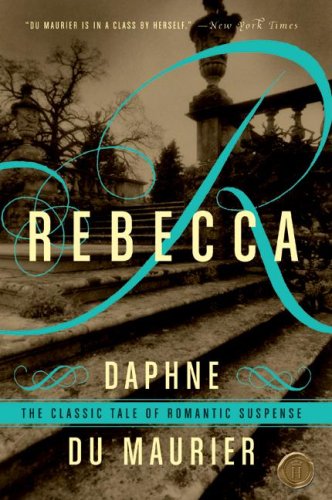
I’ve always been an admirer of the first person narrative. When handled deftly, it magnifies the complex variables that comprise us all. Rebecca is a psychological treatise with a confessional tone spawned from the narrator’s perception, and this is the story. That the narrator is young, inexperienced, and overwhelmed to the point of skittishness sets the dark tone of every paragraph in this cleverly paced mystery. Her vantage point is solidly built on assumption, suspicion and crippling self doubt. The plot is a simple one: the young narrator begins as a paid, personal companion to a domineering wealthy woman, who is on holiday in Monte Carlo, when fate places her in the dining room of a luxuriant hotel next to the table of the troubled widower, Max de Winter, who hails from the Cornish Coast. An awkward and unlikely alliance develops between the narrator and the worldly Max de Winter, which leads to a hasty marriage, in which the reader learns along with the narrator of de Winters’ disturbing past. Set in the house and rambling coastal grounds of de Winters’ stately Manderley, the narrator enters a dynamic firmly in play, whose tone was cast and exists still from the hand of Rebecca: the first Mrs. de Winter. Rebecca’s shadow looms imperiously, and brings to the fore the narrator’s insecurities. Having no background story on her predecessor, the inchoate narrator is tossed by the winds of assumption, half-truths and incomplete perceptions made all the more dark by the presence of Rebecca’s loyal personal maid, Mrs. Danvers, whose presence lends a disquieting air, due to her supercilious knack for comparison. Rebecca is an off-kilter mystery that unfolds along the road of the search for truth regarding what, exactly, happened to Rebecca. That the narrator stays in suspense until the sinister end lures the reader through a story elegantly told in language so poetic, it is its own experience.
Book Review: Serena by Ron Rash

It is the slightly off-kilter, dark tone of this book that mesmerizes. Set in the year 1929, in the North Carolina mountains, George Pemberton arrives on a train from Boston with his cultured new wife, Serena. It is a rough-hewn, brass tacks timber camp dedicated to clearing the region of its trees for financial gain that Serena enters and assumes control. The daughter of a timber man from Colorado, Serena knows the business better than most men, and uses her wits and wiles to manipulate affairs to her liking as she plots to expand the business. With a mysterious background to her credit, both George and the reader come to know Serena through her ruthless, self-serving dealings; nothing is beneath her pursuit of expansion: no morals, ethics, nor even the law. In short order, George Pemberton becomes a man caught in a web, yet is so enamored of his wife, he is willing to go along as events spin out of his control and lead to the ultimate betrayal. This is the fifth book I have read by the author, Ron Rash, and I find his voice unlike any other. Ron Rash is a writer gifted with the poetics of economy. His settings exist in society’s underworld, which he compliments through the use of language so pitch perfect in regional colloquialism it gives you the characters background and explains their individual mind-set. Ron Rash’s Serena is a villain for the ages; she is canny, single-minded, attractive, and dangerous. This bone-chilling story is both gripping and blind-siding. It is another fine example of Ron Rash’s deft handling of the darker notes of self-preservation at any cost.
The Risen by Ron Rash:Book Review

This is, yet again, another gripping Ron Rash novel. Upon reflection, what stays with me most is that the premise of The Risen is tight and simple. Two brothers, in a small North Carolina town, are swimming in a creek in the summer of 1969 and meet a seventeen year old girl, an outsider who impacts their lives. But Ron Rash gives us a thorough psychological treatise, through the character of younger brother Eugene, on the desperation behind falling in love for the first time and the complexities of younger brother syndrome during one’s coming of age. Place is a character in this story, described in Rash’s keen vernacular, and it is the unsolved past that pulls us through this story. The reader lives in two time frames as the story unfolds, which gives us the experience of cause and effect. On the one hand, The Risen floats on the wings of the fruits of summer, on the other its tension builds through the guilt of a broken man. The Risen is a page-turning mystery with a twist, written in such a way that you can feel the guilt that haunts the two main characters’ involvement. It speaks of the repercussions of one false move that shadows lifetimes, and though the mystery may have been solved at the end, it suggests that nobody gets away with anything for long.
Temple Secrets by Susan Gabriel Book Review

I’m going to try to come near stringing the adequate words together that describe how much I loved this book. I’ll cut to the chase and say it was so good, I didn’t want it to end. Temple Secrets is the kind of well crafted book that, once closed, causes you to wonder what to do next with your life. Author Susan Gabriel created a story chock-full of Southern characters and never once condescended to anything campy, rather, she infused every character with soul as they walked the wire of a story so unique as to be plausible, of character nuance so defined, you understood the underlying motivation behind every thought and deed in this electrifyingly unusual gem of common history experienced individually by players so intertwined, their lives are domino effects wrought from the hands of each other. And oh, the tone of this book: it is bluntly in your face without being offensive. Susan Gabriel writes in a direct, brass tacks voice that is howlingly funny, for all its taboo subjects, and I relished every line. The premise of Temple Secrets is this: In blue-blooded, aristocratic Savannah, where the mansions are gothic and imposing as they retain the character of days gone by, supercilious eccentric, Iris Temple, is on her last leg. For decades, she has ruled the roost of everything and everyone around her. She is one of Savannah’s inflexible old guard and proud of it to the point that she wields her power position in society like a sword. Hers is a personality so full of controlling disdain that she is feared not only by her family and staff, but by the denizens of Savannah, whose tether she keeps tight by her family’s book of secrets, which details intimate, damaging facts best not publically revealed. Iris is estranged from her full-grown daughter, looks down on her mulatto half-sister, who lives with her, and is catered to beyond reason by a handful of staff, who prefer not to stir the waters of Iris’ own self-image. It is a dynamic changer, when Iris is incapacitated by a stroke, and suffice it to say the ghosts of her past come out to haunt, literally and figuratively, which wouldn’t happen in most places, but it can and does in Savannah. In chapters detailing the individual character’s connection to Iris, the story morphs into an incestuous web you didn’t see coming. And at the heart of this story is the Temple Book of Secrets; someone has taken it upon themselves to publish part of its content, but the mystery is nobody knows who or why. It’s hard to write more at this point, without needing a spoiler alert, and I don’t want to deprive the reader of the joy to be found in this bounding story, so I will summarize by saying this novel is so engaging, so thrilling and unique that I stand beside many clamoring for a sequel!
The World Made Straight by Ron Rash
 There’s a good reason the Atlanta Journal Constitution called Ron Rash “one of the major writers of our time.” To me, he is this and more. Ron Rash writes in a gritty, mountain vernacular that can’t be faked; one has to come from it and know it as their own voice of consciousness in order to wield it as plausibly as he. Rash’s language, therefore, is its own reasoning; it speaks of a clear-cut, hard-edged, uncompromising way of living in the world devoid of the illusion of optimism. One wonders, as they read Rash, if it is the jaded wrappings of cynicism or the unvarnished truth behind his tightly crafted novels. This is a writer who delivers the dark notes of beaten humanity in such a way that there is hope. In The World Made Straight, Travis Shelton comes from nothing, on the cusp of manhood in an unforgiving North Carolina mountain community, where drug-dealing is a viable livelihood, in this hardscrabble region with few opportunities outside of one’s own wits. It is the glimmer of something more that drives him to prove himself to his rough-hewed, hard-nosed father. Travis seeks to better himself after one fight too many; he leaves the tobacco fields on his family’s land and presents himself at the trailer of a local named Leonard, who is both drug-dealer and mentor, in that he is the only one in Travis’ sphere who, at one time, amounted to anything, though fate made it short-lived. Under Leonard’s influence, Travis pursues his high school GED, while shouldering the fall-out of the one false move he made, when he riled the shackles of local heavy-weight, Carlton Toomey, when he trespassed on his land. These are mountain characters who play by their own lawless rules, in a landscape where it’s every man for himself. In a climate still stinging from the horrors of the Civil War, the characters are born beneath the shadow of the ties that atavistically bind them, albeit through a sense of random tribal placement that haunts this story in an unfolding mystery, the impact of which the characters are not completely aware, until the looming puzzle work fits. It is a small world, in The World Made Straight, but it is universal in implication. Self-worth, justice, revenge, and hope against all odds flavors this story, which ends in notes of satisfaction and just deserves.
 Claire Fullerton Author