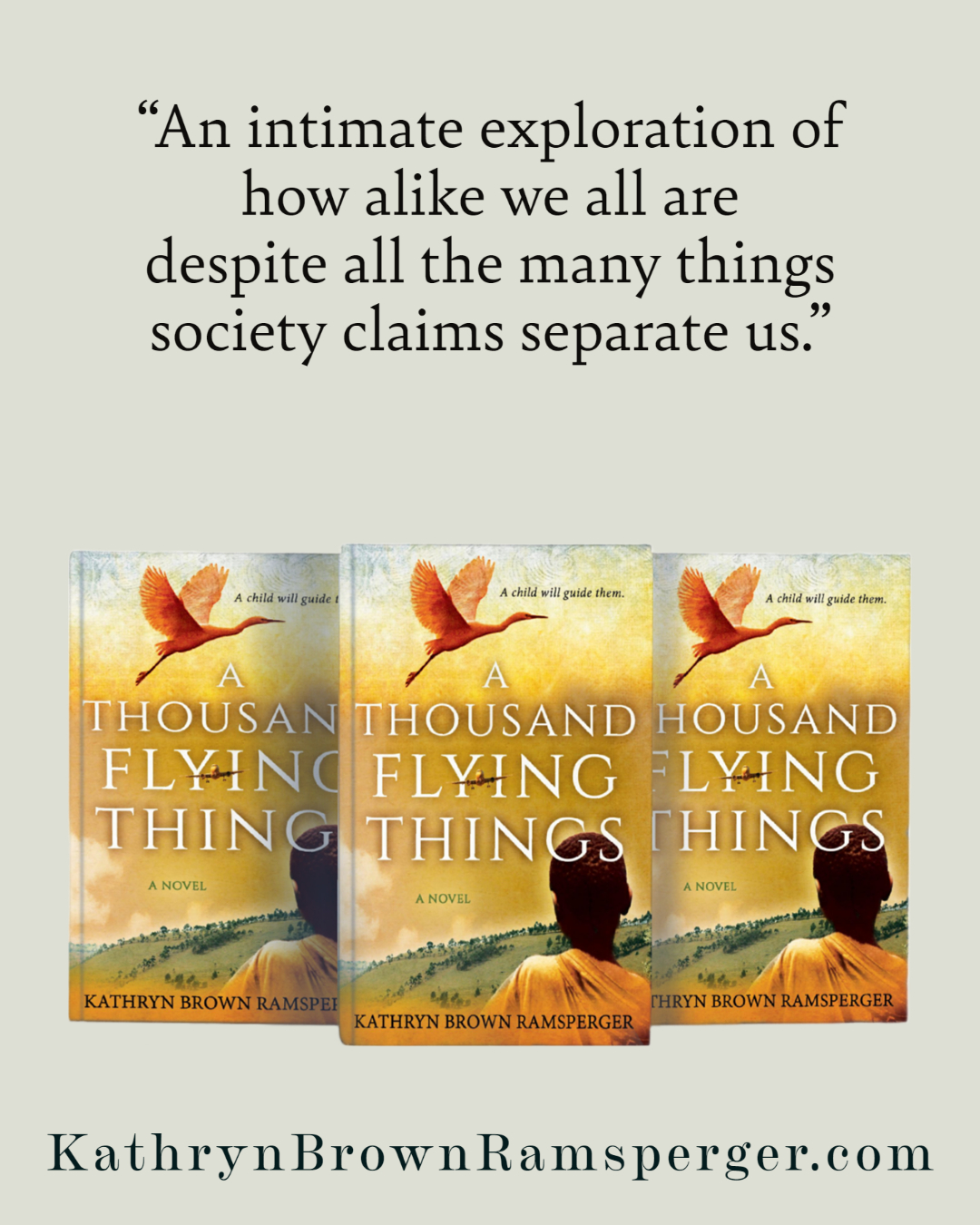
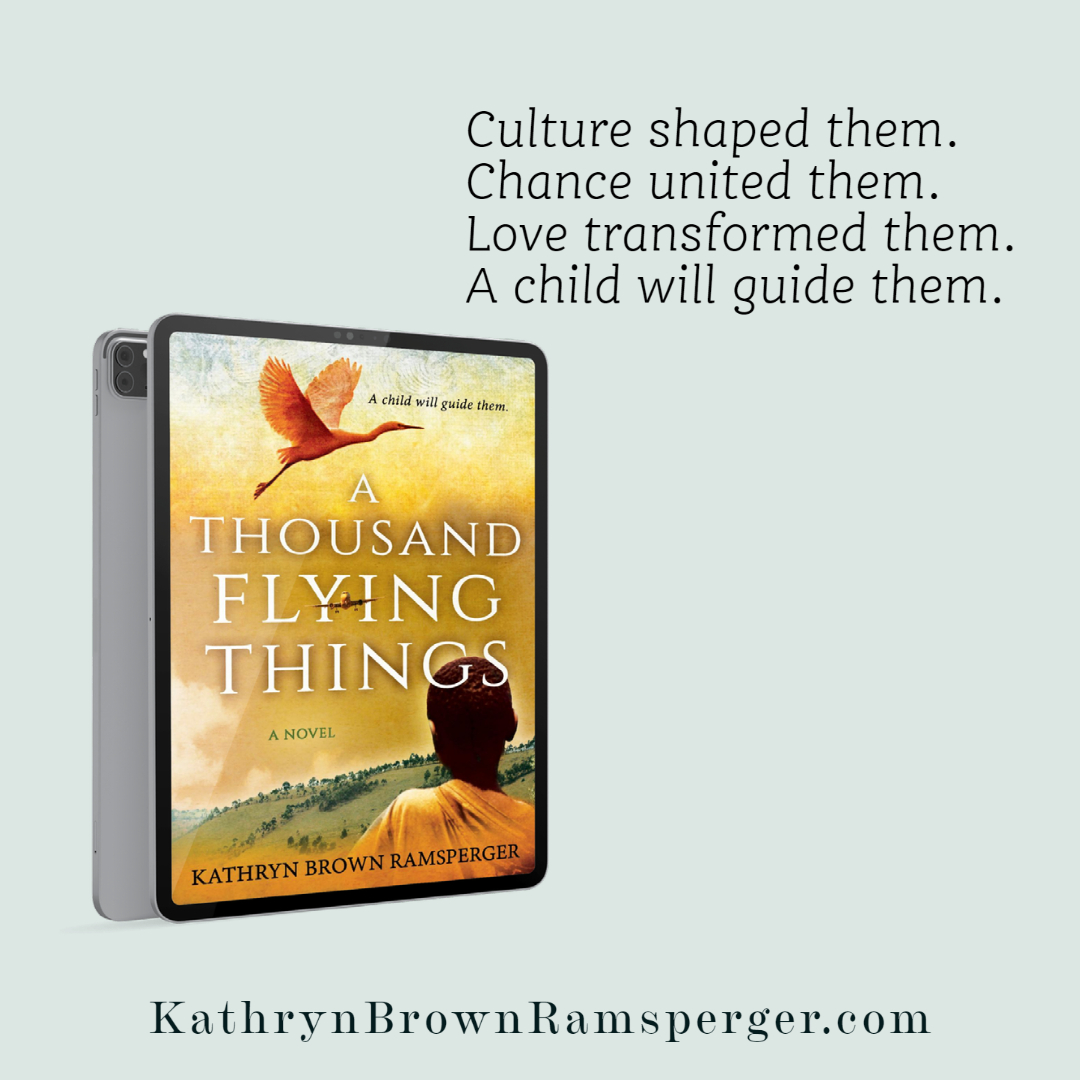
A Thousand Flying Things by Kathy Ramsperger

A love lost. A soul restored. A decade of secrets and separation.

It takes a child to lead them home.

American Dianna Calloway is committed to educating children in the thick of war-ravaged 1990s Southern Sudan. Hampered by disease, a corrupt government and a warlord who is harboring a mysterious young boy, Dianna’s passionate calling to help others in a dangerous country is only complicated by the chance meeting of a long-lost love. Faced with the choice to pursue integrity and justice or reconnect with the man she still holds dear, Dianna must make the most difficult decision of her life.

Dianna and Qasim can’t be more different. He’s a worldly Lebanese Muslim with a political family in his 40s, and she’s a 30-something white Christian American. They’ve been challenged by geography, culture, trust, career, and the passing of time. Now there’s a young boy who’s stolen Dianna’s heart. She’ll do anything to get him a visa out of S. Sudan. But when her mother becomes ill, she leaves Africa physically, but her heart stays in there as if it can protect the man who loves her and the boy who needs her. What choice does she have now?

Yet nothing is as it seems, and it may be that no one needs love more than Dianna.

Sweeping across continents and cultures, this captivating novel showcases Ramsperger’s work as a humanitarian journalist and will draw readers in with a gripping storyline, gritty details, and profound sensitivity. The novel is both timeless and timely, as war and climate change attack Sudan and S. Sudan once again. A Faulkner Wisdom Literary finalist and a Pulpwood Queen’s featured pick for 2023, A Thousand Flying Things is a riveting, poignant read that will work to heal global misunderstandings and encourage conversations about perspectives and assumptions around race, country, and culture while also showing readers that love, not war, conquers all.

“A sweeping story crossing continents and cultures, A Thousand Flying Things chronicles the long-range aspirations of an American woman teaching children in the thick of war-ravaged southern Sudan. As she searches for the balance between her career’s passionate calling and her personal fulfillment, issues of integrity, loyalty, and a love arrested are examined in an enthralling story written with uncanny insight and unparalleled prose. A knowledgeable, resonating novel memorable for its gripping storyline and profound sensitivity, this novel is a riveting, poignant read.” 

Claire Fullerton

“Beautifully written, a joy to read and highly entertaining in the most wonderful way possible. Kathryn Brown Ramsperger, quite simply, has written a great novel.” —Cindy Williams, Actress best known as the co-star of “Laverne and Shirley” & Author of Shirley, I Jest!

“Smart fiction, which speaks in a lyrical voice of love, wisdom, and social justice, containing the same rich themes as its prequel The Shores of Our Souls. Readers will relish the reunion of lovers, Dianna and Qasim, on an international stage fraught with war, hunger, and immigrants. It’s a world of instability with one constant—unconditional love. A Thousand Flying Things is an important read, resonating with the difficult choices we are forced to make in today’s fragile world.” —Johnnie Bernhard, Author of Hannah and Ariela, American University Press Association’s 100 Best Books

A veteran humanitarian journalist, coach, and communications expert, Kathryn Brown Ramsperger is the author of three novels, Moments On The Edge, The Shores Of Our Souls, and A Thousand Flying Things. She is the winner of the Hollins University Fiction Prize, a Foreword Indies Award for multicultural fiction, two Hermes Creative awards, and several awards from the International Association of Business Communicators.

Her journalism and humanitarian careers have influenced her writing, and her work has appeared in many notable publications, including Nat Geo, Kiplinger, and The MacGuffin and Thought Catalog. Her second novel, The Shores Of Our Souls, was a Washington, DC Public Library’s featured book.

Connect with Kathryn on her website https://kathrynbrownramsperger.com
Available where books are sold!
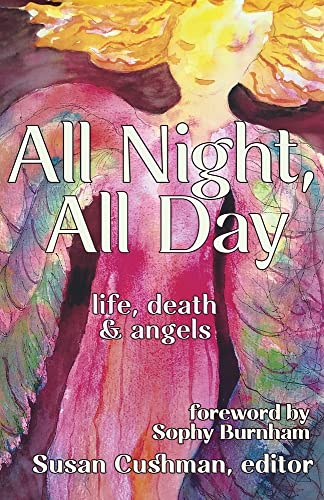
All Night and All Day: an Anthology on Life, Death & Angels.

Author and editor Susan Cushman of Memphis Tennesse had a wonderful idea, and made a call out to some of her literary friends to ask if they would contribute to an anthology on the subject of life, death and angels. Susan wanted to read our stories, and assemble them in the book whose cover you see above. The anthology was just released by Madville Publishing, and it’s available where all books are sold.

It was my pleasure to contribute an essay to the anthology, All Night, All Day. My essay is titled, The Power of Three, and in it I tell the story of meeting the author, Anne Patchett, who, along with two of her friends, arranged for the first art exhibit of their friend, Sooki Raphael’s work. The art show was at Santa Monica, California’s Bergamot Station, and its staging was an act of love by Ann Patchett and her two friends, for at the time, Sooki Raphael was battling the pancreatic cancer to which she would ultimately succumb. Sooki Raphael’s art show was extraordinary, but what impressed me most about going to Bergamot Station that day was being in witness of the supportive power of female friendship.

The anthology is an inspirational collection of personal essays, stories, and poems by outstanding women authors who write about the appearance of the divine in their lives. Some of these angels come to save a life or change a flat tire. Some appear to warn people, tell them what to do, suggest more vegetables and maybe better shoes. They appear as a tap of intuition, a whisper, a whoosh of warmth, a rainbow, or an act of kindness. They are the stranger ministering to you in the hospital, the sound of voices singing in the attic, the sudden light at the window, the man by the side of the road. They are nurses and sometimes they are you. In this stunning anthology which explores so many heartwarming brushes with celestial beings, all these angels are messengers come to assure us we are not alone, and we are loved.-Margaret McMullan, author of Where the Angels Lived

___________________________________________________________________

… an anthology to be savored. This collection includes powerful first-hand accounts, interwoven with short fiction and poetry, beautifully exploring the themes of life, death, and angels. Jewels include Cassandra King Conroy’s unforgettable tale. It takes courage to write the raw truth of last moments, as Renea Winchester did in her touching story of her mother’s death titled “Waiting for Her Angel.” I loved Mandy Haynes’ heartwarming story, “Rose’s Angel” (plus, she’s a lovely person!). “The End” by Lisa Gornick is an intimate, touching tale. I shed tears over Susan Cushman’s “Hitting the Wall.” Within this collection are remembrances and memorials, which pay homage to a loved one or to a mystical experience. At the end, Claire Fullerton’s beautiful, final words offer the hope of peace. Crafting an anthology is an art. Susan Cushman has done a big topic justice-the sum of the parts is greater for having been compiled together. Savor this book…for its wisdom, humor, and truth.-Carol Van Den Hende, author of Orchid Blooming and Goodbye, Orchid

___________________________________________________________________

Stories that evoke a sense of peace, reassurance, and safety, as well as strength and encouragement through reported angelic activities. These stories tell of unexpected humanity and love in the lives of those who needed affirmation of spirituality in the human world. The presence of angels is recounted through brilliant and descriptive imagery and intriguing yet identifiable characterization.-Francine Rodriguez, author of A Woman’s Story

___________________________________________________________________

Life, death, and angel stories are usually only shared with those whom we trust and only during the quiet hours of our souls. Susan Cushman is the finder and sharer of these stories…. She has collected a wide spectrum of authors and encouraged them to contribute their personal stories and poems, thereby giving us a glimpse into their souls and the unspoken truths of our universal beliefs.-Donna Keel Armer, author of Solo in Salento: A Memoir

Here is a recent photograph of the tireless Susan Cushman at Lemuria Books in Jackson, Mississippi as she moderates a panel of contributors to All Night and All Day before a full house of readers!

All Night and All Day is a heartwarming collection of first person essays written by a collective of authors who have wonderful stories to tell. It’s general tone is sensitive and optimistic, deep-probing and thoughtful, and I know you’ll enjoy reading each and every essay as much as I have!

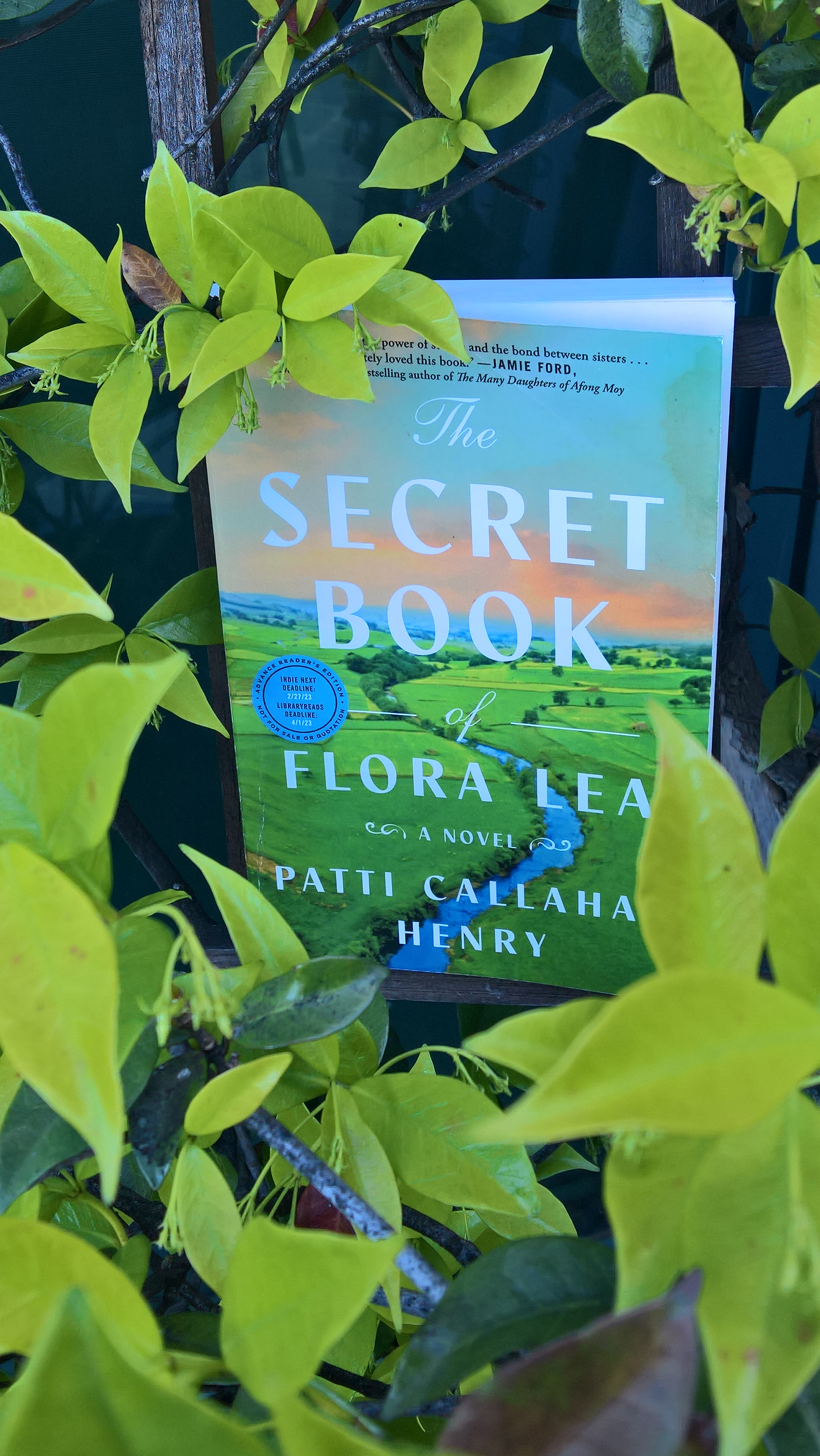
The Secret Book of Flora Lea by Patti Callahan Henry

The world building elements in Patti Callahan Henry’s The Secret Book of Flora Lea are as varied and finely wrought as brush strokes on canvas. In the enchanting story’s two timeframes, the reader is taken into a quaint hamlet outside Oxford; pastoral fields beside the river Thames; a stone cottage with flourishing gardens; the fairy tale setting of Whisperwood; an antiquated bookstore in London’s town center; and, at the heart of the unfolding mystery, a secret between sisters evacuated from WWII London that haunts Hazel Linden well into 1960.

Excited to be taking an upwardly mobile position at Sotheby’s, on her last day of employment at Hogan’s Rare Book Shoppe in Bloomsbury, 25-year-old Hazel receives a shocking delivery from America of a recently published book titled, Whisperwood that dredges up the central wound of her past. The associated guilt Hazel harbors is never far from mind. “The dread. The panic. The jealousy of other people having small children at their side . . . Some days, she’d turn to that loss and acknowledge it, and sometimes, for blessed hours, she would forget, but then the shadow would fall long and fast onto her soul and she’d remember this: She lost her sister.”

Examining the book in hand, Hazel’s thoughts turn to 1940s London and “Operation Pied Piper, “a nursery rhyme name for a horror of an idea” that swept 14-year-old Hazel and her five-year-old sister, Flora, to the countryside during an uncelebrated part of England’s history that saw the children of WWII’s London relocated from harm’s way. “Now in the backroom of the small Rare Book Shoppe, the past overcame her. She’d been searching for her sister for twenty years now, ever since she’d disappeared when she was six years old from the hamlet of Binsey, and now Hazel had a clue, something to grasp on to and she was not letting go.”

Hazel’s devotion to discovering the truth behind the disappearance of her sister drives the story, and at its center is a 1940s fairy tale Hazel made up, intending to distract young Flora from the war-torn reality around them. The story grows in magical increments and begins each time, “Not very long ago and not very far away, there was and still is an invisible place right here with us. And if you are born knowing, you will find your way through the woodlands to the simmering doors that lead to the land made just and exactly for you.” The details of the imagined kingdom Hazel named Whisperwood were kept secret between the displaced sisters. When the book with that title falls into Hazel’s hands, so begins an expertly crafted suspenseful mystery.

The two timeframes in The Secret Book of Flora Lea create high stakes motivation as Hazel endeavors to discover what happened to Flora, while securing her own future. By 1960, Hazel has made a neat life for herself, despite her family’s unhealed backstory. Engaged to a young man from a prominent family and on course as a purveyor of rare books, when the past comes to haunt, questions of life’s priorities come to the fore, tipping the scale to the importance of family.

The supporting characters oscillate with fluid strategy throughout the story, as Hazel Linden, against all odds, refuses to accept the final judgement on her sister’s disappearance. Callahan Henry keeps the reader in character invested suspense. When all characters are brought into surprising alignment, Hazel asks herself, “Is this where hope met despair? Where the past rushed to the present? Where joy replaced the agony of the lost?”

Patti Callahan Henry delivers, yet again, an historically layered, dreamy tale that keeps the anglophile fires burning, on the heels of her acclaimed 2021 release, Once Upon a Wardrobe. Her descriptive detail is cinematic. Fourteen-year-old Hazel Linden, newly re-homed at the Aberdeen’s countryside cottage, gazes out the kitchen window in the hamlet of Binsey: “What a place this was, Hazel thought. All the wide green space to run; the rippling of the sky that touched the horizon of trees unobstructed by a cathedral or tall building. It was as if by taking a simple train ride the world had unfolded, presenting itself in long stretches of rolling hills and heather fields.”

A charming story that weaves fairy tale, mystery, and historical importance with a good dose of romance, The Secret Book of Flora Lea will appeal to all ages, as the author unfurls a fantastic story about “an invisible place right here with us.”

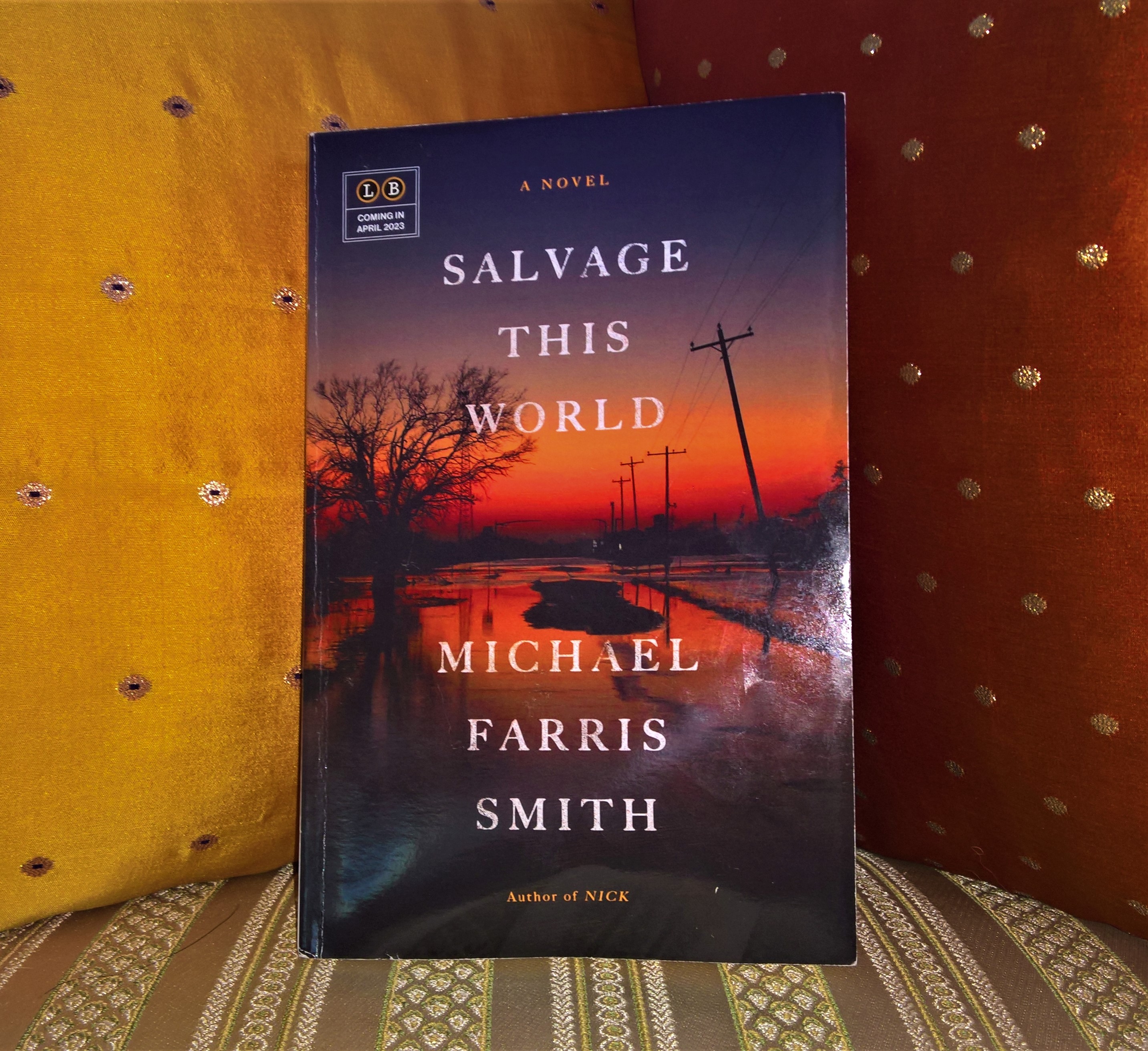
Salvage This World by Michael Farris Smith

As it appears in the New York Journal of Books

Against the kinetic backdrop of a hurricane brewing and a young mother on the run from Louisiana, author Michael Farris Smith cinematically opens his Southern noir novel, Salvage This World, with a literary split screen depicting a phone call Jessie never wanted to make and Wade never wanted to answer. The desperate Jessie is in flight for her life, and the recovering alcoholic Wade never knew how to act like her father.   

When Jessie, now in her early twenties, arrives with her young son in a stolen car at her estranged father’s ramshackle house in Pike County, Mississippi, Wade stands on his porch, lights a cigarette, and thinks, “She didn’t even tell you. And he ain’t even a baby anymore. She had a baby and didn’t tell you and now the baby is a boy, and she didn’t even tell you.”  

Farris Smith sets the stage for characters wanting to connect despite the mutual, deep-seated resentment at the heart of their estrangement, when Wade dares to ask, “Where is Holt?” and Jessie says, “I can’t believe you said his name.”

Holt is the father of Jessie’s son, and his life has gone from bad to worse. A dozen years older than Jessie, the pair met at the local dairy bar, and although Jessie never asks, she knows the scars on the back of Holt’s neck chart his unlucky childhood.  

The current trouble at the center of the story begins with Holt nursing a hangover prior to meeting Jessie. “Three years before, Holt had awakened with his face in the dirt, out behind a cinderblock bar on the outskirts of St. Francisville.” When he sees a group erecting a revival tent in a nearby field, he is intrigued. It is “as if he were not only still drunk but also trapped in a lucid dream of beckoning.”

The woman spearheading the revival is named Elser. Possessed of otherworldly charisma, she drives a hearse and leads the travelling congregation of The Temple of Pain and Glory by preaching us-versus-them sermons for monetary donation throughout an impoverished South so inhospitable it’s now dwindling in population. “No matter the field or parking lot or beaten up town the Temple of Pain and Glory raised its banner.”

As for her lemming-like parishioners, Elser “beat them with the stick of distrust and they cheered their own suffering.” The cynical Holt observes Elser from the back of the tent and knows, “She had them. The small, wrinkled, lightweight monster of a woman had them.”

In it but not of it, for lack of a better place to go, Holt intuits sinister dealings behind the scenes of the Temple of Pain and Glory, and when he witnesses the handoff of a mysterious key between Elser and a dubious character, events take a turn for the worse as curiosity leads Holt to break into Elser’s lodgings to steal them, resulting in his becoming a hunted man, and sweeping Jessie into a life-threatening story.  

It is dark and disturbing dealings against a do-or-die background, and Michael Farris Smith keeps the tension off-kilter while unravelling the broken character’s surprising cause-and-effect connections. Weaving theft, murder, and kidnapping all having to do with the key, a menacing sky is sure to unleash a hurricane any minute.  

The author’s gift for oblique dialogue is scene stealing. The characters speak cryptically in regional dialect telling of their baggage and downtrodden station, and the bleak settings are commensurate with the tenor of the story, when Wade, unwittingly drawn into Holt’s drama, embarks on a high-stakes  mission in the dead of night to parts unknown. It is “A dense and untamed landscape drenched in darkness and rain. Wade drove along narrowed roads and unmarked roads and roads covered in runnels of muddy water and he went down gravel roads and slick roads that ran along overgrown fields and disappeared into thick forests and he searched and searched to find the crossing that would seem familiar to him.”   

Farris Smith is in top form at the layered story’s breathtaking climax, masterfully guiding disparate variables from a slow burn to an incendiary ending with suspenseful detail, multi-sensory pacing, and a future open to interpretation.

Salvage This World is specifically set yet transcends regional fiction. It’s a masterly drawn, tightly controlled story about the lengths one will go to safeguard their own.   

Michael Farris Smith at Square Books in Oxford, Mississippi

Book Review! New Release!

My Last Innocent Year by debut author Daisy Alpert Florin, is an intimate, insightful novel; a 21-year-old’s first-person account depicting her last semester at small town Wilder College in 1998 New Hampshire. The coming-of-age story concerns a fish-out-of-water New Yorker named Isabel Rosen, who’s finding her footing in an elite liberal arts environment where she hopes to become a writer.

As an only child, four years after her unconventional mother’s death, Isabel remains devoted to her hard-working father who owns and operates Rosen’s Appetizing Store in the Jewish neighborhood in which she was raised. Her childhood’s insular world was comprised of, “Orchard Street, Essex Street, Rivington, Delancey, streets, where Jewish immigrants had settled at the turn of the century, dragging their history and sadness behind them.”

As she navigates the road to adulthood on the grounds of Wilder College, Isabel is haunted by the memory of her parents’ tenuous marriage. They’d met when the 25-year-old Vivian walked into Rosen’s Appetizing, when Abe Rosen was 40. Their marriage seemed to be a union of opposites. “My parents’ marriage had always been a mystery to me,” Isabel says. In contemplating her deceased mother, she explains, “My mother was an artist, and her art always came first. . . . She seemed to be searching for something in her work, a life beyond Rosen’s Appetizing and the Lower East Side. Escape. She wouldn’t have been the first artist looking for that.”

The story begins with an ambiguous, sexual experience between Isabel and Zev Neman, an Israeli student at Wilder who might have been too forceful—Isabel lacks the experience to discern. When she recounts the episode to one of her roommates, Debra Moskowitz—a budding, subversive activist—events are set in motion by Debra to get Zev Neman back, no matter the questionable tactics. Isabel is tolerant of Debra when she discovers Debra suffers from episodic depression. Isabel realizes, “I’d seen Debra at her worst, and I’ve found that is often what binds women together. Men admire each other when they are at their best, but women enjoy meeting each other in pits of despair.”

Joanna Maxwell has a troubled marriage. A professor of English studies, she’s married to unstable professor Tom Fisher, with whom she shares a young child named Igraine. Due to their upending divorce proceedings, Joanna forfeits teaching the creative writing class Isabel is scheduled to take to last minute substitute, Professor Conneely. Isabel later reflects, “Connelly was older, married, my professor—there were rules about these things. Later, I would understand there were not rules about these things and would run from inconvenient attraction to a colleagues’ or a friend’s boyfriend, as quickly as possible.”

Professor Connelly was once a celebrated poet. Now in his early 40s, he writes a column in a small-town newspaper and never discusses his failed attempt at writing a novel. Good looking in an unselfconscious way, Isabel attends his writing class and says in hindsight, “I’d had crushes before and I would have them again, but there was something different about this.” “There is something that passed between two people when there was a mutual attraction, a frisson.”

When the taboo attraction between Isabel and Professor Connelly transcends the classroom, parallel lines are drawn with the public scandal between Monica Lewinsky and President Clinton, occurring in the same timeframe, and unsettling Isabel with fear of an unequal power balance. Professor Connelly encourages Isabel to be clear about what she wants, so “there are no misunderstandings.” In hindsight, Isabel says, “I understood well enough what had happened, understood too why he had asked me, back at the beginning of things . . . He had seen the end embedded in the beginning in a way I hadn’t. It was how adults behaved, I knew now, and I would never again not see the world in the same way.”

My Last Innocent Year is written with confessional intimacy verging on stream-of-consciousness storytelling. It’s softly delivered coming-of-age themes pertain to such questions as individuality versus conformity; desire versus boundaries; and passion versus practicality along the road of growing into one’s own. A tale to please YA readers and well beyond, it’s a poignant story that doesn’t shy from sharp edges, universal, timeless, and timely.

Claire Fullerton’s most recent novels are Little Tea and multiple award winner, Mourning Dove. Honors include the Independent Book Publishers Book Award Silver Medal for Regional Fiction, the Reader’s Favorite for Southern Fiction Bronze Medal and various other literary awards.

Buy on Amazon

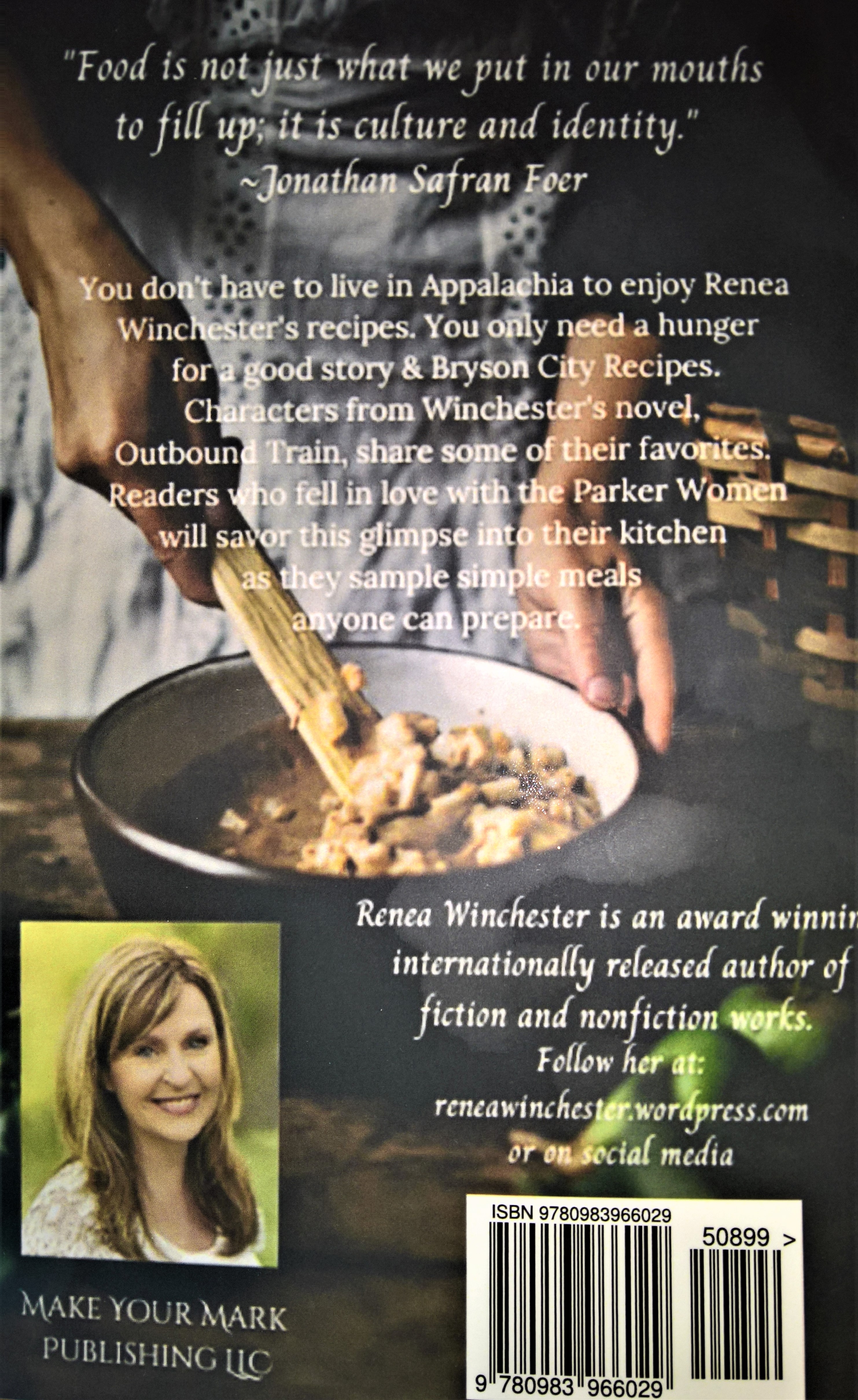
Bryson City Recipes by Renea Winchester is Here!

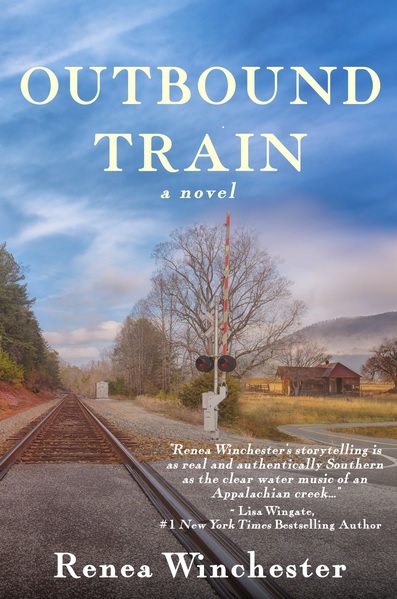
It’s here! The recipe book that acts as a companion to Renea Winchester’s celebrated novel, Outbound Train, and first published in France is now available in the US! Bryson City Recipes was inspired by the authentic characters in the Appalachian set Outbound Train, and the classic, Southern recipes are amazingly easy to follow! From Appalachian Spiced Tea to Macaroni and Cheese with Tomatoes, you’ll delight in this recipe book!

In 1976, memories from a night near the railroad tracks sixteen years earlier haunt Barbara Parker. She wrestles with past demons every night, then wakes to the train’s five-thirty whistle. Exhausted and dreading the day, she keeps her hands busy working in Bryson City’s textile plant, known as the “blue jean plant,” all the while worrying about her teenage daughter, Carole Anne. The whistle of the train, the hum of those machines, and the struggle to survive drives Barbara. When an unexpected layoff creates a financial emergency, the desperate pressure of poverty is overwhelming.
Unbeknownst to Barbara, Carole Anne sneaks out at night to walk the tracks so she can work at Hubert’s Bar. She’s hoarding money with plans to drive her mother’s rusty, unused Oldsmobile out of Bryson City, and never return. She only needs one opportunity … if she can just find it.
When Carole Anne goes missing, Barbara finds herself at a crossroad—she must put aside old memories and past hurts to rely on a classmate for help finding her daughter. But this is the same man she blames for the incident years ago. Is she strong enough—or desperate enough—to do anything to keep her daughter safe?
In Outbound Train, the Parker women struggle to make frayed ends meet in a town where they never quite do … at least, not without expert weaving and a bit of brute force.

Renea Winchester

Renea was born and raised in Bryson City, North Carolina. She began her writing career in Georgia where she penned several non-fiction works including Farming, Friends & Fried Bologna Sandwiches (Mercer University Press) which was nominated for the prestigious SIBA award, earned Renea a nomination for Georgia Author of the Year, and received the endorsement from The Pulpwood Queens, the largest book club in the country. After winning the Wilma Dykeman Award for Essay and the Appalachian Writer’s Award, Renea focused on transitioning to fiction.

Renea has served on the Atlanta Writers Board, Georgia Writers Association, and judges multiple literary awards. In April 2020, Firefly Southern Fiction released Outbound Train. Set in her hometown of Bryson City, North Carolina, in 1976, Outbound Train is a triumphant story of perseverance and hope despite the harshness of poverty.

Renea is passionate about literacy, Appalachian Heritage, preserving rare seeds, cultivating endangered plants and meeting new friends.

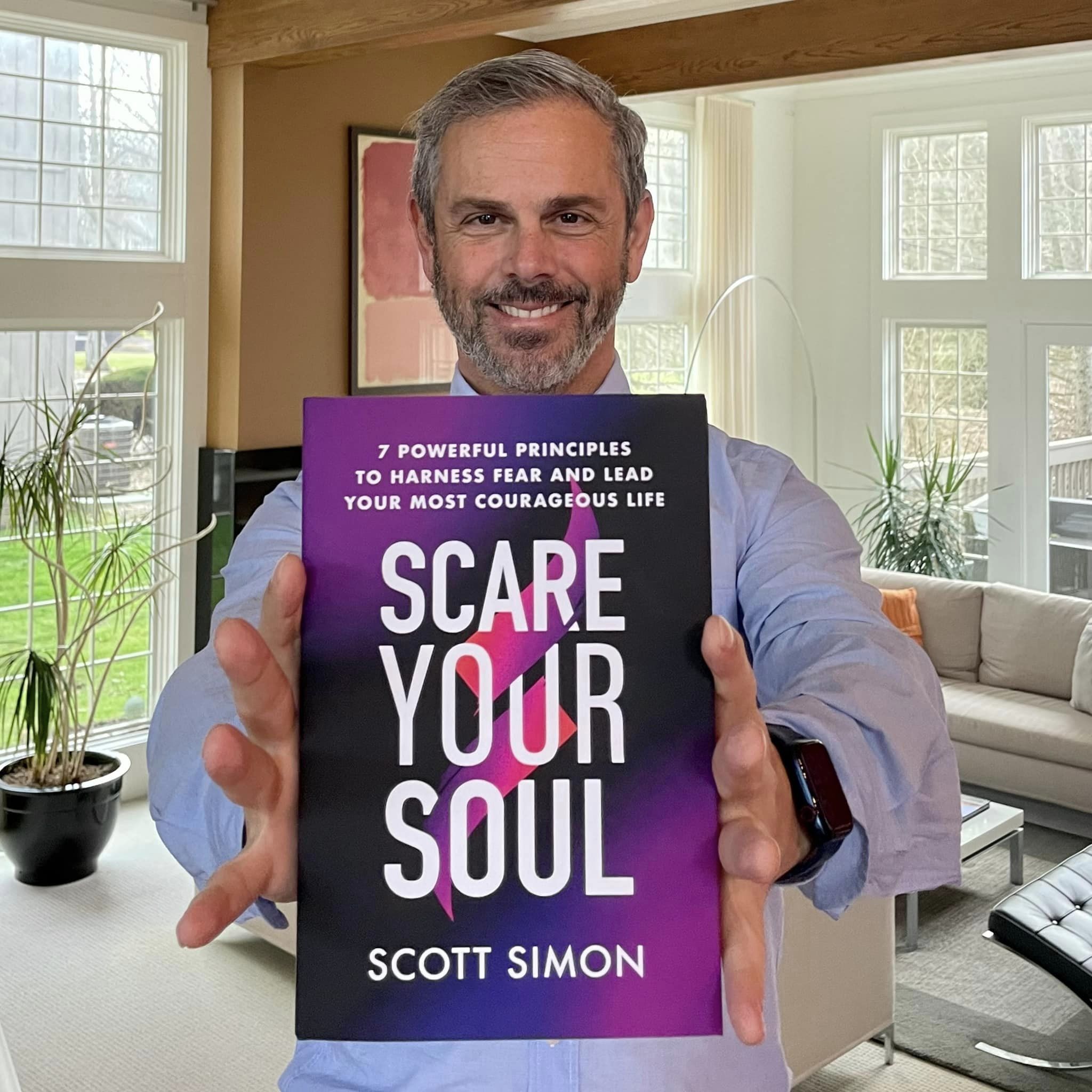
Book Release: Scare Your Soul by Scott Simon

Most books are meant to be read.
This one is meant to be lived.

It’s not easy to be courageous. Feelings of fear and uncertainty often stop us dead in our tracks. But what if you had the courage to take action anyway? What changes would you make to transform your current reality into the life of your dreams?

Here’s the good news — like a muscle, courage grows stronger the more you exercise it. And Scare Your Soul will not only teach you how to exercise courage but will guide you in taking small, boundary-pushing actions to expand your comfort zone (so that you feel less fear and more confidence with each action).

By combining research on positive psychology with real-life stories of Scare Your Soul participants, international thought leader and happiness entrepreneur Scott Simon challenges you to confront your limiting beliefs. With writing prompts, activities, and real-world challenges, Scare Your Soul is an interactive roadmap to building bravery.

Scare Your Soul teaches you that the greatest antidote to much of what ails you in your life isn’t achievement, it’s action. So if you crave an extraordinary life but feel like you don’t know how to take “extra” ordinary action, this book is for you.

It’s time to Scare Your Soul.


Editorial Reviews

Review

“This is an empowering and inspiring book! If you want to lead the life you’re meant to lead, this is the compass you ought to take along.”―Tal Ben-Shahar, author of international bestsellers Happier and Being Happy

“In a world that feels so dark and full of fear, this book is a lantern for the courageous way forward.”―Jennifer Pastiloff, best-selling author of On Being Human

“I used to think being fearless was enough, until I read this book. It’s a game-changer.”―Turney Duff, author of the New York Times bestseller The Buy Side

“For any wallflowers desiring to encompass boldness—this is for you.”―Janne Robinson, author and poet –This text refers to the hardcover edition.

About the Author

Scott Simon is a happiness entrepreneur and founder of Scare Your Soul. He is dedicated to creating, curating, and leading opportunities for people around the world to be happier and more courageous. Scott founded the Scare Your Soul organization in 2015, organically growing it from one Facebook post to a global movement with sixty volunteer ambassadors worldwide. He has presented to groups around the world, appeared widely on TV and podcasts, given a TEDx Talk, and brought his passion for courage to retreats, a life coaching practice, and mindfulness meditations in person and online.

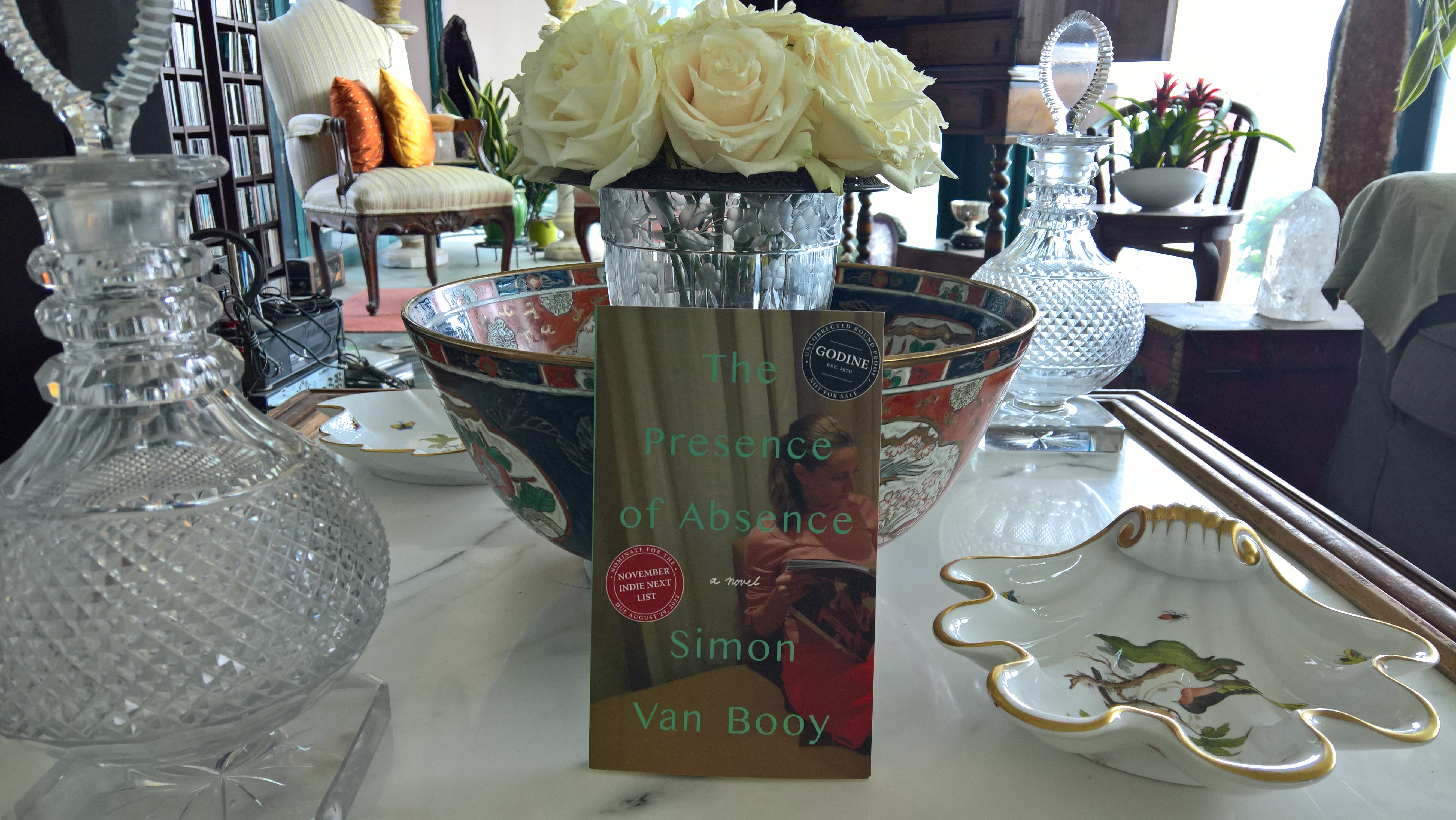
Book Review: The Presence of Absence by Simon Van Booy

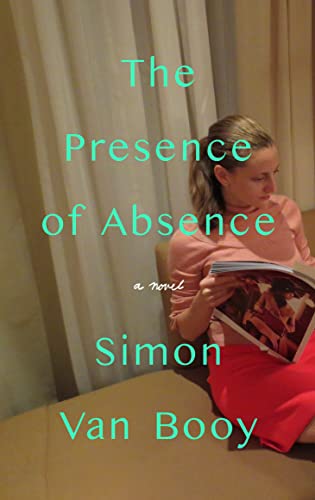
The Presence of Absence

Image of The Presence of Absence

Author: Simon Van Booy

Buy on Amazon

Reviewed by: 

Claire Fullerton for The New York Journal of Books

Max Little is dying and wants to leave behind something of his life. A young writer of novels, novellas, and short stories, Max grew up in Wales, is of Pakistani descent, and now reclines in a New York hospital bed, in full acceptance of his terminal illness.

Not wanting to beg the reader’s pity, Max does what he does best by writing, and begins his straightforward narrative by marveling at the magic between reader and writer: “You do realize that by turning the page you’ve decided to follow a complete stranger down a possibly meaningless path?” he says. “Stories lead us behind the curtain of somebody else’s life into the deepest chambers of our own.” Max considers that by the time the reader puts eyes to his words, he, himself, might be absent. “None of that matters,” he assures, “because our lives are braided here and now by this sentence.” Seemingly delighted to embellish his point, Max continues, “For instance, I’m writing this in the present, and you’re reading it in the present. Except there is a gulf of time between us. I might even be dead. Yet here I am.”

In Simon Van Booy’s extraordinary novel, The Presence of Absence, each well-wrought sentence builds upon the next, taking us deeper into Max Little’s life with staggering lucidity. The first part of the story is constructed in descending numerical chapters that decline with a sense of fatalism as the narrator reconstructs his life’s highpoints interspersed with uncanny, existential observations on the business of life, death, and dying. Max confesses his mind’s innerworkings with adroit ease. “Do people ever walk around their homes, wondering which room they will die in? Whether it will be a Wednesday night or Saturday morning at the table with toast and coffee?”  And “What would happen to things like knives and forks once I was gone. Would my wife keep them?”

At the center of Max Little’s concern is his wife, Hadley, and the reader is taken to their first meeting even as Max shares his ruminations on how to best tell Hadley he is dying. Pondering his plight alone on a beach, he arrives at a profound spiritual truth, when he comes to consider himself in the third person. Max posits, “When you nurture the ability to witness your life in the third person, in extremis, or through prayer or meditation, there is an unavoidable shift in consciousness as you realize that who you are is not simply how you feel—but a presence beyond desire of any sort.”

Jeremy Abrams’s mother is dying. He comes into Max’s life through the coincidence of their shared New York therapist. The men bond over the similarities in their life circumstances, and as their friendship grows, it is Jeremy who suggests that Max begin keeping the journal the reader now holds in their hands. Max writes, “You might wonder what dying people look forward to. Being visited, yes, but also being left alone—though that takes a lot of practice, managing thoughts . . . I also look forward to reassuring people it’s okay this is happening.”

In The Presence of Absence, Part Two is theatrically introduced as a quick, black scene change. The section brilliantly holds the subheading, Sotto Voce. The third person story moves forward eight years in time, and fittingly alternates between breathtaking poetry, poignant one-liners, and what miraculously transpires from the connections formed in Max Little’s absence. An insight comes at the hands of one such connection, who stands at a sink washing cups in a basin and thinks, “Like the cups draining on a tea towel, absence has a practical value in how it shapes presence.”

A mind-bending, affecting story that breaks the heart open with startling clarity, this book makes the reader want to take pen in hand to underline The Presence of Absences’ passages. That author Simon Van Booy has taken a universal subject most prefer to shy away from and creatively crafted an accessible work of high art is an unparalleled literary feat. The deft use of language in this tour de force fulfills its own mission when Van Booy summarizes, “Language is a map leading to a place not on the map.”   

Simon Van Booy

Simon Van Booy is the award-winning and best-selling author of nine books of fiction, and three anthologies of philosophy.

He has written for the New York Times, the Financial Times, the New York Post, NPR, Poets & Writers, and the BBC. His books have been translated into many languages and optioned for film. He lives in New York with his wife and daughter. In 2013, he founded Writers for Children, a project which helps young people build confidence in their storytelling abilities through annual awards.

Book Review: A Place to Land by Lauren Denton

A Place to Land

Image of A Place to Land

Author: Lauren K. Denton

Release Date: October 4, 2022

Publisher/Imprint: Harper Muse

Buy on Amazon

Reviewed by: 

Claire Fullerton

“Lauren Denton unfurls a mystery by reconciling a buried past with a modern-day story set in a town with vibrant characters brimming with Southern charm.”

A delightful Southern story extolling the deep bond of sisters, Lauren Denton’s A Place to Land has a heartwarming tone as it unravels a 40-year-old mystery coming back to haunt a cast of small-town characters whose lives are entwined in Sugar Bend, Alabama, which sits on Little River, with a population of under 2,000 just a few miles from the Gulf of Mexico.

Violet and Trudy Figg have an extremely close relationship. Now both in their sixties, their bond comes from “more than just being sisters, more than sharing a home and parents and a fondness for chocolate pudding.” From elder sister Violet’s point of view, “It was a single request from their fragile, damaged mother that linked them with something thicker than blood.” “With a father who was often out on the road in his eighteen-wheeler, and a mother who spent most of her energy dodging blows . . . Violet had accepted her role of Trudy’s caretaker long ago.”  

In their youth, the sisters were complimentary opposites. Trudy enjoyed a wide reputation as a popular beauty pageant queen, while Violet was the quiet, introspective sort who spent most of her time outdoors.

The sisters now keep a steady schedule. “Trudy and Violet both navigated life the best way they knew how—for Trudy, it was working with her materials and setting the pieces just right, while for Violet it was through the birds . . . helping them on their way.”

Trudy creates eclectic visual art with the likes of shells, feathers, and driftwood, while Violet works as a surveyor for the Coastal Alabama Audubon Society. Together, the sisters own and operate Two Sisters Art and Hardware Goods in downtown Sugar Bend, where Trudy’s art is sold alongside souvenirs for tourists.

Eighteen-year-old Maya is seeking her place in the world. She’d “been put in the foster care system after the death of her grandmother, and she’d lived in ten different homes since then.” After turning 18, Maya signed the appropriate papers permitting herself to strike out on her own, and following her instincts, she stumbles upon the quaint town of Sugar Bend, which leads her to Violet and Trudy. After a dubious beginning, the sisters come to embrace her.

Frank Roby has an unhealed past with Violet. A retired law enforcement officer, his long ago romance with Violet came to an inexplicable end, which caused him to jump at the first opportunity to accept a job in another town. After 40 years, Frank moves back to Sugar Bend from Pensacola as a widower. In rekindling his interest in birds, he goes to a class at the local Audubon Society, where he is unwittingly paired as a trainee with 63-year-old Violet. Cautious and still harboring feelings for Violet, he keeps his sentiments for her under wraps.  

Liza Bullock is an outsider who’s worked for a year as the editor of The Sugar Bend Observer. Frustrated by living in a backwater, uneventful town, “If she could find a story with enough meat on its bones, she could write a sizzling expose and land herself at a copy desk in Birmingham or Atlanta.” When a decrepit johnboat “awash with age and river detritus” mysteriously rises from Little River, Liza’s reporter instincts are ignited.

Frank Roby’s nephew works as a Sugar Bend policeman and is in the habit of asking his retired uncle for assistance. When he asks Frank to investigate the suspicious boat awash on the banks of Little River, memories of the year 1981 flash to Frank’s mind, when he was a rookie cop in the throes of a promising future with Violet and was sent to the exact location to investigate a domestic disturbance.  

Unbeknownst to the young Frank of 1981, Violet’s sister had recently married local celebrity, Jay Malone, a successful businessman the whole town revered, and who owned the house Frank was sent to look into. At the time, Frank was unaware Violet had fears for her sister, that she suspected there was more to Jay Malone than met the eye, and that the bruises Trudy tried to hide were inflicted by his hand.

Author Lauren Denton unfurls a mystery by reconciling a buried past with a modern-day story set in a town with vibrant characters brimming with Southern charm. Secrets, coincidence, family loyalty, life choices, and questions of right versus wrong as viewed through the lens of the law are woven neatly in two timeframes, seamlessly linking all characters until they each achieve, seemingly by kismet, the perfect place to land.  

Claire Fullerton’s most recent novels are Little Tea and multiple award winner, Mourning Dove. Honors include the Independent Book Publishers Book Award Silver Medal for Regional Fiction, the Reader’s Favorite for Southern Fiction Bronze Medal and various other literary awards.

Buy on Amazon

Book Review: The Old Place by Bobby Finger

As it appears in The New York Journal of Books

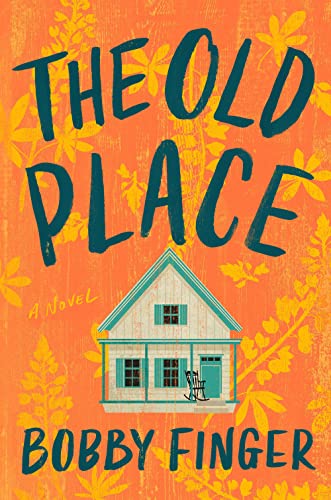
The Old Place

Image of The Old Place

Author(s): 

Bobby Finger

Release Date: September 20, 2022

Publisher/Imprint: G.P. Putnam’s Sons

Pages: 336

Buy on Amazon

Reviewed by: 

Claire Fullerton

Debut author Bobby Finger wields crisp, bright language in succinct, ample prose to reveal secrets deliberately hidden from the norms of social order. . . . poignant and memorable.”

Sixty-three-year-old Mary Alice Roth doesn’t know how to fill her days. Feeling wronged and slightly humiliated over her compulsory retirement as a high school teacher, she’s deeply invested in her local standing as a local Billington authority figure, though she’s unaware the community reputation she’s earned is equally divided between her abrasive personality, and sympathy for her tragic losses.

Thirty-something Josie Kerr is a fish out of water but intends to embrace it. Born and raised in Manhattan, she’s married to Travis, who grew up in an affluent family that owns a five-hundred-acre compound just north of Billington, Texas, a town “passersby didn’t really see until the fifth or sixth time they drove through it, a blip on a blip that existed mostly in retrospect.”  

When news of the death of Travis Kerr’s father arrives, Josie and Travis put their Brooklyn apartment on the market and relocate with their young son to Billington, Texas. Josie’s “New York City friends couldn’t believe how happy she seemed in a town so small it didn’t even have a Wikipedia entry.” The optimistic Josie looks on the bright side. “In Texas she had a house. And she had family nearby. She even got a job at a school where teachers never left unless they were forced out or dead.”   

Mary Alice resents the existence of Josie, whom she considers the usurper of her school position, now that Josie is her replacement. Were it not for her best friend Ellie’s advice, the intimidating Mary Alice might get away with her repeated attempts at making Josie Kerr’s life miserable.

Ellie Hall is a divorcee who works in a nearby hospital. She has been Mary Alice’s friend for years since she and her son, Kenny, moved into the house next door. As single mothers with sons the same age who formed an immediate alliance, Ellie and Mary Alice enjoyed a strong friendship, until the common tragedy of each losing their son in the same timeframe set their close friendship adrift for 12 years, until Mary Alice reaches out to Ellie from the isolation of her retirement, and the two begin to reconnect over the habit of sharing morning coffee.

At “dark-thirty,” a knock comes to Mary Alice’s front door, and she opens it to discover a ghost from her past in the form of her sister, Katherine, who lives in Atlanta. Three years younger, the once close sisters haven’t spoken to each other since Katherine’s wedding decades before. It was a fight that caused their estrangement, and “Their lives had expanded in different directions, but when you followed the stories down to their roots, you’d find them joined in a million different ways.”

The attractive, well-to-do Katherine is there in person because Mary Alice doesn’t answer her texts, emails, or phone calls. Katherine tells Mary Alice she’s there on a mission “to fix your mess,” and demands she return with her to Atlanta.

When Katherine reveals the urgency of a call to action, the stunned Mary Alice knows the time has come to address what she’s taken great pains to hide from the Billington townspeople, with regard to what really happened to her son, Michael, who had a bond with Ellie’s son, Kenny, that was more than anyone knew. Wanting to forestall public knowledge of her duplicity, Mary Alice asks Katherine to wait with her for three days, until she’s on the other side of the annual Billington community picnic, of which she’s in charge.

For three days, the sisters revisit the tragedies of the past, which were centered on their family’s rural, multi-generational property known as The Old Place, which had been in their family since the early 19th century. “It was twenty minutes outside of town. Not east, toward Trevino, or north, toward the Hill Country, or west, toward Mexico, but south, toward nothing.” “Getting there required directions, not a map. . . . You felt the trip there as much as much as you saw it.”

Because it factored significantly as the setting of troubling stories involving both her husband and son, Mary Alice fears ever returning to The Old Place. In recalling a particular night in high school, when Katherine talked her into throwing a party at The Old Place while their parents were out of town, Mary Alice has reason to consider The Old Place unlucky grounds in her personal narrative. She considers that high school party “as the prologue of her life . . . the start of everything else. And all of it, absolutely all of it, was Katherine’s fault.”  

Debut author Bobby Finger wields crisp, bright language in succinct, ample prose to reveal secrets deliberately hidden from the norms of social order. The backstories of intertwined, multiple characters are brought to a common light, thematically including fear of public opinion in a setting that sings the praise of small-town Texas. The characters are fully realized as each reconciles their part in the story. Their mindsets are understandable, and their dynamic creates a delightful arc of plausible cause and effect to immerse the reader in an experience that’s poignant and memorable.       

Claire Fullerton’s most recent novels are Little Tea and multiple award winner, Mourning Dove. Honors include the Independent Book Publishers Book Award Silver Medal for Regional Fiction, the Reader’s Favorite for Southern Fiction Bronze Medal and various other literary awards.