

It’s a long way from Southern California to Beaufort, South Carolina, but there was only one way to attend my favorite author’s 70th birthday celebration. In my mind, Pat Conroy is the king of American literary letters; his gift of lyrical language and sense of place is unparalleled, and I’d have rather flown across the country to meet him than anyone else in the world. Oh, I hemmed and hawed and weighed and measured to exhaustive degrees before I remembered life is short and I should grab onto its once in a lifetime opportunities with both fists. So I booked my passage and accommodation, bought my event tickets online, and attended what was billed as the University of South Carolina’s “Pat Conroy at 70” celebration. It was a three day celebration of Conroy’s work, beginning with the movie screening of “The Great Santini” followed by two days of panel discussions from writers touched and influenced by Conroy’s rarified way with language and prose, and ending with a birthday cake the shape of the shrimp boat “The Miss Lila,” featured in Conroy’s masterpiece, “The Prince of Tides.”
As a writer who hails from the South, I was in my element, yet hadn’t expected to feel this way. All around me were vibrant, chatty book lovers and Southern writers so lit with joy and enthusiasm at the thrill of simply being in this literary icon’s presence that it was like being in an ecstatic beehive with a jury of my peers. In this day and age of instant gratification and technological immediacy, book lovers are an esoteric lot, but you wouldn’t have thought this in the crowd assembled to celebrate Pat Conroy; it wouldn’t have crossed your mind that there was anything else going on in the world outside of the event, and if it had, it wouldn’t have mattered. Within the walls of the University of South Carolina Beaufort Center for the Arts, an overarching spirit of what I can only describe as pure love radiated from pillar to post, connecting each person one to the next in an inclusive, tribal embrace. And there in the midst sauntered Pat Conroy, humble, bemused, self-effacing, and accessible, comporting himself as if three hundred of his closest friends had gathered in his living room.
The thing about book people is nothing else lights their fire in quite the same way as a good book. A good book opens interior doors, calls things by name, and grants permission for the reader to take the risk of feeling outside of the parameters of self-consciousness and vulnerability. A good book tells us we are not alone in this world, that it’s okay to be human, and that there is safety in numbers. I think this is why so many flocked to bask in the glow of Conroy: to many he is the bearer of the cross; the keeper of the literary flame; the way shower who has mastered the art of storytelling in such a way that it suggests there is rhyme and reason to this business of living.
What struck me the most about Pat Conroy is his humility. He is the kind of guy who is baffled by his own impact. He possessed a kind of wide-eyed, child-like wonder at the realization that so many came to attend a three-day conference in his honor. And because he is sincerely interested in writers and what they have to say, he sat in the audience of every panel discussion with rapt attention, as if it were he who had something to learn from the authors who read from their works and expounded on his virtues.
I can’t recall what I expected from the weekend celebration of Pat Conroy’s life, for it has now been supplanted by what actually transpired. All I remember was the demanding, inexplicable lure of wanting to be a part of it because I sensed, in some dramatic fashion, that there would be something for me to take away, to pocket in the archives of my own literary journey that I would value forever. And I will. I will value forever the fact that Pat Conroy has not only shown me what is possible with the written word, but what is possible should one find themselves with the distinction of wearing the mantle of fame and acclaim. Pat Conroy exudes docile grace and a generosity of spirit that takes him outside of himself and into the arena of an inclusive, generous camaraderie with all people. He stands not only as an example of how to comport oneself as a writer, but as an example of dignity and decency in how to be a human being.
Category: Blog Post
On an Irish Bus
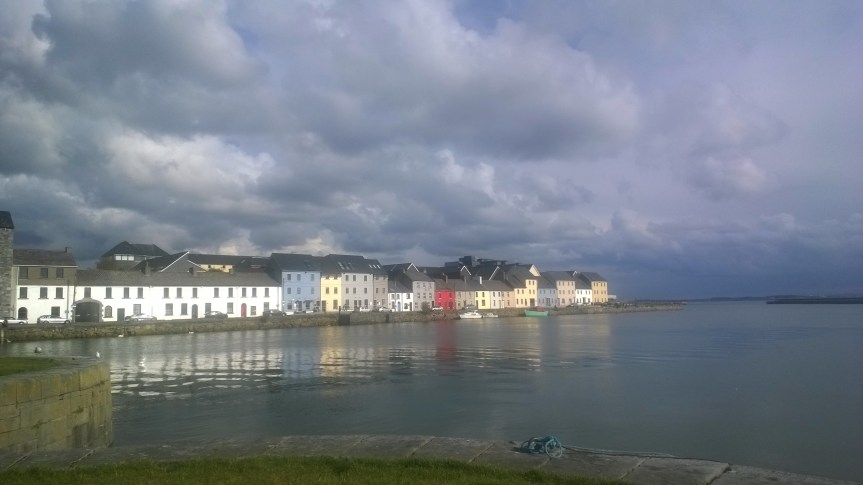
He would have stood out anywhere, and standing in front of the entrance to a boutique hotel in Spiddal, wielding a black walking cane with an ivory handle two paces before made him glaringly incongruous to everything I’d come to know about the western coast of Ireland. He wore a three piece suit on his gentle frame: black, with gray stripes the width of angel’s hair, with a fitted vest, tailored trousers, complementary cravat, and a black Fedora angled just so.
I looked out from my window seat on the bus from Carraroe to Galway. It was one of those old kinds that looked as if it once had a life as an elementary school bus now put out to pasture. With aluminum rails on the seats before, the bus would take off noisily, gravel scattering beneath its wheels before I had a chance to sit down. The bus driver greeted me in awkward English. It took a few rounds of greeting me in Irish before he finally realized I am an American, and his guttural salutation now came out sounding like something a little to the left of “Hiya.”
The bus rolled to its customary stop on the coast road that runs through the heart of Spiddal. There is no sign there; the stop is force of habit because years of driving this rolling route through Connemara told the driver where travelers would be standing shielded from the vagaries of Irish weather.
Heads turned as the dapper, elderly man mounted the bus. He steadied his gait with his cane and favored his right foot up the three steps then halted beside the bus driver to beam his greeting. Out of the corner of my eye, trying not to stare, I saw the man tip his hat repeatedly to the right and left as he made his way down the aisle to the vacant seat beside me.
“Nice day,” he said to me as he took off his hat and placed it on his lap. “Going into town, is it? Where you go every day?”
“Yes,” I said caught by surprise and thinking nothing gets by anybody around here.
“Kearney’s the name, Seamus Kearney,” he offered himself. “You’re an American, yah?” he asked in that way the Irish have of answering their own question.
“Yes,” I answered.
“From the South, is it?” he continued.
“That’s a good ear you have. Yes, I’m from Memphis, Tennessee, but I spent the last five years living in Los Angeles,” I clarified.
“God helps us all,” he said with a wink. “And what is your name, then?” he prodded.
“Claire Fullerton.” I shook his offered hand.
“And your middle name then? Have you Irish connections?”
“Yes, I have Irish connections on both sides. My middle name is Ford,” I said.
“Ford,” he considered, wrinkling his brow. “That’s an odd middle name for a girl.”
“Yes, perhaps,” I said. “But I’m not an odd girl; I promise.”
“Now the Fords, they’re from around these parts. They’re old as the hills and Irish as the soil. Many are up the road in that old graveyard by The Centra,” Seamus Kearney said. “So they called you here, they did,” he said in more of a statement than a question.
“No, actually it was a whim that brought me here. I never knew any of my Ford relatives. Most of them died before I was born.”
Seamus drew in his breath in that audible sigh the Irish do, when they’re getting ready to say something poignant. It is a sound with a world of understanding contained: one part camaraderie, the other commiseration. “So, they called you here, they did,” he reiterated patiently. His white eyebrows raised encouragingly, as if leading a child along the road to good reason.
“Yes, definitely,” I complied.
“Ah then, there it is, so. We in Connemara don’t see the need in being parted by a little thing like death,” he said.
I couldn’t wait a second longer; I couldn’t help but ask, “Do you always dress like this?”
“Like what?” he asked genuinely unaware, which made me wonder if I’d put my foot in my mouth.
“You look so nice; I was only thinking that,” I said, the heat rising to my face.
“Pride of person’s not an unpardonable sin,” he said. “Now let me ask you what it is you do in town.”
The next thing I knew, I was explaining everything I did at my job in Galway, while Seamus gave me his rapt attention, with a pleased look on his face. Had I still been living in Los Angeles, a conversation like the one I had with Seamus Kearney would never have taken place. One simply did not divulge personal information to a stranger in Los Angeles without thinking it would come back to haunt in some unexpected way. But this was Connemara, and the Irish have a way of exchanging pleasantries in a manner that is somewhere between an exploration of and commentary on this business of living. It is an art so subtle you have to narrow your eyes or you’ll miss it; it comes creeping softly wearing white cotton socks and sensible shoes.
The bus rolled to a stop at the Spanish Arch, down by the quays in Galway. I stood up to disembark. “Nice to meet you, Mr. Kearney,” I said.
“Call me Seamus, please,” he returned. “I live just by the church there in Spiddal. I’d love for you to call out any time for a cup of tea,” he said, with his blue eyes smiling.
“Thank you so much, I will,” I returned, and as I got off the bus to head over the River Corrib’s bridge, I turned to wave to Seamus Kearney and knew without question I would.
 Claire Fullerton Author