On the Writing Path

,And so the game changes.

It’s been a fast moving beginning to 2017, but I’ll digress to say that 2016 ended with a cliff hanger, which meant while most people were reveling in the holidays, I waited for the new year to begin and decided I might as well work  on my fourth novel, so I wouldn’t climb the walls over the fact that my third novel was at issue! But things are on track now, and I recently signed a contract with Julie Gwinn, of The Seymour Literary Agency, for representation. There are irons in the fire as I write this, but far be it from me to jinx anything, so I’m going to share a bit about my literary journey over the past few years, in hope that it will lend insight and encouragement to my fellow writers.

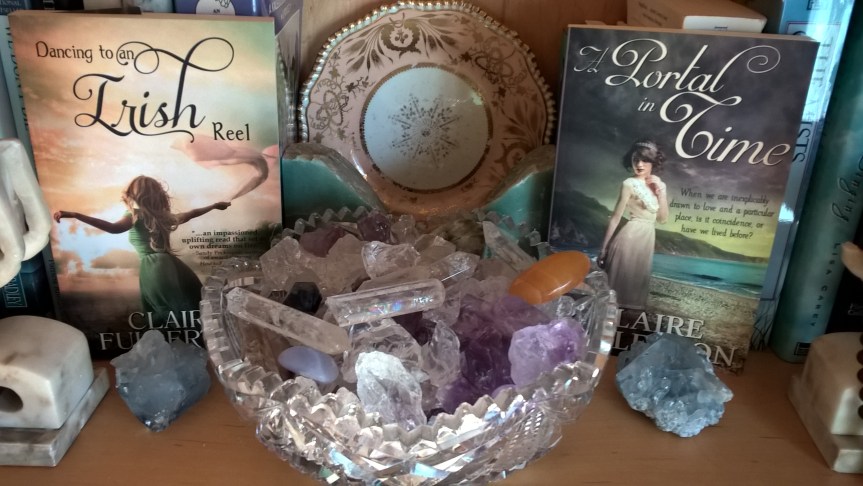
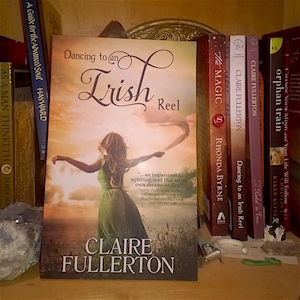
My first attempt at writing a novel began after I moved back to Los Angeles from the west coast of Ireland. Upon reviewing the daily journals I kept there, I realized, if I could craft it well, I had a great story. So, I dove in and completed the manuscript of what eventually became “Dancing to an Irish Reel,” then queried agents interested in commercial fiction, literary fiction, women’s fiction, and everywhere else that would potentially be interested. I had a few bites, yet after a year, it occurred to me that I was an unknown, with little to recommend me as a writer. I switched focus, submitted and was published in magazines then, through what can only be called sheer chance, I caught the eye of the editor of Malibu’s local newspaper, when a white Dove landed on my kitchen patio, and I sent its photograph with a little story of the turmoil the presence of this seraphic creature created amongst our two dogs as it took up roost on the patio for eleven days. Astoundingly, I was offered my own weekly column. Writing this 1,000 word, weekly column taught me the art of brevity, and I acquired a firm grasp on the art of the flow. Yet still, no progress with my novel, so I decided to write another novel, whose premise is a personal interest of mine, and whose idea came to me when my husband and I checked into an historic hotel in Carmel-by-the-Sea, California. I’ll go on and say it here and risk scrutiny: I’m telling you, this hotel was haunted. I knew it because the fine hairs on my arms stood up as I gazed around its lobby. My imagination ran rampant. I knew in my bones that this particular hotel had its origins as a private residence, and after checking with the concierge, I learned I was right. And so I wrote a novel in two time frames about a woman who checks into an historic hotel and comes to realize she has lived before, so familiar is she with every nuance of the setting. I titled the book, “A Portal in Time,” searched high and low for agents and publishers interested in paranormal mystery, and had the good fortune of being offered a publishing contract, without the involvement of an agent. A Portal in Time turned out to be a crash course in not only the publishing business, but in the wonderful world of marketing and promotion. Next, I did what anyone would do, I submitted my first novel’s manuscript to A Portal in Time’s publisher, and Dancing to an Irish Reel came out in March of 2015.

Somewhere, in the swing of all this, I entered The San Francisco Writer’s Conferences’ writing contest, and came in as the contest’s runner up. It was a 3,000 word, non-fiction narrative set in the South, where I grew up. And so I decided I had something to build upon, turned the piece into fiction, and filled it out to 83,000 words. The manuscript is a Southern Family Saga, and in no way fits what my current publisher publishes. And so I began again. Something very promising happened with this manuscript, yet rather than going into what became a false start, I’ll simply say fate intervened and everything came to a halt. I picked myself up and  pressed on with querying agents. Enter Julie Gwinn of The Seymour Literary Agency. I’ll leave you here and report there is great hope for my third book, yet I will reiterate I am not one to jinx things, and I’ve learned a little something about the folly of counting chickens!

I’m sharing “my story” to remind all writers to persevere because I’m still doing so. It’s a long and winding road ( thank you, Paul McCartney) and I’m thinking it’s also unpredictable. The important thing is that all writers recognize that it is enough to be on the road. I’m fond of saying the good news about a writing career is there is no “there” to get to; there is only the fulfilling path.

And while I’ve got you, let me leave you with something the publisher of my first two novels posted. For those of you who are Catholic Christian writers, this one’s for you, and my wish is it creates an open door to your publishing dreams:

https://getvinspired.wordpress.com/2017/01/17/well-be-accepting-pitches-at-the-catho/

Sending great blessings to you all, and, as they say in Ireland,” slainte.”
 

Art for Art’s Sake?

Lately, I’ve been given cause to seriously consider my writing career and to ask myself why I’m truly engaged in the pursuit. Though I am an optimist by nature, it does occur to me that as a universal rule, one can only work with a situation successfully as long as it works with them.  When it comes to most things in life, there is an art to meeting things half-way, to staying in the middle, to watching the dynamic of cause and effect in one’s life, to not over-extending oneself, nor taking things personally. It’s helpful for a writer to keep this in mind when it comes to the experience of rejection. This is not to say that it’s a bad thing to be goal oriented, only that there is folly in putting a time frame on the long range goal. Many writers want to see measurable progress according to their time-table, but this is where we’re best shown that we are not in control. I think the adage of showing up, doing the work, and being unattached to outcome is the aim, but how to seriously achieve this stance of nonattachment; this acceptance of our lack of control? Artists tend to be emotionally involved in their creations. We want to see the fruits of our labors manifest, elsewise, what’s it all for? But I’m going to take this to a soul level and say the soul only wants to create; it wants the experience of creation as its reality, and if one considers art from this premise, then it is enough to create. So the fundamental question for any artist to ask themselves is do you want the glory of the experience, or do you want to reap a reward? The world will tell you success looks a certain way at a particular end and therein lies your validation, but what attitude are we to assume until that fateful day? What price happiness, and how are we to manage within an arena whose premise is to contribute then relinquish control? The thing is, we have no control, and  assuming we do sets us up for all kinds of false premises, wherein frustration, self-doubt, victimization, and all the rest are given license. As a writer, I think art for art’s sake is the answer because we can’t control our reception. We may or may not gain riches and recognition, but if we engage the artistic flow as a way of being in the world and are in the right relationship with its unpredictability,  then I think we can say we’re living a successful life.  It’s not necessary to be the choreographer of the show, it’s only necessary that we are wise enough to dance.

Author’s note: This post is in response to Jason Howell’s  question of the week on his blog, Howlarium, of which I am an avid fan:

Q: How often are you able to create a desired result for yourself by sheer force of will, or by arranging circumstances? Do you ever feel as though the reason you aren’t far enough along is that you haven’t pushed yourself hard enough, even though you’ve worked very hard? In your writing life or otherwise—is control really all it’s cracked up to be? 

Check into Howlarium @ http://www.howlarium.com/

From a Writer’s Point of View

A writer’s life is a build, a constant state of becoming that begins with the secret, intuitive assumption that one must take a leap of faith and begin. There is no there to get to, only an unquenchable need that compels and drives on with inexplicable fervor. For me, it began with keeping a journal. I was young and fearful of admitting my internal mechanisms and uncertain of who would care to hear. But I felt the need to document my life in the hope that the singular act of private articulation would reveal to me who I was in the grand scheme of my self-involved adolescence. This is the prompting that leads a writer to the table; the need to explain oneself to oneself. Keeping a journal discredits all thoughts of life’s arbitrariness and puts the pendulum of cause and effect into clear perspective. One can keep current while they create a framework, then look back years later and chart the incremental construction of their personal history.
But what happens when one evolves from journal keeping to writing as a way of life? Certainly it’s an insular existence that cannot be shared. It’s like taking that running monologue we all have in our head and laying it down on purpose for no other reason than it seems the thing to do. The form of the dissertation is entirely incidental; some writers aim to inform, and others seek to enlighten or entertain. To me, it’s all the same thing: a way of communicating, and for this to happen, it takes time. And isolation. And commitment to following through no matter the length of the project.
I’ve heard it said that writers don’t write because they want to; they write because they must. What’s imperative for writers is the ability to write then throw caution to the wind. All that’s required is to say what you have to say, and then get out of the way to make room for the possibility that the devil may care after all.

The Road to Publication

Strangely enough, I wrote my second published novel, “Dancing to an Irish Reel” years before I wrote my first published book, “A Portal in Time.” My first written novel (which I call to this day “my Irish book”) was a labor of love inspired by the year I spent living on the western coast of Ireland, and the story took up residency in my soul, begging to be shared. Its road to publication was not a predictable one, but it taught me invaluable lessons concerning unwavering belief, the power of tenacity, and the willingness to learn and grow as a writer.

I’ve heard it said writers don’t write because they want to; they write because they must. That’s how I felt about my Irish book, and although I’d never attempted a novel, I was not deterred because I had so much enthusiasm for telling this particular story. I embarked upon the writing of the book with blind faith, thinking all I had to do was tell the story of a single American female who relocates to rural Ireland, and the mere novelty of the setting in this heart-and-soul, fish-out-of-water story would pave the way to certain publication. It didn’t occur to me that my first draft would be one of many, that my book had to be painstakingly crafted, or that the endless process of fine-tuning by rewrites is where the real work would lie.

Once I’d finished the first draft of my Irish book, I sent it to three friends who know their way around literature. To say their combined comments were legion would be an understatement, yet I was encouraged because all three loved the story. I took their suggestions into consideration while I fine-tuned the book then I went over my manuscript three times more until I was satisfied it was in its best shape possible. Next I reviewed the tips in “The Writer’s Market” that pertain to writing a query letter to a literary agent. I composed an introductory letter and over a six month period, I followed submission guidelines and wrote to ten agents hoping for the next step: a request for the entire manuscript. I waited on pins and needles only to receive incremental responses succinctly saying my manuscript didn’t “fit their list.” But with each rejection, I sent out another round of query letters, and eventually found myself in a cycle of protracted waiting, which stretched out for more than a year.

While I waited, I continued to write. I revised my manuscript once again and researched other authors’ road to publication, where I realized they all had one thing in common: they’d each come to the table with a body of work to recommend them. Spurred into action, I began submitting personal essays to magazines that accepted unsolicited material, and began to rack up publications. Next, what I can only describe as an unusual chain of events brought me to the attention of my hometown’s newspaper, where I was offered my own creative weekly column, entitled, “In First Person,” which amassed a local following. At the time I was encouraged by the good things in play, but I still hadn’t found a literary agent. Then it occurred to me that two irons in the fire were better than one.

I took a reprieve from my Irish book and tried my hand at writing another book in a different genre. My aim was to enjoy the process and write the story I would like to read. The result was my paranormal mystery entitled, “A Portal in Time.” When I was satisfied with the manuscript, I researched publishers who accepted un-agented material, with an eye towards those who published similar titles. The rest, I can gratefully say, is part of my career history, for “A Portal in Time” was published by Vinspire Publishing in November of 2013.

When I mentioned my willingness to grow as a writer, it was to say that my work didn’t end with the acceptance of my novel. I went through two rounds with an editor followed by a proof reader. The process was a crash course tutorial in how to shape a book, and once “A Portal in Time” was released, I took everything I’d learned from the process and went back to my Irish book.

Eight months later, I submitted the manuscript of my Irish book to my publisher, knowing there’d be no guarantee. But fate can be kind, and at the recommendation of my publisher’s acquisitions department, I was offered a contract for “Dancing to an Irish Reel.”

It occurs to me now that my first book took an unusual course to publication, but in hindsight, many elements had to align. Summarily, it wasn’t enough to know I had a good story; I had to have enough faith in the book to wait through its many revisions. But first and foremost, I had to be willing to learn and grow as a writer.

An Author’s Long Range Plan

When an author completes their first book, there are salient questions they should ask themselves, with regard to what to do next: does my world revolve around seeking publication of this particular book, or is there a bigger picture? Do I simply want to get this book out in the world and rest on my laurels, or do I want to plot a long range career? If it is a long range career one wants, then an author has to be practical. Most of us begin as complete unknowns, so there is the imperative need for a peculiar mix of patience, perseverance and humility. The road to Rome wasn’t paved in one day, and all of that. Everything is a build.

It is a huge accomplishment to finish a novel. Huge. Once this is completed, pat yourself on the back, then honor your work by getting your manuscript in its best shape possible, whether this means finding a reputable editor, acquiring beta readers, or going over your manuscript fifteen times yourself. Next decide how you want to get your book out in the world. If you’re not interested in self-publishing, consider your book’s genre, check the market, see who is publishing your kind of book, then figure out how to approach them. Do you need an agent? Are there publishing houses that will accept your manuscript without an agent? What is the best way to go?

I say do both. Get ready to introduce yourself and your manuscript to both an agency and a publishing house by writing the best synopsis and query letter you can. Do your homework with regard to agents and agencies. The questions to ask are: who are their clients; where have they placed their authors? If you plan to go directly to a publishing house, the same questions apply.

I want to now point out the good news for first time authors: in this day and age, there are many small, independent presses that all operate like “The Little Engine that Could.” They have an ethos as a business that is applicable to a healthy mind frame for first time authors, meaning they believe in themselves and have a long range plan based on the fortitude it takes to build something of value. They need you as much as you need them.

Once a first time author places their book, the real work begins. This is where the crash course tutorial commences regarding what is expected from authors. The entire game comes into focus once you’re in the arena, much of which comes down to marketing and promotion. The idea is to work your book to the point that you find your readership. Once you’ve mastered this, you’re ready to begin again with another book, and this time you know what to do, having been put through the paces.

It is my impression that once an author aligns with a publishing house, their career will take on its own momentum, much of which is self-directed. But it helps to have a long-range vision going into it and commitment to staying the course.

The Gifts of Online Community

What’s important for an author to consider is once their novel is out in the world, the repercussive work that ensues becomes all about connections. It happens organically from the state of affairs at play in today’s publishing world, which is to say that authors are expected to be actively involved, not only in promoting their books, but in simply getting in the online traffic and more or less presenting themselves.

Readers want a face with a name, they like to discover similarities between themselves and the person behind the words, and they can find this via the social media community, where edges are often blurred. Pinterest, for example, is a great author platform on the one hand, but on the other, an author can establish boards that declare their love of dogs, their affinity with a certain region, the city or town in which they grew up, and a myriad other creative possibilities that give a follower something in which to connect with an author as a person first.

Twitter affords similar opportunities, and what is imperative to keep in mind about Twitter is that it is an ever-expanding network with endless connective possibilities that come in all manners. The ethos of Twitter goes beyond the act of following someone who follows you back; it’s all about staying engaged, promoting books by other authors, retweeting something that resonates with you out of the goodness of your heart, and basically staying in a flow that lets you present who you are as well as your interests.

I’ll venture to say it is the same with Google+, Facebook, the WordPress blogging community, Tumbler, About.me, Instagram, and a host of other platforms. All are online forums in which an author can make themselves known, and have it be about way more than just their books. The way I see it, with regard to authors, as long as they’re on these social media outlets, they may as well have fun.

I think there’s much to be said for authors coming to the social media table without an iron-clad agenda. They can let their contacts with people be about sharing, connecting, and supporting those with similar interests. Certainly social media is a great place to promote books, but at social media’s foundation is a sense of community, and this can be its own reward.

Of course, all this is not to say that authors shouldn’t come to social media without a plan; just that it doesn’t need to be a constant, self-orientated agenda. I think it’s best to consider social media and online forums as a place to connect with people who share common interests, and to stay engaged out of that sense of that commonality for its own sake.

Certainly, there are different vantage points from which to engage in social media. The good news for authors is that all of them create a ripple effect through the habit of that engagement. If your contacts regularly see your posts and like what they see, it stands without question that they’ll look into your profile, which is where they’ll get the great thrill of discovering your books!

Author of the Week: Claire Fullerton

Thank you so much, Tricia!

On Giving an Author’s Speech

Wednesday, November 25, 2015

On Giving an Author’s Speech

By Claire Fullerton

I was recently invited to give a speech at The Pacific Grove Museum of Natural History, in Pacific Grove, California. An acquaintance of mine, whom I met at one of my book signings, is the museum’s Director of Public Relations. He thought the invitation would avail a great opportunity for me to talk about my two novels, one of which is a paranormal mystery set in nearby Carmel-by-the-Sea. After I jumped at the invitation, I started considering the audience. It would be an erudite group, interested in local history, which implied I better show up with dates and historic facts. But these are not elements in my paranormal mystery, and neither are they essential in my literary milieu. As I pondered my predicament, something occurred to me: anyone who makes a plan to suit up and attend an author’s event is interested in writing. They are somewhere on the path between aspiration and fulfillment in their own writing career, and therefore would like to hear an author articulate their findings along the road to publication and perhaps elaborate on their writing process and attendant lifestyle. I therefore decided to make my speech less about my books and more about encouragement along the road to publication.

I freely admit I am not an organized speaker. There are those who draft an outline and hit its notes in a planned cadence, but I’ve never been the sort to do well when boxed in. I need wiggle room and natural flow. I need to feel I’m in a conversation, as opposed to giving a lecture. I want to feel I’m contributing something of value in give- and- take forum, even if I’m the only one talking. And because I grew up in Memphis, when in front of an audience, I feel the need to employ Southern hospitality. Keeping this in mind, after the museum’s director introduced me from behind a podium, I thanked him for the nice introduction, ignored the podium, and pulled up a chair in front of the audience, the better for us all to feel at home.

I shared notes on the rewarding dynamic that has built my writing career: the push and pull that began with an intuitive whisper suggesting I should write something, for no other reason than the whisper wouldn’t leave me alone and was starting to bother me, in that way unutilized potential does, until it takes up square residency and won’t go away. I outlined the steps I took on the road to the publication of my first novel, which included my own newspaper column, contributions to magazines, and multiple publications in the “Chicken Soup for the Soul” book series, followed by a complete leap of faith in the draft of my first novel. I said that in my opinion, the act of writing is not so much about ambition as it is about the need to share my impressions of the business of living; that to me, it’s a prompting worth following, for no other reason than one feels compelled. But writing is a lonely business and one has to be okay with being in it alone. Writing is also about commitment, for one has to decide every day whether to be directed by self-discipline or self-doubt. Then there is the tendency to measure oneself against other writers, which is a complete waste of time. One has to write for the sake of writing, which brought me around to my most salient point.

When I think about art for art’s sake, I think of writing. If one is comfortable doing the task for its own sake, then I believe there are mysterious, uncanny forces that guide a writer onward in increments, until the sheer act of perseverance creates a body of work. When this happens, a writer can make a choice about what to do with it, keeping in mind that few writers ever definitively arrive, that there is no there to get to, and that there are only the stepping stones along the way of what becomes their writing career. A writer’s career creates itself if one holds true and stays the course. It is alchemical magic, the result that manifests from making repeated offerings via the written word and the bravery it takes to share.

After my speech, I invited questions. It was a half hour of unscripted banter, something of which an author cannot prepare. What I learned from the evening concerns the power of good intentions. If an author arrives in the spirit of helpfulness, with the intention of sharing their findings as encouragement and is willing to tell their story, then there is no need to be anxious before an audience and everything turns out better than if it had been planned.