
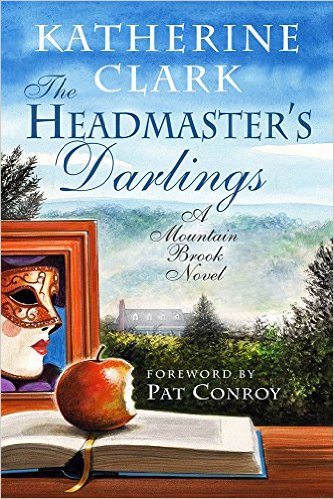
Oh, the sheer joy of this book, which is not outweighed in the least by the rarity of coming across a writer with complete command of language and craft. The Headmaster’s Darlings has so much excellence going on that it’s a challenge for me to know where to slather my gushing praise first! Within its 245 pages of the tightest, page-turning story I’ve read in as long as I can remember, there is comedy, sarcasm, heart-tugging sentimentality, social commentary, and suspense to the point where, when I wasn’t laughing out loud over Katherine Clark’s spot-on Southern cultural insight, I was re-reading her laser-sharp paragraphs as if they were a writer’s tutorial. Crisp, clever, economic sentences lead the reader through the story of the obese Norman Laney, a beloved high school teacher in Birmingham, Alabama, whose job lays in the balance of rumor and false accusation. But it is 1980’s Birmingham society that is judge, jury and executioner, and Norman Laney knows how to game the system. So wise to the eccentricities of an insular, antiquated, upper-class society, Norman Laney beats them at
their own game by being one of them. He is both fish-out-of-water and ruler of the roost in a story that is part comedy of manners and part
emperor’s new clothes. It is not so much the story as the telling of the story that makes or breaks a book for me. Kathrine Clark gives us her all, nay, way more than we expect in sardonically laying bare the mind frame of Birmingham, Alabama’s cloistered elitist society, whose aspirations are maintaining the status quo. Yet Norman Laney is a teacher of principle and integrity, in the field for all the right reasons, which he has to keep under wraps, lest he startle society’s neat and resistant grid of logic by which it defines itself. Written in a tone that both laughs and bites at the nuances of Southern society, there is an undercurrent of nonjudgmental acceptance of a culture as old as the hills as it seeks to raise its next generation in a manner that aspires to keeping it so. Yet it is Norman Laney’s aim to teach his students to aspire to at least something by reaching beyond themselves, and he must lead by appeasing Birmingham’s old guard as he acts as guidance counselor to their offspring. The Headmaster’s Darlings is more than a comedic social commentary on a staid Southern mentality that will be its own hubris in the end; the book doles out a lure that shows the way out, and slips it in undetected from the cunning lead of one impressionable teacher, who knows his way around covert maneuver. I understand there are two more books behind this one. My hand hovers in anticipatory wait over my Kindle.
Author: Claire Fullerton
Claire Fullerton is the multiple, award-winning author of four novels and one novella. She is a contributor to multiple anthologies and enjoyed her time reviewing books for the New York Journal of Books. A Shakespeare enthusiast, Claire is currently studying Shakespeare for the stage. Look into Claire on Goodreads.
Interview by Coreena MacBurnie on author Claire Fullerton
Author Interview: Claire Fullerton
Today I have Claire Fullerton on my blog. Her book is set in Galway, Ireland, the place my grandparents were born, so I am thrilled to have her here talking about her book.
Hello Claire. What book are you promoting right now?
My second novel with Vinspire Publishing, which is contemporary fiction, set on the western coast of Ireland, and entitled “Dancing to an Irish Reel.”
 How did you come up with the idea for your current story?
The idea for the novel came from the year I spent living and working in Galway, Ireland. It was an incredibly pivotal and eye-opening year for me, as I lived as an outsider in rural Ireland, and everything was new and fascinating. I took much of this story from true events and based some of the characters on people I met and worked alongside. The story is fiction, but set in the area where I actually lived.
Tell us about your writing process. How do you fuel your writing?
I have now written three novels, and my process has been the same throughout all of them. I treat the project as a full-time job, which means I am at my desk, coffee in hand, first thing in the morning and typically stop around four in the afternoon, but I do take breaks. What fuels my writing is having the complete story in hand and the motivation to craft it as a continuing project until the first draft is finished. Then I set the draft aside for a couple of days, and go back through it line-by-line with a fresh perspective. I typically go through my manuscript five or six times, and have found the trick to be retaining an overview of what is on every page. I like to be as familiar with the manuscript as if it were a one thousand word essay because this lends to continuity with an eye towards the ebb and flow of the entire story.
What is your favourite scene in your book?
I’m so glad you used the word scene, because this is literally how I write my books. I see the entire anatomy of a scene in my mind’s eye and write it as if it stands alone. My favorite scene in “Dancing to an Irish Reel” begins when the narrator, Hailey Crossan, goes with the Irish musician, Liam Hennessey, to a pub in Clifden, which is a village fifty miles away from where she lives in Inverin. It is a long drive through the breath-taking, but desolate region of Connemara, where there is nothing but uninterrupted bog land forever, until the moment Clifden comes into view. Liam Hennessey is a guest musician on this particular night, so Hailey stands amidst the audience, well aware of the captivating, salt of the earth locals around her, and finds herself engaged in a series of memorable conversations, which could only happen to a stranger in a strange land. I went out of my way to describe what it feels like to be in an Irish music venue, where everybody seems to know each other, and I gave life to the musician Liam Hennessey’s art as he played in a trio to an adoring audience.
Tell us about your main character? What makes her so special?
Hailey Crossan is a twenty-five year old American who takes a sabbatical from her job in the Los Angeles record business and takes a trip to the west of Ireland, where she is unexpectedly offered a job in the music business that is too good to refuse. I wrote “Dancing to an Irish Reel” in the first person, so it is Hailey’s voice the reader hears as she tells about her surroundings and the people in it. Hailey is confident, insightful, adventurous and able to hold her own in unusual circumstances. She realizes she must acclimate to the social and cultural nuances of rural Ireland, and canny enough to go with the flow as she navigates the region. What is so special about Hailey is she sees clearly when she meets Liam Hennessey, who is a regionally famous musician who has never been in love. So unbalanced is Liam at the prospect of love that he can’t decide if he should come closer or run away. Hailey suspects his confusion may have something to do with the inherent culture clash between them, but she remains open-minded, even subtly amused throughout a dynamic that plays itself out like the push and pull of love’s ambiguity.
What would you like readers to take away from your book?
Such a good question, and o ne I am enthusiastic to answer: I wanted to write a story about a dynamic I think happens to everyone at one time or another. It involves the initial stages of attraction, when two people meet and are clearly interested in each other, but unable to fully understand one another. There is always such hope and excitement in the initial stages of love, but there is also uncertainty, doubt and, often times, confusion. It is during such straits when one turns to their friends and says, “He’s saying this, but acting otherwise; what in the world is going on?” I love the subject of what really goes on behind the scenes, so I gave the reader Hailey’s thoughts as she is coming to know Liam Hennessey. What I want the reader to take away from “Dancing to an Irish Reel” is that love rarely has a smooth course. My intention was to write a book that is true to life.
What do you read? What are your favourite books and who are your favourite authors?
I am a fan of the well written, first person story. I find this easier to connect with the author than any other point of view, so I favor reading and writing in the first person. The authors I admire are Pat Conroy, Ann Rivers Siddons, and Donna Tartt; all have mastered this craft. Pat Conroy’s “The Prince of Tides” is my favorite book of all times, and is an American classic by quite possibly the greatest Southern writer living today. I like to read the masters of fiction because it informs my process. I am not a genre reader beyond fiction, and when I read fiction, I want to learn something significant about language and craft.
Do you have any advice for someone starting out as a writer?
The first stage is writing your book, however it is that you do that. Worry about everything else after you are satisfied that you have your best effort put forth. Next, get the book “The Writer’s Market” and familiarize yourself with the publishing world. From here, you can decide to submit to a traditional publisher, look for an agent, or self-publish. Be realistic in what you are prepared to do with regard to the work behind promoting your book. I don’t know about self-publishing because I’ve never done it, but if this is what you decide to do, align yourself with people who know the score.
How do you market your books?
I am thrilled to report that Vinspire Publishing has taught me everything I now know about marketing and promotion. Before I signed with them, I hadn’t a clue what was expected of me in order to get the word out that my books exist! Vinspire has done much for me, but in this day and age, it seriously falls to the author to be everywhere on social media. I spend a lot of time connecting with other authors, ferreting out book blog sites, promoting other authors, posting on Twitter, Facebook, and everywhere that will have me. I also repeatedly hold book signings because I believe in the merits of showing up in person!
How do you get book reviews? Has this been successful?
Before my books came out, I sent an advance copy to three authors with noteworthy careers and asked them for a review with the understanding that a ‘blurb” from their review would appear on the back cover of my book. If you look towards doing this far enough in advance, it is advantageous. All other reviews have come to me organically, but there have been times when a reader posted on my author Facebook page reporting they’d liked my book, and I’ve come right out and politely asked for them to post a review!
Who or what encouraged (or still encourages) you in your writing?
I am encouraged by brilliant writers. I am inspired by those who have literally mastered the art of writing a novel. It isn’t easy to do, but writers learn from reading other writers; many are way-showers with regard to the written word’s possibilities, and I think it is imperative for a writer to be a perpetual student. I never compare myself to other writers, but I do applaud those who do it well. It was from reading good writers that I said to myself, long ago, “This is what I want to be able to do.” So it is a constant state of becoming and a willingness to stay the course, but the aim should be to continue to grow as a writer. This is why I continuously read.
Is there anything else you’d like to share?
Yes, I am the kind of writer who loves to help other writers! I will answer anything that anyone would like to ask. I think writers can and should rub shoulders with other writers. We’re all on the same path; some ahead, some behind, so none of us should be hesitant to ask for directions!
Thank you so much, Claire, what a great interview. I love your insights into living in rural Ireland and your thoughtfulness around the first stages of attraction.
How to connect with Claire:
Website ~ Blog ~ Goodreads ~ Amazon ~ Facebook ~ Twitter ~ Pintrest ~ Linkedin ~ Instagram (cffullerton) ~
Direct Links to Purchase “Dancing to an Irish Reel”
![DancingtoanIrishReel2 200x300[1]](http://coreenamcburnie.com/wp-content/uploads/2016/01/DancingtoanIrishReel2-200x3001.jpg) Amazon Books and Kindle
Amazon Books and Kindle
Barnes and Noble Books and Nook
Direct Links to Purchase ”A Portal in Time”
Amazon Books and Kindle EBooks: Link
Barnes and Noble Books and Nook EBooks: Link
Google Play: Link
Kobo: Link
Please follow and like us:

Happy New Years: SHARE YOUR WORK HERE!
How Generous of Brittney Sahin!


HAPPY 2016!!
It’s that time again.
Please share your book(s) &/or blog links now through January 5th!
For those that are new to this post: Once a month I invite fellow authors &/or bloggers to share their novels and blogs. I invite everyone to post links to their personal websites, other social accounts, or advertise a link to BUY (if applicable). Use this space to BRAG about your blog or what you have published! Be proud of your hard-work & not embarrassed to self-promote!
If you have a book for sale (or upcoming)- I will add your book to my list of “authors to read” by the genre – See example here: Authors to Read!
For those who have posted before: Feel free to advertise again. Or- if you have a different book you would like me to add to the list (or different link to buy)- please include it.
Example:
Title. Genre. Release date (if…
View original post 49 more words
Taken into an Irish Confidence

This Irish vignette has stayed with me throughout the years, the way poignant moments tend to do. It was only a moment, really, yet even at the time I could have told you of its impact; there was something about sitting in Pol’O’Phoil’s porch on the coast road in Inverin that made me think I’d truly arrived in Ireland, that I’d been invited into its inner sanctum and was a part of it now, even though I’d heard time and again that the look of me would have eventually done the same.
The first time I met Pol’ O’Phoil, I didn’t know he was a big deal. I’d struck up a conversation with a woman in a café on Galway’s High Street, who was in for the day from Carraroe. She sat with her bags clustered around her: the red and white stripped plastic kind with the flimsy handles that are doled out in every shop in Ireland. She’d swept them aside to make room for me on the red naugahyde community cushion against the café’s wall, and I’d scooted in gratefully as she accommodated while saying “You’re all right, there.” Her name was Kathleen O’Toole, and she wore her gray hair swept up in a bun over her round, blue eyes. Somewhere in her mid-sixties, I remember marveling at the quality of her skin: fair and translucent, the color of cat’s cream in porcelain, with high coloring that took up residency on her cheekbones and made me think of my mother.
I’d only been in Ireland a week. I’d flown out of LAX to Dublin on Bloomsday, spent four days in Rathgar at the friend of a friend’s apartment then taken the train across the island to Galway’s Eire Square because I’d been told the west would fulfill the vision I held of Ireland: rolling green fields cut through with gray stone walls on the way to the steel-gray sea. So it was here in the café on High Street that I told Kathleen O’Toole I’d be staying for a while; that I’d been offered a job at The Galway Music Center, and needed a place to live. “Where are the fields with the gray stone walls?” I’d asked her, and without hesitation, she replied, “You’ll be wanting to go to Connemara; you should take the bus to Spiddal and call into Pol’ O’Phoil.”
I stood shoulder to shoulder with Kathleen O’Toole, in front of a music venue named The Lisheen, waiting for the bus out into the countryside. When the bus appeared, it took me by surprise: it was one of those high, huge touring kinds, glossy and black and ominously official. It pitched and rolled through Salthill then turned left on the coast road, and came to a teetering stop in Furbo and Barna, before it touched down in Spiddal, where I thanked Kathleen O’Toole and disembarked. I couldn’t tell you now, exactly where Pol’ O’Phoil’s office was, but I do know it was amongst a cluster of shops along the side of the coast road. I was so new to Ireland at this point that I was swimming with disorientation over the sheer novelty of everything, but I found Pol’O’Phoil’s office because it was the only one with a glass door. He was on the phone when I walked into the worn, linoleum floored room, and I felt his wise owl eyes take my measure knowingly because everything about me screamed American outsider. He hung up the phone and listened patiently as I gave him my complete story, which he nodded through with his poker face as if he’d heard it all before. Without preamble, he reached into his desk drawer and presented me with a lone key topped with orange plastic. He laid it on the desk between us and said, “Now,” which I later learned is the Irish way of completing a transaction.
The place I rented was a one level, two bedroom holiday home in Inverin, with a kitchen and living room behind a spacious glassed-in porch. It was one of four positioned in a row on the same property beside Pol’ O’Phoil’s house; all perched on a hill overlooking the coast road, facing the boundless fields that ambled down to the sea. It was the modern architecture of the holiday homes that told me Pol’ O’Phoil was a forward thinker, for his real estate was glaringly dissimilar to the white-washed, thatched roof cottages peppered throughout the region nearby. In time, I learned his particular vision was the magnanimous sort, for he elected to do his part in bringing this particular stretch of Connemara up to state of the art standards in his capacity as local mayor, and that it was he who saw to it that the Knock Airport was constructed to fly passengers to the Aran Islands, although it was not he who laid this information bare. It seemed Pol’ O’Phoil had a certain reputation in the area, and word eventually drifted to me from the lips of locals that he was impressively well respected, even revered in the little area that was not much more than a certain stretch of the road.
And so it happened, one early evening, that I came to call round to Pol’O’Phoil’s back door to deliver my monthly rent. The kitchen door flew wide in mid-knock, and there stood Pol’O’Phoil’s wife, wearing an embroidered apron and wielding a wooden spoon.
“I was just after making dinner for himself,” she said, when suddenly a voice filtered from beyond, inviting me in. “Well then,” she said, then turned her back to lead the way to the residences’ porch, where Pol’O’Phoil sat king-like in a wicker chair.
Sometimes you find yourself in the presence of someone whose very essence makes you sit up a little taller. Pol’ O’Phoil exuded authority in his low-slung, square intensity; his steady gaze and no-nonsense manner held me fast as he offered me a chair. He conducted himself as if he’d called me to this audience; he asked me about myself in that covert manner the Irish employ when it comes to ferreting out information, which can only be described as leading the question.
“So you’re long here and doing some writing, you are,” he began, and one thing followed another in what morphed into an even, give and take exchange. Somewhere along the line he must have decided I was harmless, for the air shifted when his wife brought me a cup of tea, and he motioned for her to sit down and join us. In soft rhapsody, their story unfurled: that she was from Roscommon; that they had met as teens. They’d settled in Inverin decades before and raised their three sons, one of whom was no longer with us. I knew in that moment that this pair was no stranger to tragedy. They’d known life’s rough edges and cruel adversities, and in this particular instance, it was revealed, their deepest wound had been wrought from their youngest son’s suicide.
There are some moments, when self-revelatory confession is shared, that mere language becomes too weighty and too much. It hangs in the air with such reverberant force as to break the heart open, and as I sat in stunned silence after Pol’ O’Phoil told me about their son, it wasn’t so much that I was shocked by the fact of the suicide as I was by the fact that he had told me. It had been my impression that the Irish hold their cards close to the vest, yet here I was now in possession of this family’s intimate history. And there I sat on Pol’O’Phoil’s porch in the heart of Catholic Ireland, heavy with the realization that such an aberrant intimacy had been revealed.
I offer no moral to this story, except to say that it served as the pivotal point of the year I lived in Ireland. I knew now that behind that easy banter that often times masks the guarded countenance of the Irish people, there lays an individual story replete with life’s mercilessness. But you’d never suspect this in meeting most of them, for they are not a lot prone to laying their burden at your feet. Yet if they do, you are in-crowd, you are one of them, a part of it all, and the confidential grace they bestow will stay with you forever.
My Debut Novel: Amber Wake: Gabriel Falling-It all begins here… Chapter One.

I adore this writer!

Coming February of 2016 is my debut novel, a historical adventure written with award winning author PS Bartlett, titled Amber Wake: Gabriel Falling, a prequel to her Ivory Shepard series of books. Through this novel you discover the beginnings of the beginnings. And how Gabriel Wallace is involved with the gentleman pirate who devotes his life to freeing the women kidnapped and forced into sexual slavery.
Here I give you the novel’s first chapter, with a taste of who and what is involved and a way to know in advance the book’s pace and the beginning of Gabriel’s Fall.

Chapter One
“Gabriel, there’s trouble brewing upstairs,” Miles Jacobs said, taking an empty chair at the corner table of the tavern. When I observed my Lieutenant’s set jaw and clenched teeth, I immediately appreciated the seriousness of his words. My eyes followed his to the steps at the opposite end of…
View original post 1,746 more words
10 #Books for #Christmas from my #Reviews.
Looking for a last minute present for Christmas?
Here are my suggestions from my reviews this year. Click the links for the reviews. Or click the book image to go to Amazon.

 Literary Fiction, Ireland, Contemporary
#Book Review of Dancing to an Irish Reel by @cfullerton3
“You might at times want to hit Liam over the head with something, like his accordion, but then, he is a man, it’s love, and he’s young, so what else would you expect? And that is one thing that makes this book real and allows the reader to connect with it. No one is perfect in the book. “
 Historical Fiction, Adventure, Archaeology, WWII
The Judas Apocalypse by @DanMcNeil888 “At times his encounters are humorous, deadly, and explosive.”
“He’s been referred to as the new Dan on the block of historical fiction conspiracy theories. I don’t agree. Dan McNeil handles his subject with a…
View original post 605 more words
Claire Fullerton
Thank you to Susan M. Toy!

 Claire Fullerton
What is your latest release and what genre is it?Dancing to an Irish Reel is contemporary fiction set on the western coast of Ireland.
Quick description: Hailey Crossan is an American who leaves the record business in Los Angeles and takes a trip to the western coast of Ireland, where she is offered a job at The Galway Music Centre that is too good to turn down, so she stays! It is a story of discovery that sings the praises of the Irish cultural nuances from Hailey’s first person perspective and is also a story of the ambiguity (and often times confusion) of new love, for she meets an Irish traditional musician who is so unbalanced at the prospect of love with an outsider that he won’t come closer nor completely go away.
![DancingtoanIrishReel2 200x300[1]](https://cffullerton.files.wordpress.com/2015/12/dancingtoanirishreel2-200x3001.jpg)
Brief biography:
I am a transplanted Southerner, in that I grew up in Memphis…
View original post 281 more words
Author Profile: Claire Fullerton
Thank you to the inimitable Dan Alatorre!

 Your humble host.
As we try to meet new authors and expand our literary palate, we will meet folks who write in the same genre as us and those who write something other than what we write. I personally believe that a well written story can (and maybe should) contain elements of multiple genres. A drama should have a dash of offsetting comedic relief. A mystery might have a romantic underpinning. You can’t be all things to all people but you should read things outside of your normal sphere to broaden your talents.
We also get a glimpse into how other authors work, how they started, where they get their ideas. Each one we learn about teaches us more information we can use down the road.
With that in mind, meet a fascinating, intelligent author who brings a broad spectrum to the table – Claire Fullerton.
.
DAN: What is…
View original post 2,619 more words
How Does One Become a Writer?
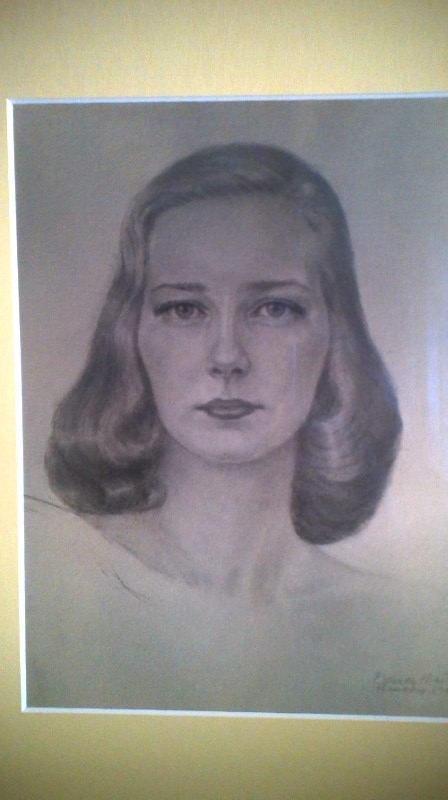
My mother was not a writer, but maybe she should have been. She was one of the most natural born story tellers I’ve ever had chance to come across, and she glowed under a willing audience, well aware when she had one in the palm of her hand. She was a product of what I now call the old south, raised in an era when ladies were cultured and charming. Her name was Shirley, and never was a woman more appropriately named. To me, the name tinkles like Champagne in cut glass: captivating and celebratory in its effervescence, happened upon only on rare occasions. Never have I seen a woman occupy a chair quite like Shirley, who could be found at the cocktail hour holding court in the card room in the house I grew up in with one feminine leg tucked beneath her and the other dangling freely at her seductive crossed knee. This was how she observed the end of the day, for in her mind, there was much to discuss. She was fascinated in the players who populated her extravagant world and had an uncanny ability to dissect their character down to the last nuance. I couldn’t say now if she was insightful or just plain observant, whether she was legitimately concerned or liked to gossip, but she had a way of telling a story that could turn a trip to the grocery store into the most enviable journey ever taken. I used to watch my mother—study her with adolescent awe, looking for clues on how to evolve from an inchoate girl into her replica. I could have come out and asked her, but I always knew she wasn’t the type to ever confess. She is nine long years in heaven now, but the reverberating shadow she cast keeps her never far from reach. I was asked just the other day how I became a writer; whether I studied it in college or took some other road. It’d be so convenient to say I have an accredited piece of paper granting me permission, but the truth is I have much more than that: I grew up under the tutelage of a southern shanachie, who showed me the seemingly ordinary in life is actually extraordinary; it all depends on how the story is told.
Reconnecting with Kieran
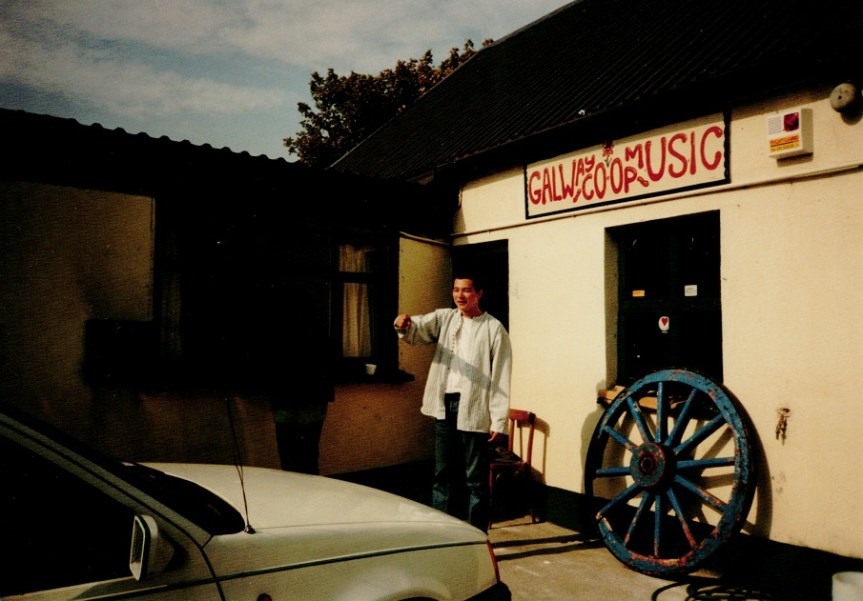
After more years than I care to count, Kieran has resurfaced. The last time I saw him, it was raining; it was one of those gray Galway days on New Castle Road, and I’d sleuthed Kieran out, after swearing to Adrian I’d never tell who had told me where I could find him. Sometimes relationships get complicated.
It was fate that brought me to Kieran’s fold. It unraveled in increments, like breadcrumbs leading the way to The Galway Music Centre’s door. I was a newly arrived American, staying in a B&B on Eyre Square without much of a plan beyond spending a little time in Ireland. The nice woman who’d shown me to my room had left me with a copy of “The Galway Advertiser,” and I’d opened its pages to discover a singular sentence announcing the opening of The Galway Music Centre on New Road. There’d been no statement beyond the Centre being open, and, spurred by the lure of the word music, I’d walked round the next day to investigate. The Advertiser hadn’t lied. The Galway Music Centre was open, so I walked in. Then I found Kieran.
He was standing in the loft of The Centre, tacking a poster of the singer Daniel O’Donnell on a bulletin board, on which he’d drawn a mustache and horns because that was Kieran’s idea of humor. I stood undetected, watching him before he noticed me on the worn, redbrick floor. Scattered about were hammers and nails, scraps of plywood, four mismatched chairs, and a fold-out card table, on which sat an electric kettle, a box of Lyon’s tea, and a pint of Oranmore milk. Kieran came clattering down the wooden slat stairs when we finally saw me. He moved with such sprightly agility, he seemed airborne, and when he landed in front of me, he held out his hand and said, “Can I help you?”
I had no way of knowing that moment would be the beginning of a relationship that would set the tone of the year I spent in Ireland, but then everything about Kieran was unpredictable. He was a vortex of frenetic energy; a twenty five year old, rapid talking, plan making youth from Derry with an unintelligible accent, who was the product of an Irish mother and a Chinese father. He was tall and neatly compact, with jet-black hair he wore in a high pony-tail that bobbed behind him with every step of his bouncing stride. He had olive skin, a devilish smile, and upturned oval eyes that could either twinkle like starlight or bore a hole right through you, depending on his mood.
Kieran had moved into Galway to make something of himself, but after knowing him for a while, it occurred to me he had moved into town to take over completely, which in many ways he did. Kieran couldn’t walk down the streets without something happening, and when he wasn’t out prowling around looking for the craic, the craic had a way of coming to him. It’s anybody’s guess if fate works similarly, whether it lays in wait preordained or we meet it halfway. But it seems to me some things are meant to be, for were it not for Kieran, I can’t say for sure that I would have stayed in Ireland for as long as I did, but Kieran’s job offer at The Galway Music Centre was too good to refuse, and one thing led to another, the way things do when you have youth on your side and life by the tail of its unlimited potential.
We were four that worked at The Galway Music Centre: Keiran and Shannon and Darren and me. We operated out of an old iron forge on New Road with the intention of creating something theretofore unseen in Galway: a musical haven aimed at furthering the careers of the local musicians. We had no business plan, but eventually created something notable as we went along. In time, we soundproofed a room downstairs and built the only rehearsal studio in Galway City, which sent word out on the cobblestone streets and put money in our pocket. And all the while, Kieran was the hub of the wheel the rest of us revolved around. He was the man with the vision, the face of the Centre, and everything hummed along nicely for a solid year, up until it didn’t. When everything fell apart at The Galway Music Centre, it was predicated upon things I now see as avoidable: misinformation, miscommunication, and the mishandling of funds, which explains why I had to wrangle Kieran’s whereabouts from a young lad named Adrian, for in fine old Irish tradition in the face of conflict, Kieran didn’t feel like talking about it and simply disappeared.
There are more enviable positions to find oneself in than to be an American in Ireland without an income. I had a score to settle with Kieran. All I was really after was the decency of closure, so I’d been grateful to Adrian when he’d said, “Well, I’m not telling you where he is, now; I’m just pointing the way.”
Armed with the full knowledge that the Irish see Americans as direct to the point of pushy, I figured I had nothing to lose. I walked to New Castle Road in the pouring rain, lifted the latch on the low iron gate of a four bedroom guesthouse, and knocked on the door. It was the setting of the last conversation I had with Kieran, and at the time I would have confessed I really wasn’t that mad. There was something so likable about Kieran that I forgave him his capricious edges, and there was no pretending I didn’t have a soft spot for him in my heart. Yet words had been exchanged that catered to our individual ego, which is to say that we never found a bridge on which to meet each other halfway. I wasn’t surprised years later, when I set out to write a novel set on the western coast of Ireland, that Kieran came pouring through my keyboard, traipsing in that bouncing walk of his all over my story. I know now that when something between friends is left unresolved, it will take on a life force all its own and find expression one way or another.
Although I still think it was fate that brought me to Kieran’s fold in the first place, the thing about fate is there’s no way of telling when the story is completely told.
I’m thinking about this now because yesterday I was tagged on Facebook by Shannon, with whom I’ve kept in close touch these many years. I clicked on the notice to see a picture of her with Kieran and I outside a pub in Kinvara, taken during the time we all worked at The Centre. I looked closely at the tag and realized somehow Shannon had reconnected with Kieran without telling me, for there he was tagged in the same picture. And as anyone would, I clicked on his name to find a picture of him standing beside his wife, who held their baby in her arms somewhere in County Antrim. Shannon’s dual tag has given Kieran and me a reason to reconnect, and I couldn’t be more pleased.
Now I’m thinking of the adage: what comes around goes around, even though it’s prone to take its sweet time. And with regard to the unpredictable hand of fate, it’s interesting to realize it didn’t forget Kieran and me; that it found its way to Ireland via social media.
 Claire Fullerton Author