A Funny Thing Happened at a Bookstore

Typically, I let a stranger’s rude behavior slide, but in this case, I’m thinking of options. I’m generally thinking of those bullying type personalities you find positioned before the public, and specifically, a certain independent bookstore owner I happened across yesterday. The question I’m turning over concerns calling this bookstore owner on his behavior, lest, in my negligence, he persists in his unseemly rapport with other authors. I’ll set the stage first then tell what transpired:

Because I am twenty-one days into evacuation, due to the fires in Malibu ( currently all power is off in my side of town), I have been staying in Santa Barbara, California. Never one to be completely deterred by unanticipated circumstances, and seeing as how it is a scant six months after the release of my 4X, award-winning novel, Mourning Dove, I decided to use my time wisely by visiting the Santa Barbara Public Library and all area bookstores in what was basically a cold call to introduce Mourning Dove. Authors do well in introducing themselves to bookstore owners if they’re prepared with their one-sheet; ISBN; book description; and distribution information. I’m happy to report I’ve had great luck in so doing. It’s led to scheduled events and my book on the shelves. After all, one hand shakes the other in the book business. We are nothing without each other. This is what I was thinking as I entered this particular bookstore, and discovered the owner standing behind the counter.

It was raining in Santa Barbara, which, in Southern California, is always a conversation starter, and which explained why my one-sheet was a bit damp. I told the owner I am a local, traditionally published author of three books, represented by Julie Gwinn of the Seymour Literary Agency. Having researched his bookstore online to discover he carries “new, used, and out-of-print books,” and that they carry books by local authors, I told him I wanted to introduce myself and Mourning Dove. For a few minutes, we discussed the weather, the fires in Malibu, the potential threat of mud-slides, then he cast his eyes on my one-sheet. “This book just won the Literary Classics Words on Wings Award for Book of the Year,” I added, to which he abruptly turned, squared his shoulders and looked me in the eyes. “I’ll stop you right here,” he barked. “I’m not going to buy your book.”

Now then, I’ll digress by mentioning I am a Southerner. We’re big on manners. To a Southerner, there is no more egregious sin than bad manners. And for some reason, I was so startled I reverted to my Southern upbringing and perfunctorily cushioned his blow, in an effort at not leaving on a bad note. “Perhaps I wasn’t clear on your bookstore’s policy,” I offered. “What kind of books do you carry?” His answer–and I’m paraphrasing, was along the lines of you better be Faulkner of a current NY Times bestseller. “You’ve explained yourself clearly,” I said. His reply? “I’ve been DEALING with authors for 40 years.”

I’m going to share a quote by Mya Angelou: “I’ve learned that people will forget what you said, people will forget what you did, but people will never forget how you made them feel.”

I’ve been thinking about this episode since it happened yesterday, wondering if I have the right take on it; if I’m too sensitive, judgemental, egoistic, and on and on, though I’m not one to second-guess myself. Plain and simple, when I left the bookstore, I felt diminished. Maybe I wouldn’t have thought twice about it, had he not issued the closing remark of “… dealing with authors for 40 years.”  What this tells me is this bookstore owner thinks its okay to treat authors with such a sorry case of bed-side manners. So much for one hand shaking the other in the book business… In weighing all this, I’ve examined a list of what he could have said, and the whole thing would have happened differently: “Thank you for coming in, this doesn’t sound like something I carry,” this kind of thing.

Now I’m wondering how many authors this man has similarly treated. I’m wondering if any author has ” called him on his stuff,” and concluding probably not.” What occurs to me is that, when in such a quandary, we always have options. In this case, is it better to leave the man to his own devices, or ” call him on his stuff?”



Malibu Fires from a 1st Person View

We’ve all heard the expression, “Life can turn on a dime,” but I know so few with a frame of reference that makes good on the claim. And I’ve always wondered to what degree events turn before one owns the adage personally. Certainly the death of a significant loved one falls into the justifiable category, where life as one has known it is inalterably changed. There are other examples, but not many.

I have a feeling I’m standing on one of those dimes, but have yet to intuit the  fallout. As I write, there are torrential fires where I live in Malibu, California. At the moment, I’m an hour away in Santa Barbara, where the sun takes center stage over this Spanish-style, manicured town, with its one-way streets apportioned in terra-cotta, wrought-iron  and stucco.  Were it any other time, I’d be wide-eyed and skipping along downtown’s State Street. As it is, I’m disillusioned and displaced– it’s a feeling unlike any other. I took a walk this morning on the city streets, longing for terra firma because I didn’t feel grounded. There’s nothing more unbalancing than a threat to one’s foundation. No matter the location of your feet, a threat on one’s home effects the head.

I’m six whirlwind days into this now, pausing for the first time to assess.  I’ve been on the move with two dogs, a cat and a husband; it took us a while to secure a base.

Last Thursday, there were fire reports in an area separated from Malibu by the arid, Santa Monica Mountains. In the cyclical drought of post-summer Southern California, fire conditions are ripe, in conjunction with the Santa Ana winds, which rage seaward from the desert at 30 to 40 MPR like breath from the hounds of hell.

I was standing in the living room Friday morning, when I saw ashes landing on our front deck. Through the moving filter of grey-cotton billows, the sun was an otherworldly neon-pink. And I’ve heard it said animals intuit pending doom long before people bring themselves to accept it. Our cat, typically self-sufficient, stood in my shadow, and both dogs whined at the front door, when I walked through it in search of my husband, whom I found wielding a full-throttle hose on the roof.

Personalities and priorities come into play, under unanticipated duress. Even with the best intentions in cogent, team-played sports, one discovers individual plans. And it wasn’t as if I didn’t see the merit in my husband battening down the hatches, it’s just that I’m pretty good at grasping the inevitable. I was useful in removing all things potentially flammable from our outside decks, then I left him to go inside and  pack.

I’ve been asked repeatedly what it was I packed so hastily, and understand this is a viable question. My urgent thinking concerned two things: the long-term and that which can’t be replaced. Clothes for both of us for the long-run; jewelry and watches and my accordion file of important papers. Laptops and power cords and cell-phone chargers, winter coats, and walking shoes, and all things pertaining to the maintenance of our pets. I pulled the car out of the garage and loaded it in record time, while my husband turned on every sprinkler on our property. His plan was to stay with the house and fight the fire; mine was to keep my mouth shut until he saw the light.

When the light came, it crept ominously behind our house from the mountain. Through the opaque, unbreathable air, the sky lightened, and I knew it could only mean one thing. Brighter and brighter the backdrop shrieked, the dawning of illumination unwelcome. When the flames appeared, they crowned the ridge in an unbreakable wall, a moving inferno with nowhere to go but down.

That’s when we fled to the car, and turned right on the Pacific Coast Highway. In front of us, the canyons of a state park were ablaze in disconnected, sporadic pockets that seemed to have little to do with each other, yet all headed in the direction of our house. In a last ditch effort, my husband called the local fire department, and miraculously, someone answered the phone. We had no way of knowing what the result would be, in a town spontaneously aflame, but our address was given, and we headed north.

Have you ever travelled with pets, without a plan, nervous as a cat on a hot tin roof? I don’t recommend it unless there’s no other option, which still happens to be our state of affairs.

And the uncertainty of not knowing if one’s house is standing is emotionally and psychically taxing. It’s an exhaustion spawned by a weariness that bypasses the bones and runs like an electrical current in the blood. One keeps going because they have to, in this fight or flight battle with fate. The world, it seems, is relegated to myopic focus. As for all other bets, suffice it to say they’re off.

For the first three days after our evacuation, my husband and I were riveted to the local, heartbreaking news and scoured the internet for information about our area of town, yet there was none to be had. Our house is on the outskirts of Malibu, so far out it can be defined as way beyond the pale. Those three frustrating days felt like searching in a sea of futility. In what I think now is help from divinity, I woke Monday morning and did a random search online of our area’s location. When the large scale, long-range photograph of our area sprang to my screen, I forwarded the image to my husband. He enlarged a dot of the picture, and when the image grew, there was our house!

Three days have transpired, since the discovery of our house standing, and in those days, we have relocated farther north, while awaiting word on when Malibu’s residents will be allowed into the city. There are a handful of social media forums where displaced Malibu residents share information, but the bottom line is nobody is allowed into town, due to the fact that the fire is not wholly contained, and for much of the town, there is no water or power.

I’ve been turning over the idea of powerlessness and how one comes to ultimate surrender. One gets to the point where they simply quit struggling with what is, and does their best to simply make due.

I’ve been hyper-aware of my thoughts these days, knowing, as I do, that one’s attitude defines one’s experience. I seem to have lost my focus a bit. My mind runs laps around the simplest of tasks as I keep looking for center page, and although I fancy myself stoic,  I’m told these are symptoms of trauma. And what startles me most is this awareness of a heightened sense of compassion and empathy I now possess. I’ve seen homeless people in parts of this city I’m in, and it takes everything I have not to break down and weep.

And here sits I, luckier than most, for my husband and I have a house standing, when so many in Malibu don’t.

I may be in an ambiguous spot now, but I can tell you one thing: When they open Malibu to its residents, my plan is to take my bleeding heart and open our front door to those in need.

I will bear witness. Life can and does turn on a dime.

www.https://clairefullerton.com


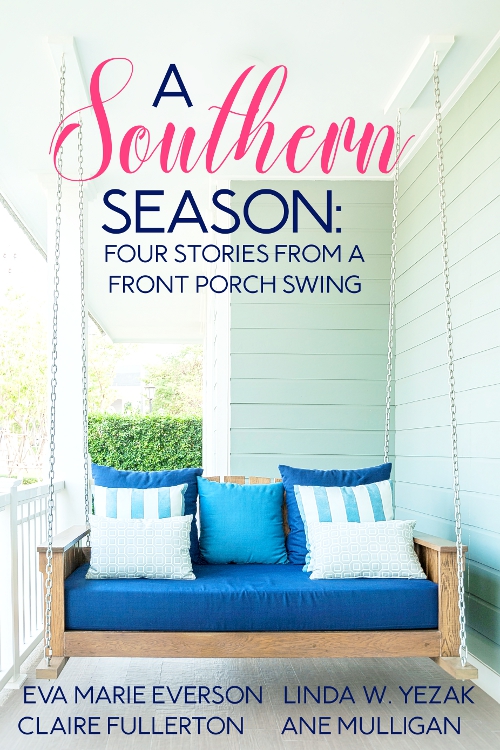
A Southern Season

A year ago, I was asked by Eva Marie Everson, the acquisitions editor for Firefly Southern Fiction (an imprint of Lighthouse Publishing of the Carolinas, which published my 3rd novel, Mourning Dove) to contribute a novella to a book she had in mind that would consist of four novellas, each set in the South and penned by a writer who hails from the region. Eva’s idea was to capture the 4 seasons as they played out on a Southern stage through the art of setting and story. At the time she asked me to contribute, Eva and I had just finished three exhillerating rounds of edits for Mourning Dove. I knew there would be a long wait ahead before Mourning Dove’s release, and although I’d never written a novella, I figured I might as well try my hand.  It was that, and what self-respecting writer would say no to an editor with whom they’d just had a wonderful experience, who gave the added incentive of A Southern Season’s assigned publication date!

Upon learning the scant guidelines of 20,000 words set in the South during the season of my choosing, I knew right away I’d write a story set in a Memphis fall.  Fall has always been my favorite time of year, for all her eerily suggestive, mood-enhancing promises. As for my hometown of Memphis: I’ll never tire of wrangling her peculiar nuances and charms, which, I’m convinced, are spawned from her proud cultural heritage.

In the days preceding the drafting of my story, I tried on many Memphis hats. There’s much to choose from in that historic, musical mecca on the Mighty Mississippi; it’s seen more than its share of changing times yet still boasts of its past. And the way I see it, a good story always comes down to the characters. How they greet the common place in the every day is where I find the heart of the story. In the Memphis in which I grew up, the particular milieu I come from was rife with story-tellers. As I pondered the subject of my novella, luck had it that one of them called me on the phone.

In the interest of discretion and not wanting to blow my source for all of its future gems, I’ll keep it cryptic by sharing I have the great largess of maintaining a friendship with a certain octogenarian who hails from the genteel side of the Delta and keep it there. Let’s just say it’s not what you say in life, it’s how you say it, and if you asked this particular Southerner for directions to downtown Memphis, they’d take that straight shoot down Poplar and purr it to spun-gold. And I couldn’t tell you now how it was we got on the subject of funerals, but when we did this refined, effusive character unwittingly coined a classic line. ” I know one thing about a Southern funeral,” this nameless person sighed, “you can bet your last dollar that something will go wrong.”

I knew right then that I had my story. I framed my novella within the rites of a three-day, Memphis funeral and titled it Through an Autumn Window. In it, I explored the unspoken complications and attendant guilt and nostalgia of a mother-daughter relationship, and paired it with the festering of unhealed sibling rivalry. I Set this mixed bag of a premise in a Southern culture where everyone tip-toed around iron-clad social mores then I let the games begin!

I am one of four authors who contributed to the book, A Southern Season, and I’m thrilled to announce the book was released on November 1st by Firefly Southern Fiction. There are four different voices depicting the South in this collection of novellas. I believe you’ll find each inspirational !